Personal Brand Story and Systems,
with Reme Mancera and Aleksandra Badea
What if your storytelling can feel easier (and more consistent)?
What if the challenge isn’t what you’re saying, but what’s supporting you behind the scenes?
Many business owners know that sharing their personal brand story helps build trust and attract aligned clients.
But when it comes to actually showing up consistently, it can feel unclear, time-consuming, or dependent on having the “right moment” or energy.
In this episode of Intersection Chats, we explore how personal brand story and systems can work together in a way that your visibility feels more sustainable, organized, and aligned with the way you actually live and work.
Personal Brand Story and Systems
Here are 3 questions we explore in this live chat:
1. How can you share your personal brand story more consistently without adding more work?
We talk about how simple systems can support your visibility, so showing up doesn’t depend on your mood, time, or energy.
2. Are you overcomplicating your systems or your storytelling?
This conversation breaks down how starting simple can help you create clarity, organize your ideas, and build a more sustainable way of working in the different areas of your business.
3. What if your everyday moments could become meaningful content?
You’ll discover how small, real-life experiences can be turned into stories that reflect your values, connect with your audience, and highlight the way you work.
If you’ve felt like you have something valuable to say, but struggle to show up and say it consistently, this episode is for you.
Who is Aleksandra Badea?
Aleksandra Badea is a Systems Strategist and Online Business Manager.
She helps 6-figure female founders get back 10+ hours a week, avoid burnout, and regain peace of mind through smart systems, tech, automation, AI, and personal efficiency so they can scale sustainably and enjoy life again.
Who is Reme Mancera?
Reme Mancera is a Personal Brand Story Strategist and the creator of the 10 Story Connectors framework, a strategic storytelling tool to choose which personal stories to share so they build trust, create genuine connections, and lead to clients.
She is the host of the podcast Who Cares About My Story? and the live series Intersection Chats.
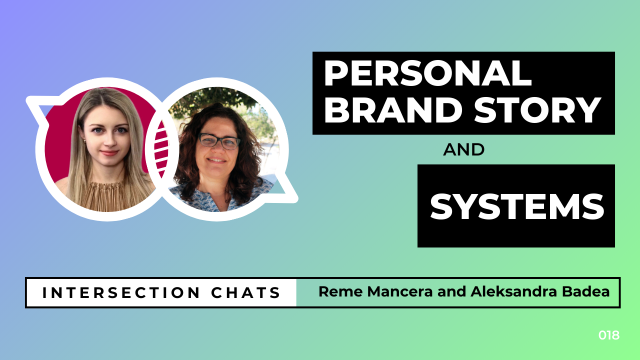
Personal Brand Story and Systems - Transcript of the episode
Welcome to Intersection Chats. I am Reme Mancera, a personal brand story strategist. And I am here today with Aleksandra to talk about the intersection between personal brand story and sales claims. Thank you for being here, Aleksandra. So happy to that you accepted this invitation.
Welcome. Hi. Hi. I’m Aleksandra Badea, and I am system strategist. I am online business manager, and I help founders.
I have tier I help teams save time and streamline their back end operations. And I do it with tech, automation, AI, systems, of course, and personal efficiency. Thank you so much for having me, Rami. Thank you. So looking forward to this conversation.
Yeah. Let’s start with your own experience when you are working with clients, how you see that intersection happening between personal brand story and systems. Mhmm. Yeah. So, you know, I can see personal brand story as the, like, soul of the business, and systems are the structure that allows this soul to be visible, to be consistent, you know, and sustainable, of course.
Because you can have the most powerful story. But without systems, it’s such a struggle to show up consistently and to share this story, especially when you have a busy life or, like, you’re a mother, for example. I work with a lot of mothers who, like, their life is, you know, like, they are juggling a lot of things, family, kids, and also, like, business owners generally juggle a lot of things. And they really want to show up and they want to share their story story, but they just struggle with time. And when we put the systems in place, it’s so much easier.
And just to share, you know, example with you, one of my clients created the full course just by recording voice notes when she was dropping her daughter to the to nursery. You know? Mhmm. She had, like, the story. She had the knowledge insights.
She didn’t have time, but she figured she figured out the time, and she created something really powerful from this. So, yeah, that’s that’s how I say it. Like, system like, systems are the structure that lets your business be show like, be shown consistently Mhmm. And exactly, like, you to show up who you are. I love that example because it’s not about one specific formula that is for everyone.
It’s like finding what is your lifestyle, what is your capacity, what is going on in your life, and how to make it okay. Here, I have this space where I can do it, how we can put a system in place where we can actually convert that work into something that is valuable for you, for her audience, and so on. So I love that. In my case, I feel like, systems are so integrate in several aspect of, how we work our own stories. And it’s like yeah.
For identifying helping my clients identifying their personal brand stories and you know that because we have worked together is like there is a process, there is a system that I follow for for doing that in a way that makes sense for both of us. And then, of course, when you have your set of stories, how you organize them to go and have the the clarity to know which one to use and how to do it. So having that not just for you, but maybe you have a a team that they can act access to that information. Maybe you have a copywriter that is going to help you with the the copy of your website. So having access to that set of stories, that’s something that you don’t need to repeat yourself every time.
You can have something in place that they can go and, use as a reference. And then, of course, as you mentioned, like, the idea of repurposing content as a system, which is a system that you can create for Yeah. Whenever you create something, you can then change the format or make some adjustments to also put that into action. Yeah. And I feel like there is, like, sometimes a misconception about what is a system and how complicated need to be a system.
I would love to know your thoughts on that as well. Yeah. So, like, first of all, I just need to say that your story connections are actually a great way of systemizing, sharing your personal brand story. I went through this, right, like, through your service, and, like, it helped me a lot because it’s ex exactly the structured way, like, of pick and choose where to use specific elements of my personal brand. So I just need to say, like, this that you perfectly systemize, like, con combined systems and personal branding.
Yeah. And when it comes to your question about, you know, the system, like, we often overcomplicate this because we think, like, it needs to be something, like, really complex and so on. But it can be really simple. It’s just that, you know, steps one by one of for the things that you are doing for a task, for example, what you do first, what you do second, what you do third, and you have system. So it’s really not about overcomplicating it.
It’s about just seeing what works, what list of steps give you the specific result. And then, of course, we can simplify. We can streamline. We can automate specific, you know, steps and so on. But I I always say start simple and just say step by step what you’re doing.
So this is already the system. Yeah. I love that approach because I feel like then when you have the clarity on the basics, then you can optimize parts of the process and and make how an experiment if you want to do something and make some changes, but having the base is so powerful, and then you can, do more things with that. And I feel that’s kind of similar with their the stories in the sense of having clarity in the foundations, like, these, main stories that you want to share. And then you can see, okay, how I can combine them, how Mhmm.
I articulate them and practice practice them to share in a different way and so on. But this process of, like, starting simple and then optimizing and then simplifying streamline. So I feel that’s, there is another way of connecting there or topics as well. And, you know, what is very important is writing things down because if we maybe we have it in our heads, how it looks like. But then when we write it down, actually document it, we can see it clearly.
And that’s, like, also, like, very first step when I when I start with systems. You know, I I tell a business owner, just do this task. Turn on your screen sharing app. Do this task, but exactly explain what you’re doing. So it’s not just clicking and not saying anything, you know, because I got this kind of videos as well.
But it’s saying exactly, okay. I choose this option because this and this. If it would be this, I would choose this option and so on. And then what I do, I put it to, like, I take this transcript of this video. I put it to the the GPT, and I it creates me the step by step from this.
And then I can actually see what are the steps and what is still missing, and then there is a process of optimizing, streamlining, and so on. But, yeah, like, documenting the first thing and the same with stories. Right? We need to document them to be maybe we are you know, we know that the stories are inside us, but they are that we we are not really aware of them and how to connect them with our business values, what we want to achieve, and so on. So yeah.
Yeah. And I feel that somehow also is connected to when at least that’s my experience. I will not I would love to know your thoughts. When someone go goes to work on their personal brand story around optimizes their systems, I feel that they are somehow a bit in a more advanced stage, if you will, in the sense of they really have a better understanding of how they are running their business, how they are, putting their processes together, and how they want to get clarity on their messaging, and they feel the need of, okay, I would like some help to do this in an more effective way, if you will. Because it’s like, I can try to do by myself, but getting someone helping me with this this external point of view will be valuable.
And I feel that both, bringing someone in this strategy for the system and for the operations, I’m looking for someone helping in the personal brand story. I feel that that could be also a sign that the the business is already a bit more advanced in that sense. What is your what are your thoughts on that? You know, I had both cases because I had business owners who were starting out and they wanted to have the, you know, the back end that is supporting their growing. But, yes, like, most often, it’s about the business owners and companies who are already, you know, making money, having clients, and so on.
And then they want to optimize. But the level of, you know, processes, systems there, like, really varies because some of the companies have this really well laid out. And you, you know, ask the business owners about this specific process, and you have the process, and you can see, you know, like, these are the steps we cannot you know, like, it’s easier to see. And in some businesses, it’s, just in the business owner or team member head. So you just you just need to ask them first to document them to be able to see what is happening in the business.
So, yeah, like, it can be both ways, but I I feel that it’s needed in both, you know, like, in when you’re starting, but it’s a different kind of level of this and when you’re, like, more advanced. And the first step is always seeing what is there. Like, they what what is there actually. Yeah. Yeah.
Yeah. And I yeah. I I agree that this is helpful for anyone. And if even if you are one person business and you are just starting out, getting clarity on the systems that you have in place and how have you being aware of what is going on in your business, I feel that is so valuable and it’s getting you ready for, like, incorporating someone to your business, can be a a team member, can be just, hiring someone and so on. I I feel the same.
I I just was curious if it’s, like usually, it’s more people a bit more advanced. The people that are you working with them because they are a bit more conscious, if you will, about how this is valuable for them. Yeah. Because specific setup can make can take you to some place, you know, when you are having clients, when you have the consistent revenue coming in, and then you just feel you’re at capacity. And you are doing a lot of things manually.
You just need probably, sometimes you need to hire the virtual assistant, then you’re hiring the virtual assistant, and it becomes one less issue, I would say, because you need to, you know, explain them everything. You don’t have time for this, so you prefer to do it on your own. And that’s that is the moment when systems are, you know, crucial because when you don’t have, like, the documentation to give them of how you want things to be done, then you won’t be happy with the work with this virtual assistant. And you will probably just, you know, fire them. Right?
Like, part ways because it won’t be really helpful for you. So yeah. But how do you feel? Because when it comes to stories, is it more for, you know, like, starting businesses or for more advanced to kind of combine, you know, their stories with what they offer and where they are going? Usually, I work a lot with people that somehow they are pivoting or transitioning their business.
So they have been in business. They know their style of communication. They know how they know to get clients to put out their offers and so on. But they are they are in a moment where they have the lack of clarity on how use that story, to amplify this new offering or to reposition themselves in a new niche and so and so on. So that’s usually the people that I work with.
I feel that when at the early, early beginning of your business, you first will have a basic version of things, but then with experience working with people and getting, like, more clarity on what is your, process, what what is that your way of working, what is different in in your way of working, and so on. So I feel that when you are just in the early early beginning, you will need to it will be useful for you to have a a brief story, but then doing a process more like in-depth makes more sense when you have tried your your offer with people, you have get feedback, you have make optimization in those processes, and then now you you have a bit of more information if you to make some decisions based on that. And then you have clarity of what are the benefits of that you want to highlight from your offer, what are the key factors. And of course, we would work together to identify those moments from your journey that will help you to highlight that. But, in the approach, in my approach because it’s so based in strategy, I’m focused on how make the the story connected to your offer, connected to the people that you are talking to, you need to have some clarity on that for that to be more effective.
Of course, when I work with clients, they they told me that through the process, they are getting more clarity because they need to answer this question and they need to think about this. So the process itself is making you, like, identify certain things, define certain things. But I have the impression that, people in a bit of more, advanced, if you will, they will get more more benefit because of that, because they have information from working with clients, getting in front of audiences, see what resonates, see what not, and so on. Mhmm. And I wanted to also mention how in my experience, those who have systems in place in their business, they have the capacity to focus more on the strategy, on the long term goals, and they don’t need to be just focused on the daily little tasks that give you a lot of time, a lot of overwhelm.
So I feel that that this when a a business has some system in place, it’s also giving them the space to work in certain things that are even more impactful. But when you have to be in the little task of every day, that will have that will take out time for doing other stuff that is more long term. What has been your experience into that? Yeah. Definitely.
Having systems in place lets you focus on the things that are, like, sales activities. Right? Growing your business. And you mentioned before the repurposing content system. And I was teaching this to my clients because we are creating from one long form content piece.
You can create 10 plus content pieces like smaller ones. And this works like this that, for example, my client shares a voice note. Mhmm. Five minute voice notes, what happened, like, to her in a day and connecting this with how it translates for her business or anything like this. And then having this, we can create a lot.
We can create a a carousel post for Instagram sharing her insights. We can create the mural, the the reel, on Instagram with specific, you know, sentence for what it what she what she said. We can create the, the post for with quote. Right? We can create the intro for the newsletter or the full newsletter.
We can look through the lenses of when we have this voice note to ask my ourself the question, okay, what mistakes people are doing when it comes to these things that she shared. And share we have another content piece. Right? And, yeah, like mini post story, Instagram stories, like, all of these things. And what is great is that these things can be, you know, streamlined.
Some of them automated, semi automated. And we have business owner who shared five minute voice note, and it’s translated into one week of content. Right? And it’s her because it’s her story. It’s how she wants to show up, but it’s even the team that can make it happen.
You know? And I like, another example is, the B roll storage system. You know, when you have the like, we have the moments in our day that we want to share this because this is who we are, how we run our business, and the values, you know. And, what I have, and many people I work with, like, have this as well, is that Google Drive with the storage, videos, and photos to be used online. Right?
And they are divided into categories. So I have, for example, category for me working at the laptop at the computer. Right? And I have all the videos, photos like me working, you know. Then I have travel alone.
I have travel with my family. I have events and, lifestyle personal moments when I’m, like, drinking coffee or, I don’t know, going for a walk. And I have also, the surroundings. So when I go somewhere and I just record without me on the camera, but I just record, like, it’s good for b roll for Instagram. And I have all this in fold specific folders.
So when business owner, me, myself, myself, I mean, I don’t feel camera ready, You know? I just don’t feel like showing up, like, recording something. I just pick something from the specific folder, you know, and it’s so much easier because it’s ready. And if you’re working with a team member, it’s you say to this team member, like, please create a reel. Choose the something like video from, lifestyle moments fitting this music or, like, fitting this message, you know.
And make sure that you don’t share something that was shared, like, for the past month. And then it’s something clear. Right? It’s not, thinking, okay. What what should I share?
Or sharing just create a reel because this person, they they don’t really know. They are not sitting in your head. But it just helps a lot with organization, and it’s just one more one thing from your head, you know, to focus on, like, that you can show up online, without, like, recording all the time. Absolutely. And I love how you bring us specific examples because it’s like sometimes when we talk about repurposing, maybe people don’t really, can see, like, okay, what I mean with that.
So I love that you you bring exactly, like, how you can, multiply one piece of content from from a client. And then also this idea of the b roll, I really like that because it’s time you have these assets for your business, and then you can combine them and create this this content. I work a lot with people that they go to podcast as a guest, and I always invite them to use specifically the parts where they are sharing their stories, but even other parts of the the the appiencies that they can use for creating new pieces of content. Content in the sense, not just social media, but as you say, newsletter, another type of of, of creation. Right?
So I feel the same, and I use this analogy of, share it, shape it, and shake it. Mhmm. Share it when you are a podcast, guest and how you share that piece of content. Maybe use specifically parts where you are talking about story or talking a benefit of your offer, and then highlight that in the text with, the story. So you are bringing the storytelling there with that piece of content that you were already doing that interview.
So why not using that? Then shape it in the sense that you can create different formats. So maybe that was a podcast interview. You can create a newsletter, with, parts of those, or you can use in LinkedIn as opposed of of text with one of these images that the from the b roll that you might have. And then check it is to create something new, but based on that appearance that you have.
Maybe during the podcast interview, you mentioned one of your systems or something from your approach, then maybe you can create a piece of content with that as the, like, the trigger for creating that bigger piece going deeper in one point. Sometimes we, based on the conversation to you think of something new and that can again bring you some new ideas. So maybe combining pieces of content that you have been in several podcasts, and then you combine and create something as a mix. So the idea to what you have done, how you can repurpose in a way that that time that you were there doing that, how you can get the most out of it, and how you can use it to highlight those moment or those important points from your approach. What makes your way of working different and what can be interesting for people to know for deciding, okay.
Yeah. I want to work with Aleksandra. I like her way of thinking, and I like her structure and so on. So that’s something that can be you don’t need to create all the time new things. You can use what you have.
So I love that you bring specific examples on how to do that with your content. Yeah. I I I really agree. Like, podcast episodes, you know, the videos that you’re making. These are the gold mine of content, really.
And if you know how to, repurpose this as you as you said and create, multiple pieces of content and also look through specific lenses. Like, you have even more ideas. So, yeah, this is this is really important. And I have, you know, like, even when you want to share something, like, personal stories and so on, and you don’t know what to use, want what to share, I have this kind of system that I I call it story mining system. Okay.
And it’s, really short weekly five to ten minutes ritual, that you’re asking yourself two questions. And this helps you notice how, like, this moments in your life, what moments in your life you can share. So the first question was about, what happened this week that my audience would benefit from hearing? And the second one was about what moments of this week, show up my values, you know, show my values or the way I want to show up. And there can be, like, really small things that happened and you would never think about connecting it to the anecdote or like something that you do at work.
But it’s so, you know, like I remember my own personal story, that I connected. It was about my daughter. She had some kind of prom in the kindergarten, and it was about where giving them the costumes that are the fruits or vegetables. And I absolutely didn’t think about this. You know?
I I did it on the last moment. I ordered something from the shop, and it came and it was awful. It was like with with holes, and it was the the the material quality awful, and it was too big and so on. So I just gave her her that t shirt with, strawberry or something like this. And she went like this.
And then when I picked her up from the kindergarten, she said, like, mommy, everyone was dressed, and I was the only one that didn’t have anything. Like, you know? And, yeah, this was the moment, you know, that, like, it was hard. It was like the business owner moment of guilt. And I trans transform this into the story.
I shared this moment with my audience, and I said what I did, what system I implemented so that it never happens again. So I because at the beginning of the month, we get the message from the kindergarten about all the events happening. Mhmm. And I missed this message. But right now, every beginning of the month, I have reminder in my phone to check this.
I’m checking this with my calendar open, and then I’m say like, saying, okay. This day, you need to bring, I don’t know, fruit to the kindergarten. I’m writing, like, day day before reminder, fruits to the kindergarten, and I’m preparing this the day before. When it comes to this kind of costumes, I I put the reminders, the task for two weeks before to make sure I make it. So this kind of personal story moment, you know, it’s just I connected this with how I handled, as a system strategist with this.
So, yeah, it’s it’s really important to, to share this personal moments and to and systems like the way how you do this are really helpful with this. Mhmm. Yeah. Yeah. And I feel that, those stories can help you to connect with your audience so they feel relatable, and they see how also, it’s a way to show your your your way of thinking because, yeah, that happened, and then I’m getting a lesson, and I’m making sure that there is not I am getting a lesson and do I’m taking action to avoid that this happened again.
So even sharing that is showing how your brains work and how that’s also that will apply also as valuable for your clients as well because that’s your way of thinking of how I can optimize this process, how I can do this, avoiding mistakes, or avoid cost of opportunities in the case of a business and so on. So I feel that this is, an example of how a little story can show how is your way of working. It can show what’s important to you, why this is something that can relate to them, and they can feel connection, and so on. So I I really like and it’s also a moment where you are sharing you are a human, and some times you want to do things in a way, but things that’s happening in that way and how you react to things that doesn’t go as you want because that’s going to happen in in a business relationship sometimes. So that’s also something else.
Right? We are all humans. And even if social media sometimes shows only the ideal parts of our lives, we have our struggles, we have harder moments, and so on. And it’s, I feel it’s good to share it because it’s, like, it’s relatable and it’s even, like, you know, people see it and, like, wow, she looks so good on the paper, you know, but she’s also human. So this kind of things, really connect people to yourself, you know, to you.
And it’s really important to capture these moments, these story ideas. And, of course, I have the system for this because there are so many stories that I missed, you know. It they just disappeared because I forgot about them because I didn’t capture them. And, right now I have, you know, like some people get their best ideas when they are cooking or shopping, you know, like walking in the park. I get them when I’m going to sleep and lying in the bed, you know, at night.
And I get get them. So when I was just falling asleep, I just didn’t want to get my phone and start something. No. Not to get awake again. And I figured out that I have something I have the widget of the app, you know.
There is it’s here. And I just click in it. It’s literally up. I click in it and I say something. You know?
I don’t need to type. Like, I say something. It transcribes this to the text. And then every week, I have the task to move my ideas to the content ideas section in Asana. And it can be it’s just about making it work for you because some people will need, again, like, this kind of app app because they are, you know, shopping and they have the idea.
But it’s it’s something that works for you. Make sure that the stories are not disappearing because they are really valuable. Right? I love that you you share with us this, even the the specific tools on how you’re doing, Because I feel that this really interesting process to have every every week having these two question that you go through there and you’d make sure that you don’t forget. But then also going to the technical part, how to make as easy as possible for you, knowing where is your moment, where you get will get these ideas, and how to make this as easy as possible.
So I feel that that’s something else as well. It’s like helping you to do that, knowing what what are your circumstances, when is the time that is going to happen, what you don’t what you want to avoid because you don’t want to go and then start scrolling in in any, app or something. So I feel like this, again, and maybe looks like a little sample, but it’s showing as well, like, how you optimize the processes and take into account, like, what are your Cisco instances, what works better for you, and how to make it in a way that works for you. And I feel that’s key in in systems. So thank you for sharing that approach.
And something before we finish that I want to to also, mention is how for me, I feel like it’s really important the communication with your the people that are helping you with the systems. And I feel that sometimes even using your story and your, yeah, your storytelling and the stories of your of your journey as a way to show your values can be something that can also help not just with potential clients, but inside your team, with people that are working with you to really understand why you are doing what you do, why it’s important, how you approach things, what is, like, the best way to do things for you, and so on. So I feel that even using storytelling in the inside community with the people that you work with can be so powerful for them to have the context of quite this specific thing that you do in a way is important for you and so on. What has been your experience? I I absolutely agree with this because working as a system strategist, someone’s personal story can show me their values and their values, their under TT, what they think about specific things.
And that is helping me a lot, you know, when it comes to building their operation, designing their systems, and so on. And, you know, like, people who value call, we will simplify their business. Yeah. Those who value speed, we will automate. For people who are creatives, you know, we are giving the systems that are more, you know, with some room to play because in creative business, a lot is changing, like, quickly.
So we don’t want to put, like, rigid systems and so on. It just needs to be the room for for improvement, for change, and so on. And, even, you know, when I am sharing, my personal story, my top values are freedom and flexibility. And I naturally attract the clients who value the same. I I don’t work with this hustle hustle hustle business owners anymore because I they just my marketing doesn’t appeal to them because I share calm, I share relief time with my family, you know, this kind of things.
So, yeah, like, for the team, it’s also very important, like, to to know why you’re doing what you’re doing, how you want this to be done, you know, when you share your values. So I absolutely agree that this is really important. Yeah. And I feel that sometimes we we of course, we talk a lot about our audiences, but it’s also really important to to share that, parts of our story with the people that we work with. Even if it’s a temporary thing that someone helping you with a certain things, it’s it’s going to help them to understand, and being able to help you in a better way in my opinion.
Mhmm. Even, you know, even in teams in corporate, they have this kind of work with me document where they are sharing who they are, what they value, how they want to communicate, what tools, like, what are the patterns. So, like, I need to when I need to focus, I can’t, like, see the Slack or something like this. So and that’s helping people, teams, like, communicate. So, yeah, for business owners, the same.
Mhmm. Yeah. So before we finish, I don’t know if we have because we have more things to to talk about, but for not making this, like, more, like, longer, there is something that we haven’t mentioned and you feel is important for people listening to think about? No. I think we mentioned a lot of things.
Okay. Important things. I don’t have anything. Yeah. I I would say going back to the idea that you share at the beginning of going back to the, like, start simple, I feel that that could be something to to as a reminder to each of us because sometimes we complicate things, and we go it’s like, okay.
How I can simplify this and make things easier? And also, you know, and also know how you are sharing your story. It’s I know that it’s by systems. Right? But the by the list of steps, you know, you will do this, then this, and then this.
So it’s easier for you to show up consistently. Yeah. Love that. So okay. Final question is, like, how would you summarize the connection between personal brand story and systems in one, two, three words?
Mhmm. Yeah. I I need to admit that I was thinking about this before the interview. And what I came come out came out with is, identity Mhmm. Structure and sustainability because identity is your story, it’s your personal brand, then systems are the structure and it all when they are both combined, it it means that your business will be more sustainable.
Right? So, that’s what I came up with. I really like that. Thank you. For me, I was thinking as well, and I came up with this idea of optimist optimizing your resources because I feel like as well that you are using the system for optimizing what you have and what you have in place, Using your personal brand story to highlight the benefits of your business is also somehow, like, using your resources that could be your own stories, to build that connection, to build the trust.
So I feel that this this idea of, okay, what are the assets that I have for my business and how I make the most out of it? So I feel those both can be connected there as well. I love that. Thank you. Okay.
So we are going to make sure that the the links are there, but, I know that you are also have some resources that can be useful for people, some tools that can be useful for them. So please tell us how people can learn more about what you do and and how you help others. Yeah. So I’m most active on LinkedIn when I share, stories and, you know, connecting this with systems. And I have my own newsletter, where you get every week the step by step system and, my freebie, which is, seven time saving, tools for business owners.
And it highlights, like, step by step how you can use them, how to set them up. So it’s, I think it will be very useful. Nice. So we will have the the links there. We will also mention in the comments what has been the tools that you mentioned about the, the app for people if they want to check it out because they might like to incorporate that idea to to themselves.
Yes. So thank you so much, Aleksandra. This has been really, nice to have this conversation. I love that you bring a lot of examples and specific practical insights that we can put in place. So thank you so much.
Thank you so much, Reme. It was a pleasure. Thank you. So, for everyone watching live or the replay, so stay tuned and see you next time. Bye.

Want more conversations like this?
Explore more episodes of Intersection Chats where I invite guests to talk about how personal brand story intersects with their expertise. Get real-world insights from experts across different fields on how personal brand storytelling builds trust and genuine connections; plus tips to use your personal stories more strategically in areas like PR, email, SEO, content creation, and beyond.
Here are a few examples to get you started:
- Personal Brand Story & Conversion Copywriting, with Reme Mancera and Mimi Zhou
- Personal Brand Story & Market Differentiation, with Reme Mancera and Marj Martirez
- Personal Brand Story & Video Storytelling, with Reme Mancera and Paige Burns
Whether you’re just starting to explore your personal brand story or want to apply it more strategically, these chats offer real-world insights from experts across different fields. Don’t miss the opportunity to get the most out of it!
WORKING REMOTELYInternational

GET IN TOUCHContact
WORKING REMOTELYInternational
CONNECTSocial links
Reme Mancera · Personal Brand Story Strategist
Copyright © 2018-2026 Reme Mancera. All rights reserved.