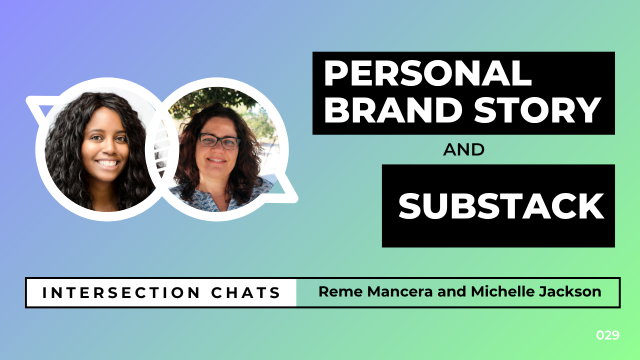
Personal Brand Story and Substack,
with Reme Mancera and Michelle Jackson
Where do your personal stories actually fit in your visibility strategy?
If your ideas feel too nuanced for short-form content or you’re not sure where your personal stories actually fit in your visibility strategy, this conversation gives you a new angle.
In this episode of Intersection Chats, we explore the intersection between personal brand story and Substack. Not just as a platform, but as part of a bigger ecosystem where your content, your stories and your positioning work together.
Sometimes the challenge isn’t what to say, but choosing where and how to say it so your work is fully understood.
Most of the advice in this episode is platform-agnostic, which means you can apply it to your long-form written content, whether you’re publishing on Substack, your blog or a new platform that comes up in the future.
Personal Brand Story and Substack
Here are 3 topics to think about as you listen:
1. Do you have a space where you can fully express your ideas and explain your approach with depth?
We talk about how long-form content can help you go beyond surface-level messaging, so people don’t just see what you do, but truly understand your perspective and the value behind your work.
2. Are you being intentional about where and how you share your personal stories?
We explore how to decide what to share, at what level of depth, and how to use personal brand storytelling to build trust without feeling like you’re oversharing.
3. Are you focusing on the right visibility opportunities for you or just trying to be everywhere?
We discuss how collaboration, community and aligned audiences can support your growth in a more intentional and less overwhelming way.
If you’re looking for a more thoughtful way to approach your visibility, positioning, and storytelling, this episode will give you both ideas and practical shifts to start applying right away.
Who is Michelle Jackson?
Michelle Jackson helps mission-led creators build long-lasting brands through collaboration and list building. When she’s not connecting with new people, you’ll find her in one of her favorite local coffee shops or exploring her hometown of Denver, Colorado.
Who is Reme Mancera?
Reme Mancera is a Personal Brand Story Strategist and the creator of the 10 Story Connectors framework, a strategic storytelling tool to choose which personal stories to share so they build trust, create genuine connections, and lead to clients.
She is the host of the podcast Who Cares About My Story? and the live series Intersection Chats.
Personal Brand Story and Substack - Transcript of the episode
Welcome to Intersection Chats. I am Reme Mancera. I am a personal brand story strategist. And today, we are going to talk about the connection between personal brand story and Substack and a bit of other topics, but let’s start there. Thank you, Michelle, for accepting this invitation.
Welcome. Thank you so much for having me. I’m so excited. But in the future, one day, I would love for us to have this conversation in Spanish. So, I have a totally different accent in Spanish, but I’ve been working on it, and that’s our goal for, like, next year.
Oh, that’s amazing. So that’s a, a deadline there to to go from that. Nice. Okay. So please start by introducing yourself.
So what do you do? Okay. So hi, everyone. My name is Michelle Jackson. I, am a person who has a couple different hats that I wear, but primarily, I’m focused on building, online brands that are, stable through, collaboration and email list building.
So, basically, I really want for people to work with others, to connect with others, to have other people, be a part of their journey of growth, but but also double down on email list building, which I find, is something that a lot of creators in the creator entrepreneurship entrepreneurship space, struggle with. And so I wanted to make that a lot more approachable and, just as a thing that you do so that if something happens with a third party platform, your brand and your business will be okay. So important. Especially whenever something crack or is not working well, we all remember, oh, yeah. This, like, we don’t have control about that.
Okay. So let’s start, by I would love to know your in your experience, how would you see the connection between personal brand story and Substack specifically? So, I have been using Substack since 2022. I’m gonna say one thing before we get into this, and it might surprise you. In no way am I saying that anyone should have a Substack.
So I want to just, like, kinda asterisk that and and make this point. I actually think it’s very important for creators to have their own website, their own email list. However, Substack is a really interesting space because it is long form social media. I know that in the beginning they were really leaning into newsletters, but these days, it’s it really is long form form social media. And what I love about it is that it is the place where people who clearly are long winded like me, can have, like, thoughtful conversations.
They can share their art, they can be geeks, they can just do creative work, and there’s an audience of millions of people who are down for that. They are not looking for quick quips. They’re not looking for, you know, tweets. They’re not looking for all that. They’re wanting to sit down, to have a cup of coffee, which I have here, to have a chitchat, and it’s a very, like, slow space.
Yeah. So that is actually what I really love about Substack is that you can do things in a long form way. I joke that it’s really great for, like, millennial like, elder millennials and gen x because, those two generations in particular straddle two points of time where like, the before the Internet and the after. And so being able to, like, create in both ways is really wonderful, and you can do that on that platform and be engaged with other people who are totally excited about that. Yeah.
I feel like this space, because of the long form, allows you to to express yourself in an in a more in-depth that the maybe other format are, like, more yeah. You can go, like, and share something impactful or useful, but this you don’t have the space to provide the context that in this kind of, long form content, you you have the the capacity to to explain more. And that’s why I think it’s a great tool. It’s like for explaining your own frameworks, for explaining your own concepts, for being clear about certain misconceptions of your industry and what is your position there. I feel like it’s a great opportunity to really show what is your unique angle in the in the thing that you do that maybe is different from someone else.
Doing that using your stories, your personal stories to reinforce that. And I feel that’s a great opportunity because maybe other people can have similar thoughts or or ways of doing things, but your personal journey is unique. So the the thing that you bring with these personal stories is unique to you. So that will bring more nuances and and a better context to understand why you do the big thing that you do and why it’s important to you. You know, I as you’re talking, I have this weird thought, that can that I I’ve never had before.
So this is actually kind of good. I realized in this moment that in many ways, Substack is like a living magazine. Mhmm. It it functions in the way that a lot of people think Pinterest does, but it doesn’t. So Pinterest is a search engine, really.
It’s a visual for for those of you who love magazines, Pinterest works for you because you you see the pictures, you click on a thing, you go exactly to where you wanna go. So if you’re on Pinterest, you’re really excited because it always connects you with what you’re searching for. But there’s no social component to this. So I don’t understand why people always think that Pinterest is is cert is, is a social platform because there’s no social anything really to it. With Substack, it kind of bridges both.
I don’t know why I haven’t had this idea before, or realization, because you can share beautiful pictures. You can share all your words, all the words that you need to express a thought. You can add audio. You can, share your art. Like, it’s just a very wordy, verbose, thoughtful space, but it has actually no matter what people say, there is an algorithm in there.
So if you are searching under the different, areas of interest, you can connect with the people that you’re excited to connect with. So, to me, it functions like a living magazine. And as a person who loved still the I still do, but I just don’t buy them anymore because I don’t think they exist anymore in The US. But, you know, it’s so cool. It’s like flipping a digital page, and then you can, like, talk to the person or connect with them in some sort of way, which I think is really cool.
So yeah. Yeah. Because it’s like it’s the digital magazine, and then you have the opportunity to actually have a conversation with the person. So it’s like even that extra, layer to go, farther. So yeah.
That I I love that analogy. And something that I am curious about is how your thoughts on how using, Sub Stack and and this kind of, content in a way to position yourself as a thought leader, as an expert in your field. What are your thoughts on and maybe if you have a some example from, people that you have worked with or or people that you you are aware that they have using that that platform in that way. You know, it’s it’s it’s interesting because it really depends on the type of project that you’re building out. I do think that when people are using, the written form, it’s easy for people to be a lot more vulnerable around what’s working, what isn’t working.
Last year was a difficult year for me. My grandmother passed away. So even now, I’m like, So last year, I was mourning. I’m still mourning. And there were times when maybe I’d be on a live stream and and even talk about it.
Like, I I just would cry. And so, I think that sometimes in digital spaces, it can be hard to be vulnerable. I think the only other place currently that I see it, vulnerability as a possibility is threads. Even though threads is really funny, typically, it leans more to humor. But I’ve seen some moments where people have been vulnerable, there.
Sorry. A little stutter there. But I think with Substack, the it it is not unusual to just to share what you’re doing, to geek out about whimsical things that you’re excited about, to share like, if do you remember being a little kid and having those little, like, gnomes, those little weird little dolls that people would have with big hair and and, like, you could share that and people would be like, oh my god. I remember that. So it’s just, I think, a a really interesting place that attracts people who would do that, who would be open to you sharing what you wanna share.
I do think though just like with anything on any platform, you have to be careful to share and not always tell. So you have to kind of balance that, that that area of, like, am I trying to sell to people? Am I trying to get them to know who I am? Am I, like, what what is your goal? And I think that sometimes it’s hard because, like, I have more than one project on Substack.
I just don’t talk about the other ones because I’m not as active I’m not actively working on them because I have websites for these projects too. And sometimes I feel like the stories I wanna share might not be, well served to be on Substack. Maybe I have it on my podcast. Maybe so I think just being aware of, like, where your audience is, what they resonate with. This year is weird for me because I’m actually kind of decoupling myself from any third party platform.
I might be using it, but I’m not not a 100% there. And so, with Substack, that is really the case where I’m trying to build up a YouTube channel. I’m really growing my my my newsletter, but I use another tool, in order to send out one of my weekly editions. So, like, one day it’s on the platform. The the next day, it is on, my newsletter, product that I purchased.
So that brings some additional challenges, but it also brings some opportunities because maybe there’s a story that I don’t want to have on the platform, but I want to have, like, ownership a 100% ownership over where I share it. So I think that’s something also to to consider when using these different tools. It’s like, what’s the best place to share the thing? And sometimes it’s not. Sometimes it is, but sometimes it’s not.
And you’ll kinda think about that too. It’s kind of thinking about what is the goal and how what is the benefits of each of them maybe in your ecosystem. Right? Because then you have, and maybe there you are trying to reach out new audience, as a way with the content that, you know, can bring more people to your world. And then maybe in your, private platform, you are, sharing other type of, content maybe more related to your services or or more.
I I always say with the storytelling that, for example, when you are sharing something that you feel vulnerable, you decide the level of detail, and you can do that in the different circles that you have. So maybe in a more public circle, you are sharing that same story, but in a more superficial level. And then when you are in a closer, more intimate circle, you share a bit more because you you want to create that safe space so people can feel that they also can be open and share with you. So maybe that’s a way to think about this, how this platform can be one of the ecosystem, and then you decide how you want to use it depending on the goal. Mhmm.
I I would 100% agree with that. Absolutely. Mhmm. I know that, apart from talking about SaaS stack, I would love to talk with you about collaboration because I know that this is one of your big topics. And I feel like there as well, when you have clarity on your personal brand story and what are the key factors that you offering is a great way or a great position to think about, okay, what kind of collaboration I am looking for.
I would love to know your, you know, thoughts about the type of collaboration that you will suggest to someone, when you you start working with them. Like, what is your approach in thinking about the potential collaborations? So it’s funny because, I typically so these days, I don’t really do one on one coaching. I really love group coaching. So if I do coaching, that’s like my jam.
However, I have a small membership that I’m growing, and, the primary focus of that membership besides just accessibility, it’s very low priced on purpose, is collaboration and, getting in front of other people’s audiences. And the way they do that is I’m growing the way I do that rather is I’m growing a list of all the members in the community and their email list or their newsletters that they have. And then the people in the community can pitch the other people to see if they’re a good fit to get in front of their newsletter or in front of their community. I think one of the the challenges that a lot of people have with list building and just expanding their reach is, it just sometimes feels like you’re throwing, like, spaghetti at the wall. It’s a very American saying.
You’re just throwing it’s trying to see what sticks. And sometimes you find yourself in front of audiences that actually aren’t the right fit for your project or for your conversation that you’d like to have. And so by building this community of creators who are very, like, aligned, like, ethically and just within the morality of, like, how they approach things, the audiences that they’re working with makes it 10 times easier to get in front of aligned audiences. Like, you you’re you’re already in community with them. You’re building rapport.
You’re building trust. And so having access to this membership, and this tool, which I call subscribed, which is super so the the tool within the membership is called subscribed. Okay. Now you’re I don’t know what happened. I I think the Internet on my end dropped, so I am so sorry.
Yeah. No worries. You were, like, frozen for for a moment. Okay. We are back.
So Okay. You’ll you’ll, whatever tool you’ll use to splice this okay. Okay. I feel better right now. So, I’ll count about back to three and then okay.
So one or three, two, one. So with the tool, my my hope my hope is, one, that they can meet people in this quiet space. It’s chill. You know? It’s chill for me to deliver, actually.
So I part of what made one on one coaching really stressful is I’m already living in a stressful moment in time, not to get weird, but it’s a little stressful right now. And so I live, in a state where life is pretty chill. I wanna go hike. I wanna go do things. And so the tools that I have built out, my goal is that it’s, you know, delivers a lot, but that it’s a easy lift for me.
Right? And and moving forward, everything has to be an easy lift for me. And so collaborating where you get to meet people in what feels like a safe space, what should be a safe space, which which really is important for me right now, as well as people who are in the spaces that I I I’m in as a community member but also as a host. And then being able to, have the time to even figure out, is this person who they say they are? This is also the age of AI.
So, like, dealing with weird deep fakes and just weird stuff. So hosting a community where people really can have the time to get to know each other, and it’s a low, investment financially, but high investment energetically is where I’m at. And, the list building piece, I think, is also key. Just being able to get in front of audiences that are aligned, but having the creator be be able to be like, you know what? Right now isn’t the right time, but I’m excited to know that you would like to work with me.
Maybe we could do something in the fall, or this is an amazing time to to connect with one another to collaborate with one another. How do you envision that to be? And, also, like, 85% of the big opportunities that I’ve had, it’s because of the people I know. I don’t care what people tell you. It it’s who you know.
It’s not it’s not always what you know. I’ve seen some really goofy people be really successful because of who they know. It’s not and so, I think that’s that’s just something it’s annoying. It’s really annoying. And if you’re a person who is introverted or you live like, I am not introverted, but I’m a little more to myself post COVID.
I’m not as, like, open as I used to be. As a lifelong extrovert, I’m saying this. Maybe you live in a small town and so you can’t get in front of the people that you wanna get in front of. So being able to, connect in communities that are vetted as well as we can, so that we can have the community, conversations we’d like. Hey.
Now you’re back. So I haven’t had this happen before. This is so annoying. No worries. You know what?
In the future, I will go to Oh. I hear you, though. You’re here. Okay. Yeah.
In the future, I’m going to the co working space because this is okay. Not live, but it’s okay. No worries. Oh, okay. Yeah.
So you were, yeah, you were talking about your community and how you have created this space for collaboration, especially for people that might not have the opportunities or Mhmm. Yeah. Or or they live in a space where they don’t have the maybe the networking opportunities and so on. So having that space. And I loved your approach of, making things easier for your members and also for yourself.
Heck. Yeah. Like, I there’s just too much going on. And so just being able to, like, check-in I host it on Slack, check-in, see what people are doing. There are people who live in my town, in my city, so we do meet in person.
If I go to a conference or something like that, we would obviously meet wherever I’m at. But I I love it. Initially, I was a little nervous to do it. You know, anytime you start something new, it feels weird, and I’m a person who actually starts really fast. So I try to I typically will start fast so that I don’t get in my head and talk myself out of things.
The only downside to that is timing. So, like, I started this at the December when no one’s doing anything, right, including myself. So I was like, let’s get it done. And so now I’m, like, having to kind of backtrack a little bit and then, like, get started again. But I’m glad that I started because it proved that there was interest in this type of community.
And so then I can make adjustments as as things go go on. So Yeah. I I really like that approach because, one of the things that I have learned, and especially thanks to our community that I am part of because they are they are encouraging others to to, like, experiment. And having that approach of experimenting, it gets a lot of pressure off because it’s like, okay. I’m trying I tweak things and I check the results or check how it’s going, and then I can improve things and make changes and adjustments.
If I feel like it’s something that I am launching officially, will I will have another mindset. So I I really like that approach of, okay. I am experimenting, try something new, see how it goes, and then iterate and make changes and make it, like or maybe I change totally because I saw that, that’s not my thing. But then it’s like you are giving yourself permission to try. I just, you know, I I have been in the creator space for a long time at this point, and it’s like there’s all these possibilities.
And as long as you wake up every day it’s a little morbid, but as long as you wake up, then you have time to figure it out. I think where the pressure can can come is if you’re a 100% in and nothing’s happening. So that’s where things can get a little stressful. I have definitely been that in that position. I feel like, it’s important to share with people.
If you’re doing this with a nine to five, that’s awesome. Gas prices are high. We’re not gonna talk about why. I’m just saying, like, it’s a 100% okay to have a side hustle, a little gig, a little something that allows you to, like, test things out without pressure. And I wish more people in the creator entrepreneurship space would talk about that, because I feel like there’s a lot of people who who dive into doing this, and they’re really ill prepared for the amount of time and energy it takes to kind of find the the fit that is right for you.
Today, I actually sent out a newsletter, and, and it it’s so annoying because I have realized that I like to monetize in a certain way. It’s the way that I dreamt of in the beginning years ago. But I did all these experiments, which aren’t bad. It’s good that I did that. And, oh, guess what?
I’m back at the way that I always dreamt of monetizing. It’s so annoying. But it but it’s okay because, I enjoy what I’m doing. I see myself doing this for at least another five years. I I if not ten, because I still like what I’m doing.
And so that gives me time to one, excuse, work towards the goals and and results that I’m working towards, but two, to, like, kinda, like, focus and and and move in the way that, I’ve identified that I clearly enjoy. Mhmm. It is what it is. You know? And I love that it this is such a creative space.
It’s still the wild West. It’s still what we’re doing is still so new. I know that for some people, it feels like it’s it’s, like, been here forever. No. This is new.
This is so wild, what we’re doing. And so there’s a lot of opportunity to change what you’re doing, to pivot, to use different types of tools. So I I think it’s gonna be, very interesting. Uh-oh. K.
I can hear you. You’re moving. Can you hear me? Okay. Now?
Yeah. Okay. We yeah. We are talking about technology, technology and adjusting, and that’s what we need today with this. Okay.
Maeva, I am so sad right now. Yeah. I was just saying that like, so sad. No worries. Happening.
I was just saying that you we are talking about adjusting a technology, and that’s good. Yeah? This is how it is. We are just adjusting. So, yeah, I wanted to to point out something because of what you said.
And I feel like, first of all, expectations. It’s like when you are trying things, I feel that one of the main important parts to me is, like, setting my expectations correctly because I have clarity on what are my goals first, and then understanding what is the thing that I am checking here to see if this is working or not. Because sometimes you feel like you need to check numbers according of what others are saying, but maybe your goal is different and is totally okay what is happening. For example, I started this live conversations to talk with others about my topic, to be consistent about being out there talking about my topic. So no matter the numbers that I got, like the vanity numbers, this is helping me to build relationship with my guests, to talk about my topic from different angles, and having conversation that otherwise didn’t happen.
So that part by themselves is already a win. And then I get in front of people, I get to have other conversation with people that get to me. All of that is amazing, but how it started this look okay. I want to be out there talking about my topic, having this conversation. So that’s already a win.
And that’s my my invitation for people is, like, have clarity on why you are doing certain things, what are the the results that you want to check first to see if that’s working? And then you can go to next phase. Okay. Let’s see what we can do to do this in a better way, get to more people, or whatever it’s the case that you want to do. I feel that that’s something important and expectations as well.
These two things, like your goals and your expectations. I I love that you brought this up because, the other part of the expectations, it’s it’s like being reasonable about those expectations too. Like, if I started doing this this year and I’m like, I need to make a million dollars by December. I mean, I guess there’s a possibility, but the pressure is just that’s a lot. So, I don’t like the phrase being realistic.
I don’t like that phrase because I want us to be wildly, like, anything’s possible. But it it just things have to make sense. And so when you’re setting those expectations, like, have it make sense. Maybe you’re like, you know what? I don’t know how I’m gonna do it, but I’m gonna make a 100 k this year, and this is how how it how I imagine it happening.
That to me makes sense. And then if you weigh exceed that, boom. There you go. So, yeah, I I think having, ideas about what your end goal is, but also just, you know, making making it make sense. You know?
Dream big, be be wild, but don’t be crazy, because sometimes that that’s gonna stress you out unnecessarily too. So Yeah. And and the stress will will arrive without us looking for it. So and this I feel like this is connected to to one of the articles that I read, from you about having a business that is, like, friendly with nervous system. So I love that approach, and I would love for you to share a bit more about that angle that you share in Antarctica.
So one of the things that I have come to realize is or just that I’ve observed with people in the digital space is that there’s different ways that they’re showing up. Right? And I don’t quite understand why people are showing up in a way that’s still very corporate coded. Like, why are you designing your online creative business like your previous or current nine to five? It really just does not make sense to me.
I think the first like, past the first year, once you’re serious. The first year you’re stressed out likely, you’re trying everything, you’re really intense and then as you get into the flow of things I think you have a lot more power to design the dream that you you imagine with whatever it is you’re building. So, uh-oh. I’m still here. Wait.
Yeah. I can hear you. I just I just froze it. So for example, if you are like, I hate working, you know, seventy five hours a week, that’s an exaggeration. But, why are you working seventy five hours?
Why why is it that you’re just doing your project Monday, Tuesday, and Wednesday, if if that makes sense for you in your life? Why why are you working twelve hour days every day? Why why aren’t you, like, building treats into your life? I’ll give an example. I work hard.
I front load my week. Weirdly, it seems like I work a lot on Sundays, but not, like, in a stressful way. So I I tend to do, like, Sunday through Wednesday are, like, my deep work days. I tend to work a lot more in the summer. I work a lot in the summer.
And so it makes, like, the fall much easier, but I do a lot of, like, content creation, just a lot of work when everyone is taking off for summer. That’s why I’m working really hard. I will, go to the mountains. I live in Colorado, so I’ll go to the mountains for for, work work weekends, but not in the weekend, like, during the week for a couple days, and I just get a lot of deep work done. But I’m looking at, like, a a river and the mountains, and I sit in a hot tub.
And, you know, I figured out how to, like, hack the price so it’s not expensive. I like to go and meet my friends. You know, they all a a lot of them here are creative entrepreneurs, so they have flexible schedules. So we’ll go and do random stuff. There’s a lot of fun of it.
So I put that in the calendar so that that, you know, is not missed. I spend a lot more time with my mom even though she would like to spend even more time together. So trying to figure out how to do that, which is hard to do here, honestly, with how work culture can be. So really thinking about, you know, business design and how it how it matches with with, the content and and, products that you’re selling. So just really be thoughtful around all of that and making constant adjustments.
I don’t have kids. If I had kids, I would probably once I I could afford it if you know, depending on, like, where you are in your business, I would probably have a mother’s helper who who’s in the house with me. I was a mother’s helper in Paris, by the way. It was so fun. My charge was 12.
She was great. She was so sweet. I had to, like, pick her up from school and avoid protests. That was literally my job because the French. So so we would I would go pick her up.
Her name was Zoe. We would get snack, a little, you know, little, you know, delicious treat, and we would, like, avoid the protests. And it was the best side hustle, but we’re not gonna talk about that. And so if I were a parent, I would have someone come in or my co parent and be like, here they are. You’re in the house.
I gots to get stuff done. I I just feel like we’re not deliberate enough about the vision around what we’re building. The first year is fine because you’re trying everything. But once you’re, like, really serious about it, being thoughtful about how everything is is going to be, I think, keeps you from presenting what you’re building. Also, it’s a lot of work.
So, you know, just being efficient with your time and being thoughtful around, just what you’re trying to do. So right now, I have a smaller project that weirdly is very easy to monetize. It’s very easy. And this year, I’m like, okay. I’m gonna, like, double down on this.
Now this project is about Colorado. It’s my Colorado website, And literally, it’s blogging. That’s what it is, basically speaking. It has a podcast, but it’s blogging. But I don’t have schedules for it.
I just when I have the energy, I do the work. I just have to get one thing out a week. And in fact, that’s for basically everything nowadays. One thing out a week, that’s it. Everything else is sales, relationships, product development.
That’s it. It’s taken a lot for me to get to this point where I’m like, wait a minute. I don’t need to show up like a crazy person all the time. I need to be a little more thoughtful about, to your point, collaborations, conversations, content design, how I position my brand. And I I’m trying to share that with other people.
Like, you don’t have to be on social media every day. You don’t. There’s a reason why there are lots of people who are very successful without social media. Social media is new. Businesses have been around for thousands of years without social media.
You know? Yeah. Yeah. So yeah. I feel like, connecting back to the to what you mentioned about the idea of how when we start a business, we might bring some, I don’t know, some ways of doing things from corporate.
And I feel that there is a lot of unlearning to do, especially at the beginning, because you feel like doing things in a certain way because, yeah, that’s the way that you do it. It’s like, wait a minute. Doesn’t need to be. You are the one deciding how this business, this especially if you are the face of your brand and you are just a solopreneur or a freelancer or or someone by yourself, it’s like, you are the one decided deciding how this business is going to look like, how it’s going to have your lifestyle in consideration, how you are con like, having in mind the type of business that you want to have and how that is, like, connecting to the type of life that you are looking for. And then you decide things, and you maybe said what are your nonnegotiables and what are things that you want to have.
Like, have in mind that when you are, I don’t know, planning your way of creating content or your way of launching services or offers, it’s like, okay. Are you doing that in a week that you know that you you want to do doing certain thing? Because there is a I don’t know. Some of your hobbies has a big flexible of the year. So why you don’t have that in into mind?
Because you are the one deciding how this is, being going to be. And then the idea of how for some people maybe taking the Wednesday off or having some plan with their family members does agreeing and does the fame that they enjoy. And for others, it’s like taking a month off or or doing other stuff or having the and or maybe doing a lot of trainings because they love, getting, like, courses and things like that. So you are the one deciding how this makes sense for you, and there are not just one way of running a business. So that’s something that I always like to to make us, like, as a reminder because it’s something that we sometimes forget even if, have been in business for a while.
Right? So it’s like, yeah. Deciding yourself what is the thing that you want to do, how you want to get there, making your own terms on Yo. Yes. Yes.
Yes. I I love that. Making your own terms. I feel like that should be a t shirt. Okay.
Thank you so much for all the insights. I feel like we can, keep talking, but let’s keep it clear. I would love for for you if you have a way to summarize that especially what we started with the connection of a personal brand story and Substack as a platform for long tour long form. How you how would you summarize that connection? I would say that you have permission to show up in the way that is most authentic to you.
If you are a talkative, verbose, you know, use all the words kind of person, there are people who love that. You do not have to show up in a way that is inauthentic to how you show up in the world. And I love that there are platforms and spaces that, really encourage that and allow you to get in front of people who are excited about that. Right? But don’t forget to also have your own platform so that you could do that anyway.
Yeah. Nice reminder. For me, I would say that good I see the connection between those two is like doing a thoughtful positioning. So being really, like, thoughtful, about your positioning and and the and the your opinions, your approach, what is the concepts that you want to share, and using that, platform to do that using your stories as a way to highlight that. So it’s like helping your positioning that you strategically have thought about.
So that’s the key. So thank you so much, Michelle. How can people learn more about you, get in touch, learn more about your community, and all the things? So you can find me at creatorsgettingpaid. There’s two links I’ll share.
The first is just the website, creatorsgettingpaid.com. So that is my actual website. Or you could go to creatorsgettingpaid.com forward / newsletter, and that’s where, you’ll find me interacting with, my community, and how to get to the actual community. So that’s my substack, information. Nice.
I am going to make sure that all the links are in the description so people can easily go there. I invite anyone to share in the comments, like, if they have a substack or not, if they have considering to doing or not. And then what what is, like, the the things that they are having in consideration to deciding or not. And if someone wants to learn more about my approach to personal brand story and my 10 story connector framework, they can go to my website. My link’s going to be also in the bio in the description.
And there there are specific examples of how to think about good personal stories to use to highlight your value and the benefits of you, what you offer. So, yeah. And that’s for now. Thank you so much. Please keep the conversation going in the comments.
Thank you, Michelle. Thank you.

Want more conversations like this?
Explore more episodes of Intersection Chats where I invite guests to talk about how personal brand story intersects with their expertise. Get real-world insights from experts across different fields on how personal brand storytelling builds trust and genuine connections; plus tips to use your personal stories more strategically in areas like PR, email, SEO, content creation, and beyond.
Here are a few examples to get you started:
- Personal Brand Story & Conversion Copywriting, with Reme Mancera and Mimi Zhou
- Personal Brand Story & Market Differentiation, with Reme Mancera and Marj Martirez
- Personal Brand Story & Video Storytelling, with Reme Mancera and Paige Burns
Whether you’re just starting to explore your personal brand story or want to apply it more strategically, these chats offer real-world insights from experts across different fields. Don’t miss the opportunity to get the most out of it!
WORKING REMOTELYInternational

GET IN TOUCHContact
WORKING REMOTELYInternational
CONNECTSocial links
Reme Mancera · Personal Brand Story Strategist
Copyright © 2018-2026 Reme Mancera. All rights reserved.