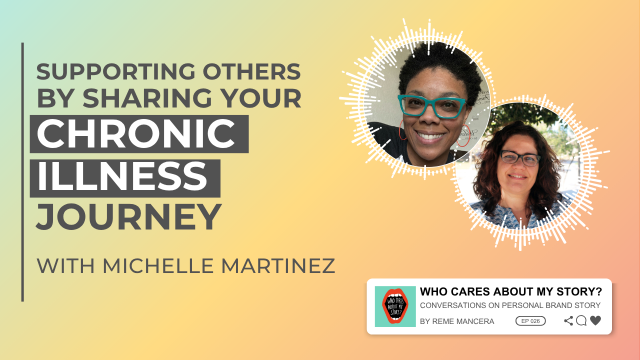
Supporting others by sharing your chronic illness journey, with Michelle Martinez
Supporting others by sharing your chronic illness journey
Have you ever felt like life forced you to stop, only to guide you toward something more meaningful?
Today’s guest is Michelle Martinez, a Life Systems Strategist who helps overwhelmed women simplify their lives with humor, heart, and zero BS. Her work is rooted in real-life experience, and in this conversation, she shares the deeply personal journey that inspired her mission.
Michelle opens up about caring for her father during his final months, leaving a toxic job, and navigating a multiple sclerosis diagnosis, all within a short time. These moments didn’t break her. Instead, they became the foundation for a new way of living and working.
We talk about the origins of her “Life” framework, the power of asking for help (even when it feels impossible), and how to build routines that support your real, messy, beautiful life. Michelle also shares how storytelling has connected her with others navigating chronic illness, caregiving, or just plain burnout.
If you’ve ever wondered how to balance your needs with all the demands of life, or if you’re craving more ease and joy in your day, don’t miss this episode.
Links and resources
🔗 Connect with Michelle:
– Website: www.mmvirtualresources.com
– Instagram: https://www.instagram.com/simplifyinglife_michelle/
– Michelle’s podcast Simplifying Life’s Beautiful Bitchiness: https://feeds.captivate.fm/simplifying-lifes-beau/
🔗 Reme Mancera’s links:
– Website: https://www.rememancera.com/
– Instagram: https://www.instagram.com/rememancera/
-Linkedin: https://www.linkedin.com/in/reme-mancera-postigo/
-Youtube: https://www.youtube.com/@rememancera
🔗 Ready to gain clarity and confidence in storytelling? Let’s explore your 10 Story Connectors: https://www.rememancera.com/story-connectors/
Who is Michelle Martinez?
Michelle Martinez is a Life Systems Strategist who empowers overwhelmed women to reclaim their time, energy, and peace of mind through simple, flexible life systems with humor, heart, and zero BS.
When the old way stops working, we rebuild life differently. Michelle offers simple systems for when your capacity changes.
Who is Reme Mancera?
Reme Mancera is a Personal Brand Story Strategist and the creator of the 10 Story Connectors framework, a strategic storytelling tool to choose which personal stories to share so they build trust, create genuine connections, and lead to clients.
She is the host of the podcast Who Cares About My Story? and the live series Intersection Chats
Who Cares About My Story? Podcast - Conversations on Personal Brand Story
Interviews with amazing guests about how sharing their stories has impacted their businesses. We cover the benefits and the behind-the-scenes challenges you face in deciding what to share, without oversharing or pretending to be someone else.
Subscribe now and don’t miss an episode!
Who Cares About My Story? Podcast 026 - Transcript of the episode
Reme: Hello, Michelle. Thank you for being here. So excited that you are today with us in Who Cares About My Story podcast.
Michelle:
Yes. I am thank you so much. I mean, I am honored to be a part of your podcast and sharing my story, and, hopefully, I can help at least one person with my story. That’s kind of been my goal with my story. And if I can, then, you know, the that just makes the world to me.
Reme:
Nice. So let’s start by please tell us, who you are, what you do.
Michelle:
Yes. I am Michelle. I am a life system strategist, and I help busy moms, chronic illness girlies, women craving calm from overwhelm, simplify life’s beautiful bitchiness with life systems without the BS, without just complicated things, try to make it as simple as possible. And it basically started with me going through all of the things. And like most of us, we went through such turmoil during the pandemic, and we just a whole new, you know, world, basically, when the pandemic happened. And for me, it was, the beginning of 2020. My dad was diagnosed with stage four lung cancer, and I was a part time caregiver because I was still working. And at the same time, my daughter started distance learning.
Michelle:
So there were times where my daughter’s in the back seat on her tablet doing distance learning while I’m taking my dad to his chemo appointments. And then, you know, trying to, again, do work in between. And then fast forward to 2021 in June, my dad’s health took a turn, and I became his primary caregiver. And that was a whole new level of strength I never knew I had, let alone anybody. You know? It’s like caring for a loved one, that’s the strength to have, but to care for a parent, it’s totally different. And so then, as this health started to decline, I used up all of my paid family leave. I asked my job, like, hey, my dad still needs me.
Michelle:
Can I request a layoff? And the the the best part I love telling about my story is that HR goes, well, how much more time do you need? I I don’t know. My dad is, you know, he’s unfortunately dying of a cancer. I, you know, it’s like, I don’t know how to answer that question. And so then my husband was just like, ask them for two months, and if your dad’s still with us, then great. Ask them for two more. You know, go from there just to see if they can you know? I was like, okay. Great. And then, of course, unfortunately, we can’t grant you two months, but we can grant you two weeks, and we expect you in the office on this day at this time.
Michelle:
It’s like, what? You know, it’s so crazy. And I know everybody has those fun stories about toxic jobs and things like that. That was just the one. And it was a it was a blessing in disguise for me to just resign from that job, you know, and really be there for my dad, be there for my family, all the things. And fortunately but unfortunately, my dad passed away in October 2021. And then I thought the hardest part was over, but then about a month later, I started getting these weird symptoms for a ten day stretch. And the final straw was, it was two weekends after Thanksgiving in 2021. And my husband and I, we are in Las Vegas for a softball tournament, and I’m trying to drive him to his game.
Michelle:
And I start getting these, dark spots in my left eye, and I always joke because it’s like, okay. How much did I drink last night? Because, you know, when you’re in Las Vegas, you have fun. Right? But it was such a weird thing, and the symptoms kept, you know, getting more and more. So I finally called, my ophthalmologist and was just like, hey. I need to be seen. She took me in right away. I explained everything to her, and she’s just like, okay. I’m gonna be fully transparent with you.
Michelle:
It sounds like you have the early onset of multiple sclerosis, and I ordered an MRI for you. And I’m just like, okay. I go home. Doctor Google, what is multiple sclerosis? And multiple sclerosis is a neurological chronic illness where it affects the brain, the spinal cord, and your optic nerve, which is why I had those symptoms in my eye. And, I got my MRI, and it was officially diagnosed that I had it in January of 2022. And so once I got that phone call, she was just like, yes. You have swelling in your brain. You, have the start of MS lesions.
Michelle:
And it’s like, okay. I cried in my husband’s arms, and then I was just like, see. This is why I’m batshit crazy. I have swelling in my brain. I’m just, you know, trying to find humor. Right? Because it’s just, you know, the information is just so big. You gotta gotta laugh.
Reme:
You have to digest it. Yeah.
Michelle:
Right? It’s so crazy. And from there, I was just sitting in my chair one day, and I didn’t have to take care of my dad. I didn’t have a job. And I was just like, okay. I’ve been wanting to start my business for the longest time, but what do I do? And so I slowly kind of jumped back into Facebook groups and on, you know, social media in general just to see, and I started to learn more about the online space. And, oh my goodness, there’s other people like me, or there’s other women that could hear my story and benefit from my story, and how can they navigate life.
Michelle:
And it’s one of those things where that diagnosis helped me realize I truly needed to start taking care of myself and putting myself first to be able to take care of my family, you know, and so on and so forth. And that’s kind of how everything started from there.
Reme:
Wow. First of all, thank you for sharing that journey with us. Yeah. I I can, see how all these parts of your journey is, like, moving you in the direction of what you do now. And I would love for you to share with us how did you came, go to the idea of specifically working around life systems.
Michelle:
Yes. So I my background, my main background is customer service and, sales admin and working with within systems, in the business world, standard operating procedures and just, you know, everybody following. And for some random reason, I don’t know if I was in a conversation with somebody. I really can’t pinpoint how, but my brain just kinda you know, it was like, hey. That might be something. But I was curious on how could I turn standard operating procedures into a personal side of things. And so I was at first calling them personal SOPs, but it wasn’t quite sticking. And then I did a poll on Instagram and on different names, and people liked the idea of Life Systems.
Michelle:
And I was like, okay. I can go with Life Systems. And, basically, the Life Systems that I help my clients with is just trying to navigate your day. So, for example, as someone like us, if you work from home, how do you manage your time? You have a household to take care of. You have, you may have a little one to take care of. How do you simplify your day to get through these things and not, I’m a recovering doer of all things. That’s my biggest problem. I just, “”no it’s okay. I can take care of it. I can take care of it. I can take care of it.”” And it’s like, okay. Wait. I can’t anymore. Now that I have this this chronic illness, it’s really letting me know I can’t anymore. So it was building the systems to, one, learn how to ask for help because us as women, we are used to doing everything, and it’s like, no. Sit down. I’ll do it the right way, kinda it’s the kinda thing. Right? But it’s like, okay. No. I have to ask for help. I have to you know? And these systems, what if you put them together, it could be super detailed. It could be super simple, however you choose to have them set up. And it’s your support system saying, hey. How can I help you today? Oh, this is how you can help me. I need help with my house. If you wanna pick a room, this is the steps to take care of on how to clean up the house. If you wanna have me time, girls’ night, date night, here’s a peace of mind childcare planned. Here’s how you can take care of my child, the do’s, the don’ts, you know, on how to take care of my little one. I have, like, 12 or 13 different categories, but self care, energy flow, how to get yourself active again, whether it’s, you know, high energy, low energy, but it’s just the many, I have bare minimum systems now to where if you just can’t do anything, but you want to be able to accomplish something, let’s find a way to make that work for you. So that’s kind of the systems that I I put together over time.
Reme:
I love that. I like how it’s, like, customized for different needs on different levels depending on how the person that you are helping, good are their situation and their circumstances. So I love that. And something really important is, like, how your systems can help us to ask for help and somehow to, like, make it easier if something that we are not used to do, how to using a system can make it for us a bit easier to to ask for help. So I love that you bring that.
Michelle:
Yes. Because that’s that’s the hardest part. And we are we are the we’re the ones who put the home together. We know where everything goes. We know, we know our little ones because we are connected with them. We know what’s going on with them, and you want, because you know everything, it’s taking everything out of your brain, those 20 tabs that you have open and taking a moment to close some of those tabs and be able to you know what? You know, my significant other is taking care of it, or my little one’s okay. I can take five minutes for myself because we don’t we don’t give ourselves five minutes to do anything, to sit down, to have some water, to use the bathroom. You know, it’s like the little things that we just I’ll get to it in a second. I’ll get to it in a second. And then the day goes by, and it’s like, oh, wait. I was supposed to do something. Oh, yeah. Take care of myself. And one of the little things that I love sharing are make sure you add joy pockets into your day. It’s it’s not a luxury. It’s a necessity.
Michelle:
Schedule that into your calendar. You know, five minutes, ten minutes, something that brings joy to you because we, more than before, need joy in our life, something to make us happy, make us smile, make us feel good and lighter and better. And so it’s a lot of little different things to whatever. Like you said, you’re unique. Everybody’s unique. Everybody’s situation is unique. So I wanna get to know you so we can find the right system that fits you in the season that you’re in, and that’s kind of how I go about things.
Reme:
That’s really interesting. I know that you have a a framework which is called life. Do you want to share a bit about that?
Michelle:
Yes. The framework life is I love it because it’s really about life. And so with the framework, L is for learn. It’s learning what your challenges are, what your goals are within a system that is kind of bothering you. Is it a morning routine? Is it trying to find time in your day for self care? Find time in your day for exercising. Take a moment to reflect on what’s challenging you and what goals you have for that particular system. Then from there, once you’re able to do the little tweaks you need to kinda make it feel good to you, you’re gonna implement those new tweaks in that new system and kinda go from there. My favorite part is fluid of life because you gotta keep it flexible because life is ever changing, ever changing, and you gotta be able to roll with the punches that life throws at you.
Michelle:
And so if you are feeling like, okay. I can’t do this right now or this is not working for me in this moment. What can I do to change it? You gotta be able to okay. This is what’s happening. Adapt. Make the change. And then the next part, which is elevate and elevate yourself into that system and make yourself feel better. Not that you don’t want to have your routines be so rigid and so stressful.
Michelle:
You wanna be able to feel lighter, like, oh, I can go through my day. This is working for me. I don’t you don’t have to follow everything on your routine or your list. You wanna keep it, you know, smooth and going with you and flowing with you.
Reme:
Yeah. Yeah. That’s an interesting and easy way to to make it, understandable. So thank you for sharing that.
Michelle:
Yeah.
Reme:
Going back to the personal brand story, I would love to know if you can recall specific moments when you realize how impactful was for you and your business to share your story.
Michelle:
Man, honestly, I’m still trying to get used to sharing my story. It still feels new to me even though I’m about three years into this journey. But I realized with my particular chronic illness that even though it’s been around for a long time, like, forty, fifty years as far as it being known, that it’s still new to people. And I’m learning about the whole invisible illness thing where I may look fine, but I’m not. On any given day, it could be different. And so I want to be able to share my story to let others know they’re not alone. And there’s ways to go through your day to where you’re not stressed out, sad, you know, beating up on yourself for what you’re going through. You can be happy.
Michelle:
I’m not gonna say every day is cupcakes and rainbows, but if you have the right systems or tools in your toolbox, you can get through it. And that’s trying to share my story to say, hey. You know, I’m right there with you. I’m on this journey with you. Let’s get through this together. This is what I’ve gone through and some of the things that’s helped me through it. Hopefully, it can help you through the journey as well and make make it a little bit lighter for you. And that’s that’s the biggest part of of wanting to share my story with others.
Reme:
Yeah. Beautiful. I think that sharing that you have been and you are through going through this process is helping them to understand that, yeah, you have been in my shoes, and you really have the context of understanding. And I love that how it’s connected to the fluid from your framework. Like, you need to have this flexibility because you don’t know how one day it will be, to the other, so you need to have that flexibility in within a system. So love that part.
Michelle:
Yes. Definitely. And it also is talking to moms who are busy, not just chronic illness girlies, but moms who are busy, because we’re always busy with the kids, with trying to take care of ourselves, the house, everything, and, also, women who have gone through my shoes as far as being a caregiver for someone. That’s huge. And, sharing my story of going through that, that, again, I went through all of the emotions of of caregiving for my father, and I I did put a system together to do something that I didn’t do during my time of caregiving my father, but making sure you take care of yourself.
Reme:
Yes.
Michelle:
And that I had that system together to make sure you still take care of yourself. You still make sure your mental health doesn’t take, you know, a toll on trying to be there for this person, be there for yourself because it is hard. It is tough to go through. And, again, I’ve been there. I understand. I appreciate everybody in the medical field that do this on a daily basis because that is an experience that I don’t know if I can do for a living. And for those who do, all my heart goes out to them, and I appreciate them so much so so much for through that. And so for those, again, those who are like me, just getting a little bit of a taste of that world, I’m here to help you.
Michelle:
And if you need someone to talk to, how did you get through this? How’d you get through that? Let me know. I’d be happy to talk to you about it and and share my experience on that too.
Reme:
Mhmm. Yeah. Totally with you in the, respect for the people taking care of others and and and in the health sector. Something that I I would like to point out because I in my family I have been around caregivers, and I know how difficult it can be for them to ask for help. And they are in the situation with like, they are into it every day, and they are not taking days off, and and they are just, for their, significant, loved ones just taking care of them. So I love that you bring that point of take care of yourself, learn to ask for help, because there might be people around you that they would like to help you in a way or another. So but sometimes it’s even difficult to get to that point where you know how to help them in a better way. So having that kind of system can be helpful for both of the sides.
Michelle:
Yes. Definitely. And it’s it’s something that’s forgotten. And I think sometimes it’s even forgotten for the the professionals in the medical field that they don’t take care of themselves. They’re so in it, you know, that they may forget to take care of themselves, or they’re doing long days, long shifts, and stuff like that. So self care, we are definitely in an era of self care. Self care is so much more important than it was before than what it used to be perceived where it was manicures, pedicures, spa days. It’s like, no.
Michelle:
It’s more than that. It’s sitting down in your comfortable chair. It’s cleaning your glasses so you can see better. It’s putting on the comfortable shoes so you can have a comfortable walk. It’s the little things that can take care of you for self care, not just the glamorous type of, you know, things to do it. And I love the era that we are in now to where there’s more to self care than just what used to be perceived as self care.
Reme:
Mhmm. Yeah. 100%. And something that just came to my mind is how we are also going into or going back, if you will, to a moment where we would really need self care, but also somehow collective care where we care about each other and we help each other. So I I feel like having this kind of systems is also, building on that, on having the opportunity to care for each other and support in a way that we can to each other. So I I feel that there are something out there as well.
Michelle:
Oh, yeah. No. Definitely. Definitely. Community is huge. Definitely trying to find your people that understand what you’re going through, that can speak to a particular situation. It’s basically those those best friends that you need that’s that that’s in that particular, niche community, however you wanna describe it, that’s just like, oh, yes. You know? I’ve been there.
Michelle:
Oh, wait. I don’t have the answer, but I know someone who does. Let me give them a call, and we can get together, you know, online or in person and talk about it. How can we help you through it? You don’t have to do this alone. That’s that’s the ultimate thing. You don’t have to do this alone. And 9 times out of 10, it’s just like, you may think, because I did go through this where, crap, I feel alone because it feels like it’s just me going through this situation. And then you go online and you see it.
Michelle:
It’s like, oh, there’s others like that, but they’re not going through it exactly how I’m going through it. And it’s you have to have, which is hard. It’s a practice. The mindset of, like, no. They’re going through what I’m going through, but it may not be exactly what I’m going through. And my best friend and I, we joke about it because it’s like parallel lives. You know? You may be you’re going you guys are probably exactly at the same time going through it side by side. But because we are different people, it might be a slightly different path than what you’re going through, and you can still share.
Michelle:
And there still might be one little thing that someone just like that says, and it’s like, oh, I didn’t even think about trying that. You know? And then that’s the community that you need to get you through those tough times. So, yes, I definitely agree. The community is huge, and it is starting to pick up again in this in this season.
Reme:
Yeah. And connecting to what you say, I feel with the storytelling it’s kind of similar. I always say that, even if you are sharing that story or a meaningful moment for you, the other person, they might not have have gone through something like exactly like that, but you can connect with the emotions. You can connect with the lessons that that person learned. So the same, when you are sharing your experiences, even if it’s not exactly the same, it can resonate with the other person. It can help them in a way it can inspire them or see that there are different options or or different ways to to try to deal with things. So I agree on that. Like, it’s going to have to be just, there sharing, and understanding each other each of us.
Reme:
We are have our difference, but also we go through similar things and can can feel seen by others and understood. And it’s so important. Right?
Michelle:
Yes. Definitely. Definitely. Definitely. It’s like, oh my gosh. There’s someone else who gets me. That yeah. That’s yeah.
Reme:
Yeah. So for some of our listeners, they feel that they are very protective of their of their privacy, and they are not sure about how much to share from their stories. I would love to, for you to share with us how you decided what to share about your own chronic illness and how to share it.
Michelle:
Man, for me, that’s kind of a hard question only because I am an open book. You ask me, I’ll tell you kind of person, so I don’t really have a problem with sharing. But for those who are very protective of their feelings, share with what’s comfortable. You don’t have to give away the whole story right away if you don’t want to, but go with what feels comfortable for you. Again, if you just wanna say, oh, I have that too, and then leave it at that, leave it at that. And if you’re okay with someone asking one or two questions, then, you know, you and you’re comfortable with answering those questions, then answer those questions. You don’t have to tell your story if you don’t choose because it’s you. It’s your it’s how you’re going through it, but it’s the ultimate thing.
Michelle:
Just know you’re not alone. That’s that’s the biggest part. Just know you’re not alone. And whenever you’re ready to share your story, to talk about your story, to give advice to somebody else or something, then that’s when you’re ready to share and and tell your story and help somebody else out. But if you’re not quite there yet, then that’s okay. I’m not the person that’s gonna push you. I am not I know not everybody’s like me. I am a social butterfly in any situation you could put me in.
Michelle:
My husband hates it because he’s just like, I can’t take you anywhere. You talk to everybody. Sorry. You know, there are times I don’t even start the conversation, and I’m just in a conversation with somebody. But I know there are people who are like my husband, and he will sit back and he just observes, and he’s quiet. I’m, on the other hand, talking to anybody and everybody. Like, oh, you wanna talk about it? Sure. Let’s talk about that.
Michelle:
But I’m also of the understanding that not everybody’s gonna share like I’m gonna share, and that’s okay. I’m not that person that’s gonna judge you about it. You are you. You’re a unique person in and of yourself, and that’s why you are beautiful person that you are. Stay who you are, be true to yourself, and share when you’re ready.
Reme:
Yeah. Love that. Thank you for sharing that. And I always say that you you even if you want to mention as in a superficial level, you don’t need to go into details. You can just, as you said, mention if you feel comfortable. And in business, if you think that is something that is important and meaningful to your journey, you can share it in a way that is more focused on the lessons that that situation gave you and not that much in the details of the situation itself. So you have different ways of doing in a, yeah, in a way that makes sense for you, is comfortable for you. And as you say, like, practicing because there is even even if you are comfortable sharing pieces of your story, maybe not related to health or anything else, you might be okay with sharing it, but also you feel a bit not sure how to articulate those thoughts and how to share those stories.
Reme:
Practicing is so important. So I am there with you. Like, even if you want to share something because you feel like something is a message that you want to convey and it’s something important, practicing will help you in any situation. So that will be a a general advice, I believe. So, when sharing your story, your personal brand story, have you faced any challenges that you didn’t expect?
Michelle:
Sharing my story, yes. The biggest challenge was, when the people that were in my community, in my life, friends, family, whoever we hung out with, you know, for longest time, they saw me as okay. And then right when I got diagnosed, right in the very beginning, my my health was bad. I was walking around with a cane because I didn’t have the energy. I couldn’t quite get around, before I really started getting treatment, and my treatment started to really help me. So it was a completely shock you know, complete shock, I should say, to those who are used to me being active and running around. I mean, I’m a former athletic person. I’m a former Zumba instructor running around with my daughter, all kinds of things to all of a sudden come to a complete stop and not be able to do those things.
Michelle:
And I’m still trying to get back to just some kind of active life now. I’m better, but still trying to get there. And so people seeing me not like how I used to be, it’s just like, oh, what’s wrong with you? And, oh, okay. Well, I hope you get better soon. It’s like, no. That’s not how that works for me. And so it was taking the time to try and educate people on what was going on to me with me, and but only educating those who actually wanted to listen. There are some people who are just like, oh, you’ll get, you’ll be fine.
Michelle:
Just take this, do this, you’ll be fine. It’s like, that’s not that kinda illness. You know? So that was the that was the hardest part was realizing how many people who were like me before I was in it did not know or understand what was going on, what the situation called for, what I was dealing with. And there are some people that I wanted to understand, and I appreciate them because I could explain, you know, what my situation’s like. Yeah. No. There’s no two days that are alike. One day I may have energy.
Michelle:
One may I one day I may not. It could change within the day. This is what’s going on with me, and so it’s a matter of paying attention to what’s going on, having my tools in my toolbox. I’m like, okay. This is what I’m going through. This is what I need at the moment. And, you know, just being ready and you know? And then also having the tool in the toolbox to be prepared for those conversations, like, oh, you’re fine. You’ll get over it.
Michelle:
You’ll get past it. It’s like it’s just a cold. It’s like, no. It was yeah. It’s really interesting how people perceive it, and that was one of the biggest lessons for me to realize that’s what they mean by invisible illness. Because on the outside, people see you and you look fine to them, but it’s like, no. There’s a lot more going on on the inside. You know? And so that was probably the hardest part on sharing my story and having people understand what was truly going on with me and really becoming an advocate for those who have my chronic illness and those who have chronic illnesses in general and just advocating for that new community that I’m now a part of in talking about it. Yeah.
Reme:
Yeah. And I can imagine how this is also process where you have to get along with this new identity that you have because you are a new version of yourself. And and then it’s, like, in front of others, but also for yourself to understand these new situations. I can imagine that, must have been super hard to go through that and even that process of, understanding the new situation that you are in. So yeah. Thank you for sharing.
Michelle:
That was, yes, that’s definitely the biggest part is the mental side of it. Yes. The mental health side of it. Not just, being diagnosed with a chronic illness, but grieving my former self and honoring my former self, but accepting my new path, my new life, my new journey, my the new me, you know, and embracing it and saying, okay. I can do this. I will get through this, one day at a time, give myself grace. And and, again, like we were saying earlier, you’re not alone. You know? It’s not just you.
Michelle:
You’re not doing this by yourself. You have your support system, but there’s also a community out there that’s going through something like this or go through something exactly like this, and they could help you through it. And being open to talking about it, because at first, it it was that was probably one of the times I was ever quiet in my life was just like, oh my god. Something’s wrong with me. How do I deal with this? What do I do? I don’t want people to look at me weird or judge me weird. Like, all of a sudden, something’s wrong with her. You know? And it’s just like, well, no. You’re still you.
Michelle:
You just there’s a slight difference, just only a slight difference. And you, I’m still me. You know, I still have my personality. I still smile. I still laugh. I still have those things. And, yeah, it’s just I can’t may, I may not be able to do everything all the time like I used to, but there’s there’s a ways I can go around it, like being a part of the family gatherings. I may not be as actively involved, but I’m still there, and I can still help out in some ways, you know, that kind of thing.
Michelle:
And that’s the biggest message to let people know. It’s like, I’m not completely incapable of doing anything. I can still help. Don’t treat me as if I’m just, oh, Michelle is like this now. We can’t ask her to help. We can’t you know, that’s another challenge that, you know, I had to fix. It’s like, well, no. I’m not completely useless.
Michelle:
It’s like, oh my gosh. Wait. And, randomly, I even had a family member think, take my my diagnosis as me dying. Oh, Michelle’s dying and it’s.
Reme:
Okay.
Michelle:
Woah. No. That’s not what’s going on. Hold on. And that was another way to share my story and share what was. Like, no. This is what I’m diagnosed with. This is what it means. It means that I, my immune system is attacking my nervous system, and it’s a lifelong battle until there’s a better medicine or a cure for it. But I’m still here. I’m not going anywhere. I don’t plan on going anywhere.
Michelle:
You know? It’s and it’s, you know, that part of there’s so many you know, I love this conversation because there’s so many ways to share my story, share a story, and the mental side of it, the acknowledging it, the accepting it, sharing it, so many different ways of embracing that story and and and going with it. It’s just oh my goodness. It’s a whole new thing that’s just like, wow. You never knew you’re, it’s something you were gonna go through and, you know, be it now be the new normal of your life.
Reme:
Yeah. Yeah. And it’s like there are so many layers that you can go and talk from that side and and get closer to someone through your stories. And you can as you said, like, from different angles and different, touch points, and then it’s a way to connect with someone and to to get to for them to know you, like, your context and what’s going on and why you decided to work around these topics and helping this specific group of people and why that’s important to you. So I feel that, like, all of that is, connected. So I would love to know your how, like, what would you say to someone that might be thinking, who will care about my story?
Michelle:
Oh, man. Yes. I I’ve been there, and I I went through that. That’s that would be the the one of the first things I would say. It’s like, I know exactly what you’re thinking, and I know you’re thinking you’re alone because I am me. I am going through this. And it’s the the the selfish mentality about it, which is totally understandable, totally acceptable because it’s like, oh, wow. I’m going through this.
Michelle:
How do I go this? How am I gonna share my story with somebody? Nobody’s gonna understand what I’m going through. Someone’s gonna understand what you’re going through, and you don’t have to broadcast it to everybody. There will always be that one person that crosses your path, whether it’s literally in, you know, in the physical form or online space. Oh my gosh. I didn’t know you were going through that too. Can you tell me about your story? And that’s when you can share your story. Or if you’re someone who wants to go out there and saying, hey. Guess what just happened to me? And you share your story that way.
Michelle:
You can share your story. It’s how you want to share your story because it’s better coming from you than coming from someone else. And it’s always harder when it comes from somebody else because they might get the the details wrong. Just like I said, that family member that thought I was dying, it’s like, no. You don’t wanna hear it from that person. The you wanna hear it from you, and you wanna be the one to share your story to make sure your message is clear. And that way, you might find that one person that needs to hear your story. And just, oh my gosh.
Michelle:
How are you handling this new diagnosis, or how have you been going through this journey? I just joined this journey. I just now a part of it. What do I do? And you might be able to help somebody even if it’s just one person, because sometimes that’s all it takes is just one person.
Reme:
Hmm. Wow, thank you for for that. Yes. I I totally agree on that, the power of just helping one person. That’s, all it takes to to be meaningful. Right?
Michelle:
Mhmm. Yes.
Reme:
So when getting ready for these, interviews, I always like to research on the my guest backgrounds to see if there are some past work experiences that somehow can be connected with with what they do now. Because in my framework, which is called the 10 story connectors, I look for 10 meaningful moments in someone’s journey that are connected to the benefits of what they do.
Reme:
And one of the categories is the past work experience. So one moment in your work experience that is, connected to what you do now, to your skills, some things like that. And when I was, listening to your previous interviews and all that, I yeah. You as you mentioned here, yeah, the aspect of being an admin a sales admin, and, of course, that’s connected to the system. But I would like to ask you for about something else. You mentioned here as well how you were a Zumba instructor. And when you said that in the interview that I listened to, I was like, how in Zumba, you have the choreographies where it’s guiding participants to go through a structure flow, to make it easier and more fun? And I thought, how is that connected to your life systems as choreographies to make life easier and to help with this step by step? So I would love to hear your thoughts. Do you feel that there is a connection?
Michelle:
Oh, that is great question. That is the question of a lifetime for me. Thank you. I would say my Zumba experience, because I like to keep things fun, that’s one. I love dancing. I love having a good time dancing. As a Zumba instructor, I would say because there are your your people in your group class that learn the steps at different different ways, you’ll always have that one or two people that will go left when everybody’s going right. You know, those kinds of things.
Michelle:
And so you just gotta be patient, and you gotta understand what they’re having trouble with, and you help them through it. Because, again, they’re unique. They’re gonna learn differently. They’re gonna, the pace might be too fast. You gotta find alternative ways to help them through it. And that’s one of the things with Zumba I can say. I’m actually going back to that mindset myself with trying to get active. And there was one term that they used was, deconditioned body.
Michelle:
And that is somebody who hasn’t been as active as another person has. And so for me, I have an I finally got a room, a space in my house for my husband and I to try and get active again. And for me, all I’m trying my goal just to get back in the habit of moving my body five minutes on the treadmill or a five minute song. Start slow. Start simple. Don’t go into a full on, you know, work, routine where you’re lifting weights. You haven’t lift weights in, months or years because you could hurt yourself. So that’s the mindset of a Zumba instructor.
Michelle:
It’s like, okay. What level are you at? Where are you where and then to to relate it to life systems, where are you in your current season of life?
Reme:
Mm-mm.
Michelle:
What’s bothering you in your current season of life? How can I help you get through this and help you navigate life’s beautiful bitchiness as I love to call it, to help you get through this season with ease, less stress, little bit more flow, and kinda just be there on that journey to help you through whatever you’re navigating? And that’s the best way I can say Zumba, my Zumba instructor life can help in the life systems world. Oh, that was a great question. I love that. But that’s probably best way I can say can relate it. It’s understanding who you are, what steps are you able to follow. Those aren’t working for you? Alright.
Michelle:
Let’s throw it out and find something that’ll work work for you. Maybe it’s a little slower. Maybe it’s a little faster. Maybe you need something that gives you a little bit more of a challenge or you’re like, that’s a little too much. Give me something that’s a little bit more down here. Alright. Tell me what works for you. And so we’ll go from there and try to keep it fun.
Michelle:
That’s the best part. Find a way to keep it fun. So because if it’s fun, it’s something you want to do. That’s the biggest biggest biggest part. It’s if it’s fun, it’s like, oh, I wanna do this again. I like doing this.
Reme:
Yeah. That’s great. So and I’m glad you like the the connection there. So since you are an advocate for simplifying our lives, I am curious to know how you apply that into your business. Do you have any advice for us?
Michelle:
Say the question again.
Reme:
Yeah. Since you are an advocate for simplifying our lives, I am curious to know how you apply that simplicity to your business, if you have any advice for us.
Michelle:
Yes. It’s knowing your capacity. Really knowing your capacity. For me, I have my schedule set up to where, because I get infusions for my, treatment for my MS every four weeks.
Reme:
Okay.
Michelle:
And when that week comes, my body lets me know, alright. You’re dipping a little bit. You’re about to get your infusion. You’re in need of your infusion. So I try to do the least amount of things as possible. That’s business and in life. And, again, asking for help, the biggest part. But with business, I try to keep it as simple as doing my admin work, whatever I fell off on my my to do list and doing it in small chunks to where it’s not overwhelming me.
Michelle:
Doing my drafts for my blog, drafts for my emails, drafts, scripts for my podcast, captions for social media, those kinds of things that you can kind of easily kind of brain dump your thoughts out and put it together. So that way when you get to the next week and your energy is up, then you can kinda batch everything that way, and you’re able to do that. I try not to, schedule anything during the week of my infusions just because I know my energy is depleted. Just it’s it’s knowing what you have capacity for. That’s the the ultimate part and listening to your body. That
Reme:
Mhmm.
Michelle:
I should take that back. The biggest part is listening to your body because we don’t do that either. We don’t do that, and that’s part of that self care that we need to make sure we do is your body is letting you know your brain’s letting you know, I got brain fog brain fog. I’m not functioning. I’m not you know, what’s going on? It’s like, okay. I need to take a step back. I’m doing too much. Let me break this into smaller groups of tasks that I can manage and get through.
Michelle:
How much can you, how much clients can you take on in a day, in a week? It’s, you know, looking at your hours and how to maximize your usable hours in a day, in a week so where you’re not overwhelming yourself. You’re not doing too much because that’s what usually leads to burnout. And then you’re just like, I’m gonna burn down my business. I’m gonna burn down my house. I’m gonna burn down life because I can’t do it anymore. I’m done with all of this. Someone else take it. I don’t, I don’t want it.
Michelle:
And we’re trying to avoid those moments. So just truly listening and honoring your body, your body will tell you what you can and cannot do. And that’s usually what dictates how you run your business. And definitely have your business evolve around your life. Never put your business first over your life. Always put your life first and then your business.
Reme:
Mhmm.
Michelle:
That was a hard fought lesson for myself.
Reme:
This is always a good reminder. So that’s that’s, like, that’s great. And it’s like that’s something that I love about this podcast is listening. From one way or another, it’s always the conversation about you can run your business on your terms, and you need to define your own version of how you what what are your goals and how you want to reach them. So I love that you bring that aspect of listening to your body and owning what you need and with the lifestyle that you want. Right? So, before we wrap up, a question that I love to ask to all my guests. What part of your personal brand story surprises people the most?
Michelle:
Oh, man. Oh, I don’t know. That one’s another good question. You got the good questions. I love it. I think one thing I can I I won’t say I think? I’m gonna guess that surprised them the most would be life systems and how I view life systems. I asked my mom the other day, when you hear life systems, what comes to mind? And she goes, well, I think, she goes, your internal organs. That’s your life.
Michelle:
It’s your systems. And I was like, okay. You’re not wrong. And I was like, okay. Do you know what I do when I talk about life systems? She goes, well, I think I know what you do, but I didn’t know you use life systems. And so that’s the part I think surprises people the most is using the term or the saying life systems because the systems you, I don’t like to say routines or habits. It’s systems that you put in place. And it’s, you know, it’s kind of the same thing, but for me, routines and habits are something that you always do by the book every single time.
Michelle:
Like, it has to be done at 10 ‘o clock in the morning. It has to be done at this time. It has to be done at that time. And it doesn’t feel like there’s any flexibility where with systems, there’s always a flexibility idea or mindset or thought about it. And if you apply it to your life, then you’re keeping things fluid and flexible. And that way, you’re not so rigid about going through everything. And so I think that’s what surprises people the most is when I say life systems, and I’m a life systems strategist. And like, okay.
Michelle:
What the hell does that mean? And that usually is a conversation starter, so that’s the fun part about it.
Reme:
Mhmm. Nice. And I really like that, distinction between habits or routines, and system and the flexibility that it brings. Love it. So, yeah, good for you for bringing that concept. So please share with us how we can learn more about what you do and the work that you do.
Michelle:
Yeah. You can find me on Instagram. I am life systems underscore Michelle with two L’s, on Instagram. You can find me on my podcast, Simplifying Life’s Beautiful Bitchiness. I am on all popular places that you listen to your podcast. And, I can drop a link in below if you wanna join my email family, my balancing life connection, and that’s typically where you can find me these days.
Reme:
Good. I am making sure that all the links are are there so it’s easier to go and check more about your podcast and the resources that you have, and the work that you do. Thank you so much for being here, for all the insights that you have shared. It has been a pleasure to have you here.
Michelle:
Thank you so much for having me. I’m very, very honored to be a part of this. Thank you.

Want more conversations like this?
Explore more episodes of Who Cares About My Story? where my guests share how telling their personal brand story has impacted their business, and how they’ve faced the challenges of deciding what to share and what not to, especially pivots in their lives or businesses. Here are a few examples to get you started:
- Sharing your story as part of your healing journey, with Nancy Diaz | 002
- Overcoming fear of rejection when telling your story, with Kim Gross | 012
- Sharing your real story despite the fear of losing clients, with Laura Vegh | 027
If you’re ready for more, explore the full podcast library for honest conversations, real stories, and practical insights to inspire you to share your voice and amplify your impact.
WORKING REMOTELYInternational

GET IN TOUCHContact
WORKING REMOTELYInternational
CONNECTSocial links
Reme Mancera · Personal Brand Story Strategist
Copyright © 2018-2026 Reme Mancera. All rights reserved.