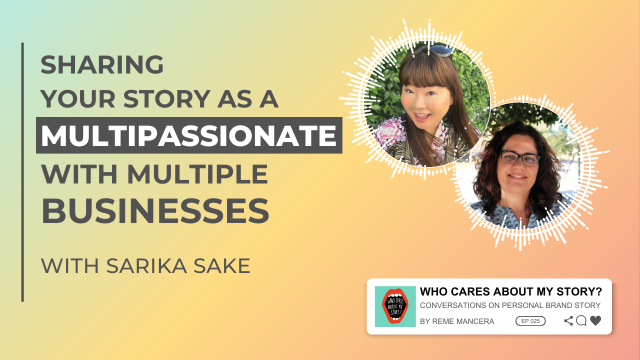
Sharing Your Story as a Multipassionate with Multiple Businesses, with Sarika Sake
Sharing Your Story as a Multipassionate with Multiple Businesses
Have you ever felt torn between your different passions and unsure how to bring them all together under one story?
Today’s guest is Sarika Sake, a former UN official turned award-winning entrepreneur with a mission to spread joy and preserve the 2000-year-old craft of Japanese Sake. She’s the founder of Sarika International and the Sake Beauty Balm, a natural cosmetics brand infused with sake and recognized by the 2024 European Natural Beauty Awards.
In this episode, Sarika opens up about navigating life as a multipassionate entrepreneur, running several businesses while anchoring them under one personal brand. From her surprising first encounter with “real” sake, to launching a face yoga practice by accident, to creating a community for global women leaders, Sarika shares how everything she does ties back to joy, sustainability, and women’s empowerment.
We also explore how she’s learned to share her story in a way that honors both her values and her privacy, and why owning all her “babies” (aka business ventures) helped her define a brand that feels true to who she is.
If you’ve ever wondered how to merge your many interests into one clear message, don’t miss this inspiring conversation.
Links and resources
🔗 Sarika’s links:
– Website: https://www.thesarika.com/
– Instagram: http://www.instagram.com/sarika.sake
– Sarika’s Sake brand: https://www.thesarika.com/sake
– Sake Face Yoga: https://www.thesarika.com/faceyoga
– Sake Beauty Balm: https://www.thesarika.com/sakebalm
– Zen & Sip Salon: https://www.sarikasake.com/salon
🔗 Reme Mancera’s links:
– Website: https://www.rememancera.com/
– Instagram: https://www.instagram.com/rememancera/
-Linkedin: https://www.linkedin.com/in/reme-mancera-postigo/
-Youtube: https://www.youtube.com/@rememancera
🔗 Ready to gain clarity and confidence in storytelling? Let’s explore your 10 Story Connectors: https://www.rememancera.com/story-connectors/
Who is Sarika Sake?
Sarika is a United Nations official turned Forbes-featured Entrepreneur, on a mission to preserve the 2000-year-old declining craft of Japanese Sake. She loves to eat and drink!
She is a certified Japanese Sake Scholar, Sake Competition Judge, and Sake Educator, and the Founder of an award-winning, 100% natural, Sake-infused green beauty brand, the Sake Beauty Balm, winner of the European Natural Beauty Awards 2024. She is also an online course creator with over 11,000 students enrolled in her online courses, and now also helps other women wanting to start a freedom business with soul and purpose.
Sarika has lived and worked in 14 countries in 4 continents in Africa, Asia, Europe, North America, and travelled to over 60.
Who is Reme Mancera?
Reme Mancera is a Personal Brand Story Strategist and the creator of the 10 Story Connectors framework, a strategic storytelling tool to choose which personal stories to share so they build trust, create genuine connections, and lead to clients.
She is the host of the podcast Who Cares About My Story? and the live series Intersection Chats
Who Cares About My Story? Podcast - Conversations on Personal Brand Story
Interviews with amazing guests about how sharing their stories has impacted their businesses. We cover the benefits and the behind-the-scenes challenges you face in deciding what to share, without oversharing or pretending to be someone else.
Subscribe now and don’t miss an episode!
Who Cares About My Story? Podcast 025 - Transcript of the episode
Reme: Hello, Sarika. Thank you so much for being here. I am delighted to have you in the Who Cares About My Story podcast.
Sarika:
Oh, thank you for having me. Really, I’m so excited to talk to you. Thank you for your super kind invitation.
Reme:
Good. So let’s start. Please tell us who you are and what you do.
Sarika:
Oh, such a good question that I have always have a hard time answering. Well well, first of all, my name is Sarika, and so lovely to be here. And, well, I’m Japanese, but I’ve lived in worked in 14 countries and four continents. So I’m a United Nations official turned entrepreneur, and I should add multi passionate entrepreneur. And my mission is to spread joy through, sharing the beauty of Japanese sake and face yoga.
Reme:
Amazing. And, yeah, we will go into the details of all this multi passionate entrepreneurship because this is so exciting. Can you tell us a bit about more about how you converted to being working in the United Nations to going into this entrepreneurial journey?
Sarika:
I know. It sounds like a pretty crazy career change. And, of course, everyone thought I was crazy, because it sounded so numb, so different. But, you know, sometimes your gut instinct tells you it’s time. Right? It’s really, there was no logic behind this. But sometimes that’s how things happen. So yeah. No.
Sarika:
I mean, I’ve been I was working for ten years, for the UN in the area of, urban poverty and gender equality, women’s empowerment. And just by you know, life is so strange and surprising. Just by chance, I discovered sake and that I mean, I’m Japanese, so, of course, I have drank sake before. Have you drank sake, by the way, Reme?
Reme:
Yeah. I have tried. Yeah.
Sarika:
Oh great! Because there are actually two Spanish sake breweries run by Spanish people here. Yes.
Reme:
I didn’t know that.
Sarika:
So, originally, I’m really did not like sake at all. And, you know, it was like, my grandfather’s drink. I mean, my grandfather is from one of the largest sake production areas of Japan. But, unfortunately, the sake from before, because, you know, when Japan was poor, they used to dilute sake and with god knows what, so it wasn’t really pure sake. So that was the kind of thing he was drinking, unfortunately, and I thought, this is sake? No way. But just by chance, one day, when I when we were traveling on family travels, we were in Fukushima, which is the North, Eastern part of Japan. Unfortunately, now famous for the nuclear incident, but this was before. And when we stopped there at the local inn, like a hotel, they told us, oh, with your dinner, you should try our local sake.
Sarika:
And I said, oh, I don’t like sake. Do you have wine or something, beer or something else? But they said no, no, we insist, just have a sip because, you know, with local cuisine, of course, you should have local sake. And just to be polite, I said, okay. I’ll have a sip. And that really kind of changed my life in a way in hindsight? Of course, I never I did not know that would happen. It’s because everything was organic, and it wasn’t overnight. So yeah. And once I sipped that sake, it was so incredibly delicious.
Sarika:
I mean, yeah, it was like angels singing. I was floating with one sip. Completely different from what I thought sake was mistakenly. And after that, I wanted to have more of the same sake, but that that’s when I gradually learned about the, sad status of sake in Japan, that sake consumption, and production is seriously going down. And, yeah, it’s a 2,000 year old beautiful craft, but it’s literally going down in front of my eyes. And I thought, you know what? I think I have to do something. So I kind of, I mean, it wasn’t overnight. I think it took about ten years literally to really study and really, really get to know sake.
Sarika:
And I knew that, well, the two things I love to do, which is gender equality and, well, sustainable and urban development. Actually, I can do it with sake too because, you know, women in sake is a minority. And, as you probably know, unlike Spain, Japan is unfortunately still very gender unequal in terms of, I mean, even the statistics in this year, in 2025, it’s we’re like, the bottom of the so called industrialized nations in terms of gender equality. So I thought, okay. I could I was always looking outside for everything, but in my own country, we’ve got all these issues. And I can work on it through sake if I, you know, still get to drink sake, and I can share the beauty of sake. And, obviously, sake is an agricultural product. It’s made of rice, so it ties in with my sustainability mission.
So I thought, you know what?
Sarika:
It makes sense. Let’s try doing this. So I’ve started, kind of, not an experiment. I was all full in fully in during the pandemic. I started my little sake consultancy at that time.
Reme:
I love how it’s everything tied together, and from outside, maybe it looks like, okay, how these are, they are connected. And, actually, they are. And you just nicely share with us, like, how what is the connection with your story, with even with your, country, original country, story and all that. So it’s like, okay. This is like it makes sense. Everything lies together, and I can see how it’s breathing the joy, it’s so important to you and it’s, how you can use sake as a tool for achieving that. Right?
Sarika:
Yeah. Absolutely. Of course, I love to drink sake, but it’s our excuse me. I’ve got a bit of a cold, but yeah. No. It’s really what I really love about sake is that it get it connects me with so many all kinds of people because there’s no barriers. There’s no hierarchy, you know, when you’re sharing sake. Yeah.
Reme:
Nice.
Sarika:
Yeah absolutely.
Reme:
Yeah. And, I would love to know how do you think sharing your own story, your own personal brand story has impacted your businesses? Because you have several of them, we will cover them in a in a bit. But how do you think, it has impacted?
Sarika:
Yeah. You know what? To be honest, first of all, I never, you know, I never when I started my little sake consultancy, I never even went through any training or anything. So I just literally jumped in. So to be honest, I did not know anything about so called brand story or, you know, all these much more strategic, business things. So in hindsight, this was the story. I didn’t know it at that time. And, yeah, when I did this big change, of course, everyone asked me why. And I just literally explained, like I did now, the reason, which is just a for me, it’s just a natural progression.
Sarika:
But it seemed like, yeah, that was, that was how I started the, yeah, the sake education consultancy. And somehow people remembered through my story that, oh, I didn’t never had any idea that sake was seriously going down. And so through the story, people remembered and they fell in love with sake. So it was a good thing. But to be honest, I had no idea about all these, you know, much more strategic brand story concepts and stuff. It was just I was just saying what I experienced.
Reme:
Yeah. And this is really interesting because sometimes you naturally do, this, sharing your story as a way to explain how you are starting this business. And then later, you learn about the concepts and, like, the strategy behind and the marketing ideas and all that, but you have somehow already done. And it’s like, okay. I naturally did that. It’s just now maybe having a bit of more structure and things like that. But still, you are naturally explaining, okay. What is the context for me to, wanting to do this specific new thing.
Right?
Sarika:
Yeah.
Reme:
Yeah. Let’s go to the other part of your business, which is face yoga. Can you tell us a bit about how did you get involved into face yoga?
Sarika:
It was, again, accidental. Everything I have done is, like, organic and accidental. Nothing has been, like, through a strategic thinking, to be honest. So, again, for face yoga, it was just organic. A story was that, now it’s already back into more than more than ten years ago. You know, my friends and I, we were on a trip, and, we were taking pictures. And I don’t go to the gym, but all my friends do. And when they looked at the photo, they said, oh, how come our bodies are so toned, but what happened to our faces? And someone just jokingly said, oh, maybe, you know, you can, go to the gym for the face or something.
Sarika:
It was just like a casual conversation. But at that time, I thought, that totally makes sense. If everyone’s working out their body muscles, of course, there’s muscles on the face. Why not? And I was so intrigued. And we were just, you know, laughing and joking and googling. Maybe, yoga no. No. No.
Sarika:
Gym for the face or something like this. Like, workout for the face. And, strangely, face yoga came up, and everyone was laughing thinking it’s a joke. And I was laughing too, but then I thought, that makes complete sense. And I saw that the person teaching was in Japan. So I thought, next time I go back to Japan, I have to track this person down. And I did. So and that’s how I, I was at that time, I was doing a PhD and completely doing something different.
Sarika:
But I went to this face yoga just and I only needed, like, a little one hour workshop, but the only thing they were offering was, like, a ten day teacher training.
Reme:
Okay?
Sarika:
And there was nothing else. So I thought, you know what? No. I wanna try this. So I just jumped into this and without thinking I’m gonna teach. It was more about from my curiosity, and I thought it’s a self investment. Let me try, you know, learning it, like, fully and see. And I have no idea what it is, but somehow my heart was telling me, let’s try this crazy thing.
Sarika:
So when I went back to Japan, I did it. And, and what I learned was so interesting because I came more from a superficial side. You know, in Japan, it’s like, take ten years off with face yoga, this kind of thing. But what I realized is that because we carry so much stress on our faces, on our neck up, you know, our forehead, in between our eyebrows, gritting our teeth, these are all the emotions that we carry on our face even though it comes from our mind and our heart. So when we actually let go of the facial stress, we actually let go of a lot of the stress in the mind and the heart, and you feel so good. So it was way more than what I was expecting. And, when my friends, heard that I went to Japan and did this crazy thing, I was living in Vietnam at that time, and they said, oh, show us this what you did, this face yoga thing. So I said, sure.
Sarika:
Come on over. We’ll have, wine. And, at that time, I wasn’t fully into sake yet. So I and I said, we can, you know, have, like, a cocktail and, face yoga. And after my friends came, just like a handful, maybe eight friends who can sit around the dining table came, they start, I gave them homework, and somehow their friends started noticing the changes in them and asking the asking them saying, what did you do? Did you go to Bangkok? Meaning that did you do surgery or something? Because Bangkok is, like, famous for all kinds of surgeries. And they said, no. No. No.
Sarika:
It was this crazy thing, face yoga, that Sarika taught me. And that’s how through word-of-mouth, so many people asked me to show them. So it was you know, I never intended to become a face yoga teacher, especially my background is completely different, as you know, on urban development and the UN. And so, yeah, it was never my plan, but it was so popular that somehow it became my second business. To this day, I still do it. I mean, I’m still actively doing it.
Reme:
Yeah. I love how everything is driven by your curiosity and how you want to keep, like, self development in a way. Right? And at the same time, it’s, like, connected to this idea of the woman empowerment. Because, again, when you feel like your face and you are feeling better outside, you are feeling also better inside and the other way around.
Sarika:
Absolutely. Because you feel like you are in control of your face and your destiny.
Reme:
Yeah. So I would like to move now to another element of your business, which is the cosmetic brand. Can you tell us a bit about that side of your business, please?
Sarika:
Yeah. Absolutely. Again, this was never planned. It was, again, organic just like the sake and face yoga. In fact, it was, in hindsight, it is what brings the both together, sake and face yoga, because the, what I call because it’s well, yes. It’s, it’s a sake infused cosmetic. So, basically, I it’s not like I wanted to produce a product, but as you know, my main mission is to share the beauty of sake. And that’s been always my main mission, but I started to think that I wanted to share sake beyond just an alcoholic beverage because sake is so much more.
Sarika:
It’s really a 2,000 year old craft, and it actually just got, designated by UNESCO as a world heritage the in December, so just several months ago. So I really wanted to share it in a different light, not just for drinking. And, for the last ten years or no. Actually, more now. So since I’m, I’ve been living in Vietnam, at that time, you know, the beauty products or creams or cosmetic products in Asia in general, were very dubious. Well, maybe even now because the sometimes there’s bleach and all kind of toxic things in there. So just naturally, I thought, I think I’m better off just putting coconut oil. So, like, for a long time, I’ve always been experimenting with my own DIY products just because, you know, just it’s yeah.
Sarika:
It’s I just felt safer that way. So it was just an extension, but, of course, I never expected to commercialize this. So and, yeah, sake, just by through experiment, of course. So I started adding lavender oil, all kinds of things to make it, you know, fun and nice to change things up. And, you know, sake has been used in Japan for, you know, hundreds of years as a beauty product because it has this moisturizing and nourishing effect to the skin. So, you know, geishas have been bathing in sake and all these things. So it was just natural to experiment putting a little bit of sake in there. And, and it turned out and I just felt like, oh, this is great.
Sarika:
Of course, I love sake. So I love the smell of sake, and, it’s not doesn’t smell alcoholic. I mean, it’s more it’s very fragrant when you use this, particular type of sake. So for me, it’s like aromatherapy, and it’s mixed with lavender oil, etcetera. And just, yeah, just like that, I’ve always been using my own things. And one day when I was talking again casually to two other women entrepreneurs in London, who have their physical products and, not nothing to do with cosmetics. One was laundry, sustainable laundry, and the other one was food. And when I was talking to them, I thought, wait.
Sarika:
This there’s a new way to share the beauty of sake. I can also share it, not again, going back to sharing the beauty, but, not as an alcoholic beverage, but something more. And I thought this is the answer, but I had no idea about, you know, cosmetics. As you know, my background is totally different, and I’ve never been into so much, you know, cosmetic things. Just as it’s just that I wanted to use something safe and not bleach and toxins. So I had no idea what even how to start, but these two women who started their own things assured me that anything it’s all possible. They said they started in their kitchen, the one who was doing the food, and so I was very encouraged by them. And they were very young, like half of my age.
Sarika:
And I thought, yeah. Well, let me try. So I was googling every day, how do I because as you know, in the EU, to sell a cosmetics, of course, you have to go through this, rigorous thing of, first having the assessment, and then you have to officially register it in a EU, cosmetic portal. So but I didn’t know any of these. So, like, like, I was googling every day and then joining, like, Facebook groups who people who are starting natural cosmetics and trying to get information. And, yeah, that’s how I started. And, by complete luck, the balm, was awarded the European Natural Beauty Awards.
Reme:
Yeah, congrats on that.
Sarika:
Oh, everything is organic. Not I mean, like, it was a accident. Not accident, but, you know, it was not strategic planning, but it kind of happened.
Reme:
But something that I really, like about your journey is how, how your curiosity and you being a resourceful person, just finding the way. I think for everyone listening that, can see themselves as someone multi passionate, I assume they are going to feel so related to your own journey because, of course, you have different passions, but somehow there is a common thread and this idea of everything is somehow connected. But at the same time, it’s like you having conversations with friends and with business owners about this is empowering you to take the next step and making that into a business somehow.
Sarika:
Yeah. Absolutely. No. It’s really thanks to people around me because I’m always getting inspiration from people, including you.
Reme:
Thank you. So one of the new things that you are including in your business, brand is this new, membership from, like, Zen & Sip Salon is the name. Right?
Sarika:
Exactly. Oh, wow. I’m so honored you remember.
Reme:
So please tell us, what is this about, and how it’s connected to the rest of the pieces of your puzzle?
Sarika:
Yeah. You know, in my mind, they’re all connected. So first of all, the Sake Beauty Balm kind of bridged the gap between sake and face yoga, which is completely different because I can talk to my sake people, and, I shared about my Sake Beauty Balm, and it resonates with them. But also with my face yoga people because you can use it while doing our crazy faces. So that kind of bridged the gap between the two. And for the Zen & Sip Salon, I wanted to do something similar, but this is, I’m actually, it’s still a very baby, kind of a newborn baby, and I haven’t properly launched it as such yet. So I’m actually going to launch it in the next two weeks, which is exciting. So, yeah, what I wanted to do is really have, have a virtual community of fabulous women creating change and, so that we can have connection and, kind of, self care together, which is the face yoga part, and a kind of a happy hour.
Sarika:
It doesn’t have to be alcohol, but that way to connect. So it’s an experiment of wanting to connect with, you know, I always love to be with people who inspire me. So, yeah, that’s the idea. And I, I soft launched it, six weeks ago, and, it’s still very small, but we have really amazing women from Asia, Australia, Middle East, Europe, and USA. And, yeah. So some yeah it’s, what I really wanted to build is the connection and then have a relaxation. It’s not like a business mastermind.
Sarika:
It’s more, like, there for soulful connection, and we do face yoga together. And I’m experimenting with guest speakers, this kind of thing. Yeah. And really welcome too.
Reme:
Yeah. This, I believe, just sharing with you, this is the thought that came now. It’s like, you went from the United Nations to now having this circle of different women from different parts of the glo of the world and how you are creating your own version of, having people from all over the world sharing this idea of fun and joy and taking care of yourself and women empowerment. So I love how you go you went back somehow to your, original, place in the United Nations now in this other side of your journey.
Sarika:
Oh, I love how you put it like that. I never put it, I mean, in my head like that. So I love that how you put it.
Reme:
Thank you. So one of the reasons why I invited you as a guest, of course, to share, your own experience, it’s also about learning how you have this personal brand, which is Sarika, and how it’s, like, the umbrella for your different businesses. And I know, especially, some of the people in our audience, they are navigating some kind of transition in their businesses. And some of them, they are, like, including a new business line in their umbrella of brands. So that’s why I believe they are going to be interested in learning about your experience because somehow they are not sure about how to refresh, how they introduce themselves, and how to somehow redefine the way that they share their personal brand story. So can you tell us a bit about this having your personal brand as the umbrella of your different businesses?
Sarika:
Oh, absolutely. No. It’s been a huge struggle. I’ve been struggling really for years with this because when you’re multi passionate and, like my other mentors were always telling me, pick one and, be an expert in one. You should niche down. So this is always the advice I was getting. And for me, I tried once, but it just didn’t feel like, right because it’s like I’m, I have other babies and all babies are, you can’t drop one baby. Right? So it’s like my own babies, and I just couldn’t just drop face yoga.
Sarika:
So it’s been a struggle and how to put it together, especially when it’s so different, like face yoga and sake. It is like Pilates and yoga that’s easier to combine. Or maybe there are other niches that are easier to combine, but sake and face yoga, it’s been really difficult for sure. And some of the times when I was, because I started with the sake consultancy, so I was not, originally doing face yoga. And when I started introducing face yoga because of all the demand, you know, and it would, I was scared, not scared, but, you know, I was thinking, oh, dear. You know, it’s the sake, in the sake world, it’s like, certifications are important and, you know, there’s some authority building. And then if I’m making crazy faces, will that kind of erase my authority? So and then the other way around also that in the yoga world, a lot of my yoga friends don’t drink alcohol. So it’s like, what? She promotes alcohol? Or I had this idea that it’s like. it’s like a conflict.
Sarika:
So it’s been a struggle, but at the end of the day, you know, I can’t drop either because they I really love both equally. And if I drop both, it’s like I’m not complete. So I made the decision. I somehow wanna, do this both. And I did not know anything about, you mentioned personal brands or anything because I thought, you know, I’m a sake educator, and I did not know this umbrella and every, anything like this. It only, so at some point, I had three different websites to keep things somehow independently and separately, and that was very painful because, oh, so much, you know, labor in maintaining these three completely different things. And, so it’s been a lot of struggle for me until I got to this point that, oh, wait a minute. It’s all me.
Sarika:
But, yeah, it has taken maybe, like, three years to realize that. And now I have one website where I have three doors when you enter, and, hopefully, it’s now more connected. The sake and the face yoga is connected through, the Sake Beauty Balm. And then Zen & Sip Salon is kind of what I really like to achieve, to have that connection and, yeah, inspiration with other similar women or fabulous women creating change.
Reme:
Yeah. And I invite the listeners to go and check your website because you did a really good job there to combine the different, sides of the businesses in one website. And it’s clear, and it’s. So yeah. And we will have the links, of course, in the in the show notes, for them to take a look. Because something that I really think you have done really smart is how in each of the pages where you are specifically talking about one of your businesses, you are including a section about you, but you are somehow shaping it a bit, connecting more about the topic of the of that specific landing page. And I think that’s a really smart way of again, you might be sharing the same stories, but you are, the angle might be a bit different depending on who is the audience and who is the product or the business that you are trying to convey, right, to highlight. So how was that process of deciding that angle of, okay, let’s reframe a bit how I share my story in each of the pages inside the main website.
Reme:
It’s just one website with different inside pages about the different businesses.
Sarika:
Yeah. To be honest well, first of all, thank you for saying that. To be honest, I feel like it’s still a mess, but it’s better than before when I had the three completely different websites that they were not talking to each other whatsoever. Because at some point, what I realized is that my sake people, when they discovered that I also do face yoga, they’re interested, and vice versa. So I realized there’s a over, you know, like a crossover. And I thought, why am I having three separate websites? I should have one. So when I dis, when I realized that and some people were asking, like, for their birthday party, can we have a sake tasting combined with face yoga? So they were, like, new things not done by me, but people asking for these fusion things. So I thought, okay.
Sarika:
I think it’s time to transition from three, three dots three dots to merge them into one. So kind of through people’s response, I realized I could bring them together because they are crossovers. But when I brought them together, of course, I had no idea because I’ve never done this before, and I did not know other people since most people are experts in one area, and they’re, that’s how they build authority. And that’s how I was told too that you that’s, you know, you can’t build authority if you’re jack of all trades. However yeah.
Reme:
Yeah. But this is an interesting topic because somehow when you have these different passions, finding your own specific thing that you like, and for you can be the combination of how they tie together and in a way that at the beginning might be not likely, but then makes sense. And people see how they can combine well together and having these different sides of, of you in different, like, scenarios. Right? So I feel like sometimes, especially for people that are different passions, it’s like, okay. Maybe just try to figure it out what is the combination that you will like to or you will be interested in. Like, what is the touch point between the different passions that you have and how that could be your niche in the sense of this is your specialization because that combination is unique to you and to your interest.
Sarika:
Yeah. Absolutely. And my friend told me, well, you know, Disney sells tickets, movies, Disney goods. You know? So it was like, it’s not just Disney, but yeah. So I think, of course, there’s different ways to do this. And as you said, Reme, the personal brand is the easiest way, I think, because the, I did try to combine it like, face yoga for sake drinkers.
Reme:
Mhmm.
Sarika:
But it was a little bit of a forced marriage in a way that I was, like, forcing these two things.
It didn’t come so naturally, but somehow the Sake Beauty Balm, the cosmetic product, really just naturally gelled. So I think when you
Reme:
Yeah.
Sarika:
Start combining things, you will come up you it will naturally occur, maybe not instantly because it took a while for me. But I think, absolutely, I think the personal branding is the answer rather than trying to force marriage two different things like I was trying to do. Yeah. Because under that, you can put anything.
Reme:
Yeah. And I think this is something important as well, like, allowing yourself to try and to experiment these things that you were attracted to and your curiosity was driven. It’s like, okay. Allowing yourself to try and give you the space and patience to try and not try to force things. I think that’s an important lesson in general for having a business. It’s like things that need their time, and it’s a process.
Sarika:
So true. Yeah.
Reme:
And it’s like you need to give it the space to, for things to get their way.
Sarika:
Absolutely. Absolutely. And sometimes we just want it fast, like, overnight, but it just doesn’t happen that way. You have to plant the seeds and water it and
Reme:
Yeah. Of course. Yes, it’s like and with the things that you, do, all of them, they require that patience, and it’s a work of, a craft. It’s like something that is, over time. It’s not, it needs their time, like, for sake, for the cosmetics, for the results of the facial yoga and the compound effect. So all of that needs their time, and it’s like, you cannot rush it.
Sarika:
True. True. True. Everything happens when it’s at the, it at their own timing. So
Reme:
Yeah. So I see how you have certain topics that are crossing over all your businesses, but also related to the United Nations, like this idea of spreading the joy, this positive social change and empowering women, and then also the sustainability because the cosmetic brand has also this aspect of sustainability as well. So I love how all of them are connected. And I would love to know how you are when sharing your stories, if you have some topics that you are, like, yeah, they are connected and I am using in different slightly different ways, but all everything is tied together because they are topics that are important to you. So it’s the over everything in some way.
Sarika:
Yeah. You mean, well, how do I how do I make different stories for Yeah. Well, in a way, for example, just as an example, two days ago in Ireland, I had a sake workshop. So people were there for sake, not for face yoga or anything else. So, of course, I was, concentrating. I mean, I was delivering, what I was asked, which is to share about the, we had five sake with amazing pairings of food, and we covered the history, the, you know, the production process, everything quite geeky about sake, but I made sure to throw in, face yoga and the balm by for example, for me, sake tasting is meditation because you really have to use all your five senses to really, really, understand and feel the sake. I mean, because I also judge in, sake competitions. So for me, it for me, I really treat it as a meditation where I see, hear the bubbles, for example, for sparkling sake, and, of course, the aroma and the taste and the touch.
Sarika:
So I included that in that sake workshop that we had a little bit of three cycles of breath before we started the tasting. And then, so and then by kind of using all our five senses, then you can really concentrate and taste more and really feel more when you really do that. It sounds crazy, but it’s absolutely true. That’s how I got a high score in my tasting test. So just as an example to answer your question, I hope I’m answering your question. Like, for a sake audience, I would, of course, concentrate on sake, but I would bring in elements of face yoga. Of course, they were not interested in face yoga, so I did not do, like, a actual face yoga, but I brought the elements of the meditation and prepared the psych, the breathing. You know? Breathing is very important, so breathing is also essential in tasting.
Sarika:
And we and I always like to make it fun in a sake workshop. So I tried to, I included my little Sake Beauty Balm, a trial size as a present for the quiz. We had we had a sake quiz about the history and stuff. And, for there were four quizzes, and people who got the answer got the trial mini size as a present. So that’s how I try to combine and bring in other elements even though the main thing for this two days ago was the sake event. So that’s how what how I do it and vice versa for yoga and others.
Reme:
Yeah. It makes a lot of sense how you are making them aware of the other side of things that are interesting to you. And I love how you bring fun as an important element in everything that you do. I love that side and the idea of, somehow, like, changing the status quo because I know that for you, especially in the sake industry, you tell me about this, how you are doing these interviews to different women in in sake and that gender gap. So, again, that connection with topics that are important to you. So can you tell us a bit more about that process when you were doing the interviews? Why, what motivated you to do that?
Sarika:
Yeah. Well, first of all, gender stereotyping has been, you know, in Japan in all my life. I think any Japanese woman have experienced gender stereotyping. And, again, you know, Japan, unfortunately, the gender equality ranking, I think is, like, this year was 121 out of the surveyed countries in the World Economic Forum of 140 something. So it’s really shockingly low when you think that Japan is such a modern, you know, modern country, so called modern country, technologically advanced. But the reality is that the social side is still really low. And, it’s very unfortunate. So it’s always been, I think even when I was five, I already doubt, had question marks about I mean, I didn’t know about the wording gender stereotyping, of course, but I already wondered how come I can’t wear blue, for example.
Sarika:
This kind of thing. So it’s always been, like, a important part of my life, even, not even before joining the UN. I mean, it’s always been, like, a question mark for me and why things are this way in Japan. I mean, actually, in the rest of the world is also it’s not perfect either. But
Reme:
Yeah.
Sarika:
And my specifically, my experience are in Japanese society. And so it’s always been on my mind, and, and that’s what I also did in the UN. And my last posting was also in the, gender equality and women’s empowerment section, for Asia and The Pacific.
Sarika:
So Asia and Pacific is very complex because they are advanced countries as well, but, yeah, Japan is low and other countries. So knowing that when I entered, joined the sake world, of course, Japan is already unequal, but the sake world is even more male dominated than the normal Japanese society. So, it was quite interesting in a way because women were not allowed to enter Japanese sake breweries for hundreds of years because, myth by superstition and also practical reasons. You know, women’s, they said women’s menstrual cycle can interfere with the fermentation of sake, so it could spoil the sake and will. Yeah superstitions and things like this. So women were not allowed to enter the sake brewery, means that there were no real no woman brewers or no woman in the sake industry in a way. So the only women were, like, wives of the brewery owner, etcetera. But, luckily, this has been changing, and I thought this is so interesting. I wanna talk to them, and that’s how I started the interview series during the pandemic.
Sarika:
I thought, well, maybe I’m gonna hear their stories. How did they end up brewing sake when, you know, it wasn’t allowed well, people weren’t doing that forty years ago. So, yeah, I started interviewing one person and then the next, and it was so interesting. Out of even now, out of 1,300 sake breweries in Japan, only, I think, 30 to 50 woman master brewers. They’re only, so it’s a really disproportionately low number compared to the brewery numbers. And, yeah. So I interviewed quite a few amazing women brewers, and their stories were so fascinating. It’s like, wow.
It’s so tough, and they’re now winning awards and amazing. It’s so motivating to hear their stories. Yeah.
Reme:
Yeah. And it’s so interesting that you shared that about the menstruation and the superstitions because my family has a rural background. So, both of my mom and my side and my dad’s side so they were living in the countryside. And I hear I’ve heard these stories about how, women that were menstruating, they were not allowed to do certain foods when they were doing that, like making the bread or making certain foods. Again, because superstitions and things like it’s going to go bad and things like that.
Sarika:
Yeah, even in Spain?
Reme:
Yeah. Yeah. Of course. So here because, yeah, we have so, this was before, and, of course, things have changed, have changed, but there is still always so much wrong. And all these traditions and superstitions are still, like, in our, heritage background. Right?
Sarika:
Oh, yeah.
Reme:
So there is a lot of, stereotypes to break and to and to build that, yeah, that equality.
So I love that you bring that because I think it’s I even because we have an international audience, I would love to hear from different, people in the in, like, listening if they have some other stories around this kind of superstitions because it will be interesting to hear about that. Right?
Sarika:
Absolutely. And another one that’s related to the superstition of sake, why women were not allowed to enter was that the god of sake is actually a woman. So they thought the god of sake will be jealous if a woman enters the brewery. So there are all kinds of, you know, not just the menstruation. But yeah. But I guess we’re almost this is almost jokey to me, but it was still the truth that people were, yeah.
Reme:
Yeah. Talking about our backgrounds and our families, I would love to bring one of the stories that you share about your great grandma, Chiho. I don’t know if I told, said it write. Please tell us about this and how this person has in inspired your work and your different businesses.
Sarika:
Yeah. No. It’s really thank you for wow. You have such an amazing memory, Reme. Exactly, that’s from my great grandma. So it’s already one hundred years ago, and, she was one of the first Japanese women to go to university because, Japan the universities in Japan were only taking men until, I think, 1911 or I’m not sure about the specific date, but so she was one of the earliest batches of women who were allowed to go to university in Tohoku University. Excuse me. And then, when she graduated, she’s she somehow realized that she wants she heard about, this faculty in Germany, and she decided she wants to study there.
Sarika:
But she knew that her family would be against this idea, so she actually crowdsourced using a modern term now at that time from her, classmates in Tohoku University to study in Germany, and she took a boat by herself forty days from Japan to, there was no boat directly to Germany, to Marseille. And, so I was reading this book, and I was, wow. Even now, that’s pretty impressive, but this is a hundred years ago. So
Reme:
Yeah. Absolutely. And I love how that is, like, nicely connected to your nomadic lifestyle and all the countries that you have lived in and you have traveled. So it feels so, like, connected to your own, path of doing this kind of nomadic lifestyle.
Sarika:
Yeah. Yeah. I think that’s definitely Chiho, my great grandma has always been in my background. I never met her because she passed away before I was born. But, of course, you know, all our family knows her story and her she published many books. But maybe I should add that, on I have two extreme sides of the family. So she was like a super pioneer modern one.
Sarika:
On the other hand, my paternal grandma, was married, arranged marriage when she was, I think, 13 or 14. So it’s like a complete opposite, and I know both sides. So one is like a super pioneer side, and then the other is the other side. This is my, the sake production area, Nagano, my other paternal side. So seeing both is like, wow. I mean, it’s really a, it’s yeah. Both are
Reme:
Yeah.
Sarika:
Both are real, and both are inspiring in a way because my grandma from the my paternal side, she had no education, and she was you know, arranged marriage was a norm at that time.
Sarika:
So she married my grandfather who was way older, and, but she had no choice. I mean, no education. And I think they had a fairly happy marriage, so she wasn’t like she needed to leave. But should there be an scenario if she needed to leave? I think there was no choice because she wasn’t, she had no education, no way to make income, and with three kids, my father included, I think there was no alternative. So it’s like I’m seeing both sides and I, yeah, I have to kind of, give both credit in their own way. They were in that circumstances, not by their choice, but how things were. So yeah.
Reme:
Yeah. Absolutely. Like the, like, learning from both of their experiences and acknowledging that, like, recognizing their way of being in life and all that and how that somehow is forming your way of thinking and having this wider perspective when you were going into the United Nations works, but also now with your work with different aspects of your businesses. So I feel that this, like, this idea of the woman, women empowerment is also connected to the both of their stories. Right?
Sarika:
Yeah. Absolutely. Absolutely. I love how you put it all together in such a way because it was never, you know, clear in my head until you said it.
Reme:
Thank you. That’s the like, this is something that my clients highlight about how I am well connecting, like, concepts on different aspect, of their. So thank you for saying that. Okay. So I would like to just, ask you a couple of questions more. So have you ever thought that you were oversharing, like, sharing too much and you didn’t feel comfortable about it?
Sarika:
Yeah. Well, first of all, I never even now, I’ve never done an introduction post on Instagram, for example, because I feel like I don’t wanna share everything. And so even, I know, like, normally people on social media, there’s introduction posts, but I’ve never actually done that. And I’ve I haven’t shown my face for such a long time because in the beginning, I was just basically showing sake bottles because I felt like I don’t wanna expose, you know, to myself to Internet danger. So, yeah, definitely, I had this, even now, I would say I still have it. And that’s why I don’t even show my family or not even my pet dog. I just I’m kind of, in a way protective, but it’s a it’s a for me, it’s alright. I just share what I I’m comfortable sharing.
Sarika:
So, of course, I’m very comfortable sharing about my sake tasting, and journey, and this kind of thing, but I just keep some of my things are sacred. So Yeah.
Reme:
I love that you bring that aspect because somehow, there is an idea that when you have a personal brand, you need to share all the aspects of your life, and you don’t need to. You are the one decided, like, you are in control. Right? You can keep the areas of your life that you want private. It’s just about sharing how is your personality, sharing what is what are your values, what is important to you, why this specific work that you do is important to you. And I always highlight how you are the one deciding the level of detail that you share.
Sarika:
Yeah.
Reme:
And you can put the focus on sharing about the lessons of a certain moment and not sharing the details.
Sarika:
Right. Exactly.
Reme:
And the emotions that you live there because that’s what will help us to connect with the person that is, listening to us. Right?
Sarika:
Mhmm. True.
Reme:
So I love that you are, like, setting your boundaries because that’s really important to feel comfortable, to be confident about, okay. I know that I am sharing until here because that’s where I feel comfortable with. And there are space that is just for myself and my people that know me in the private way, and it’s okay. It’s not going to damage my business.
Reme:
My business is going okay because I am sharing the parts of myself that they are showing the context of why I do this work and why this is important to me and why I’m passionate about this mission that I have.
Sarika:
So absolutely true. So so true.
Reme:
So, I would love to know if at certain point, have you got any help deciding what to share in your, like around your stories and your messaging and for your businesses? Have you got any help deciding, what to share in your messaging, or everything has been natural, like, you deciding what you want to share?
Sarika:
Yeah. I never gotten help, like specifically for I’ve been, I, I got, I always get help for business, um, strategies and stuff because I have no strategy, but, but I have not. Sought, uh, looked for help specifically about, um, boundary boundaries on visibility. ’cause it’s just that in my mind, this is the line.
And for me that that’s it. I mean, I’m kind of protective of my dog and family, so I don’t share that, but, but the rest is, um, yeah. So no, to answer, I guess the answer to your question is I’ve never gotten specific help for that, but it’s just kind of, it’s just a natural thing in my mind. This is the, this is, yeah.
Reme:
Yeah. What about like, storytelling in general, like your messaging and your, how you use your stories in your, in your businesses? Have you got any help around that? Like the copywriting of your website and things like that? Oh yeah. Copywriting and stuff. Of course, of course.
Sarika:
Yeah. So I’ve had a number of, business coaches and mentors, of course, of course, and they helped me a lot. Well, some of them was, like, exactly the opposite of what I needed to hear. Like, you should concentrate on one niche and but I mean, everyone’s opinion I love to hear everybody’s opinion, and I will take what resonates with me and, I’ll disregard whatever doesn’t make sense with me at that time. But, of course, I could always be wrong. But, yes, of course, I’ve been I always get help. And, yeah, absolutely con, continuously from
Reme:
Yeah, this, what you just mentioned about taking what it makes sense to you and not taking what it doesn’t, I feel this is really important for us to remember. Like, okay. You get the advice even from general people. General in the sense of people that you are listening online or podcast or books that you are reading, even if they are not your hired mentor, but they are somehow sharing with you their knowledge, is always go through it and think about your own opinion on things. And considering, okay, how I how do I feel about this? It’s something that I want to incorporate? It’s something that I don’t? Thinking about considering your own, like, the business that you want, the lifestyle that you are trying to reach.
Reme:
The things that are important to you might not be the same that the person is trying to highlight, and they are talking for getting certain business goals that are not your goals. So having that in mind, I think, is all always important. And you can get lessons. I am also a really curious person, so I love to hear from different people, different backgrounds, and different advice and experiences. And then you go through your own, like, thinking about this and considering, okay. This is good. This, I keep it for myself. This, I don’t, but I know that for some of my clients can be useful and things like that.
So having that consideration, I think, is really valuable. So I love that you bring that thought.
Sarika:
Absolutely agree with what you say.
Reme:
Okay. Now a question that I like to make to all my guests.
Sarika:
Mhmm.
Reme:
So what part of your personal brand story surprises people the most?
Sarika:
Yeah. Normally, the people when I say that I used to work for the UN, everyone’s really surprised. They’re like, you don’t look like that type. It’s like, it’s very somehow unexpected for some reason. And I think I’m the same person, but I think I’m more free now in a way because yeah. But, yeah, the I think that that’s what surprises people. And, of course, I love sake so much. And when I say that I used to not love sake at all, it’s like, what? I thought you always loved sake.
Sarika:
No. No. No. It’s actually just in my recent well, the recent as in fifteen years of adult life only.
Reme:
Yeah. Yeah. I think this is really interesting for you even to share with the people that might be thinking about trying or not. It’s like yeah. I the first time that I tried, I didn’t like it, and I now I enjoy this process and this. And you explained this meditation, like, this sounds like a whole different experience. So that’s something that is like, okay. This is a new perspective, and this is good for sake and for all many different things.
Reme:
Also for face yoga is something that I haven’t heard before. And when I listened from you, it was like, oh, wow. This is really interesting. So just to think about the possibility that’s okay. The there is something else there that you can try. So I love that.
Sarika:
Oh, I’m glad I made you curious.
Reme:
Okay. So thank you so much for all this conversation. It was so lovely to have you. Before we finish, please share with us how people can learn more about all the amazing things that you do and learning more about, you and your businesses.
Sarika:
Oh, well, first of all, really, thank you for having me. I had so much fun. Really, thank you so much for your, yeah, amazing and such thoughtful questions. I really enjoyed talking to you.
Reme:
Thank you. So where can they find you? Like, the what is the best place that they can go?
Sarika:
Yeah, I guess two places. One is my website, and one is Instagram. So my website is www.thesarika.com.And my Instagram is sarika.sake.
Reme:
Okay. We will make sure to share the links so people can easily go there. Yeah. Just thank you again for having this conversation. It was a lot of fun.
Sarika:
Oh, thank you really for having me, Reme.

Want more conversations like this?
Explore more episodes of Who Cares About My Story? where my guests share how telling their personal brand story has impacted their business, and how they’ve faced the challenges of deciding what to share and what not to, especially pivots in their lives or businesses. Here are a few examples to get you started:
- Sharing your story as part of your healing journey, with Nancy Diaz | 002
- Overcoming fear of rejection when telling your story, with Kim Gross | 012
- Sharing your real story despite the fear of losing clients, with Laura Vegh | 027
If you’re ready for more, explore the full podcast library for honest conversations, real stories, and practical insights to inspire you to share your voice and amplify your impact.
WORKING REMOTELYInternational

GET IN TOUCHContact
WORKING REMOTELYInternational
CONNECTSocial links
Reme Mancera · Personal Brand Story Strategist
Copyright © 2018-2026 Reme Mancera. All rights reserved.