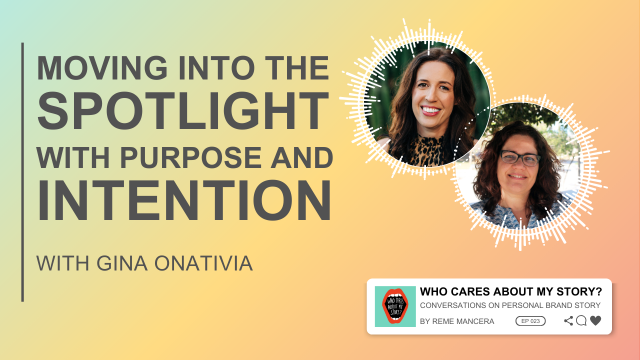
Moving into the spotlight with purpose and intention, with Gina Onativia
Moving into the spotlight with purpose and intention
Have you been working behind the scenes for years and now feel like it’s time to step into the spotlight? If so, you’ll really appreciate this episode.
Today’s guest is Gina Onativia, founder and CEO of the Course Creation Boutique. Gina helps experts, speakers, and entrepreneurs get their online courses and programs done and out to the world, and she has built programs and content for Tony Robbins, Amy Porterfield, Bo Eason, IBM, and Special Olympics.
Gina shares how she went from working behind-the-scenes to becoming the face of her own business, which she runs with her husband, Alex.
In this episode, we talk about:
– Gina’s transition from supporting big name clients, and using their stories as social proof, to embracing her own narrative and sharing her own personal stories in her business.
– Gina explains how sharing your story can build trust and connect you with your audience, particularly in the online course space where personal brands dominate.
– We also talk about Gina’s experience around sharing health issues with her audience, like what do you share when you go into surgery? And how do you keep boundaries around this?
Whether you’re a course creator yourself, or a service provider who tends to stay in the shadow of your clients, tune in for Gina’s insights on storytelling and how it has helped her build relationships with her audience.
Links and resources
🔗 Gina Onativia’s links:
– Game plan for building your online course:
https://coursecreationboutique.com/gameplan
– Course Creation Incubator Podcast: https://coursecreationboutique.com/podcasts/
– Her podcast on YouTube: https://www.youtube.com/channel/UCmueJi9AkM1HZ9R8ZcmZsSw
– Website: https://coursecreationboutique.com/
– LinkedIn: https://www.linkedin.com/in/ginaonativia
– Instagram: https://www.instagram.com/coursecreationboutique/
🔗 Thanks to our mutual friend, Becky McCleery, for introducing us! You can find Becky here: https://www.beckylytermccleery.com/
🔗 Reme Mancera’s links:
– Website: https://www.rememancera.com/
– Instagram: https://www.instagram.com/rememancera/
-Linkedin: https://www.linkedin.com/in/reme-mancera-postigo/
-Youtube: https://www.youtube.com/@rememancera
🔗 Ready to gain clarity and confidence in storytelling? Let’s explore your 10 Story Connectors: https://www.rememancera.com/story-connectors/
Who is Gina Onativia?
As a Course Consultant and Digital Strategist, Gina Onativia has spent the last decade helping entrepreneurs, coaches, and thought leaders turn their expertise into profitable online programs and digital offers that actually convert.
She has worked with brands and leaders like Tony Robbins, IBM, Amy Porterfield, and former NFL safety Bo Eason, learning exactly what drives engagement, sales, and long-term growth.
Her focus goes far beyond course creation. She helps established creators design seamless customer journeys (from lead magnet to course to high-ticket programs) and build websites that sell with strategy, storytelling, and offers that scale.
Who is Reme Mancera?
Reme Mancera is a Personal Brand Story Strategist and the creator of the 10 Story Connectors framework, a strategic storytelling tool to choose which personal stories to share so they build trust, create genuine connections, and lead to clients.
She is the host of the podcast Who Cares About My Story? and the live series Intersection Chats
Who Cares About My Story? Podcast - Conversations on Personal Brand Story
Interviews with amazing guests about how sharing their stories has impacted their businesses. We cover the benefits and the behind-the-scenes challenges you face in deciding what to share, without oversharing or pretending to be someone else.
Subscribe now and don’t miss an episode!
Who Cares About My Story? Podcast 023 - Transcript of the episode
Hello, Gina. I started my business as a virtual assistant for course creators, and I learned a lot about course creation, thanks to you and your content. So thank you for that. And after all these years, it’s a pleasure to have you as a guest on my podcast. Welcome. Oh, Thank you, Reme. It is an absolute thrill to be here and thank you for saying those kind words.
I’m glad we were able to make an impact for you. Thank you. So please tell us a bit about who you are and what you do. Yes. you mentioned upfront. So we work with a lot of different course creators. I am a digital course consultant. We work with small business owners, bigger organizations, higher ed, medical practitioners, lawyers, etcetera, to help them build their courses and their back ends and lead gen as well.
So it’s been quite a wild ride since building courses way back in the day for Tony Robbins. Nice. Could you, Could you explain how you got started into, actually, into course creation, please? Yeah, so I, I’ll take you way back to when I first moved to San Diego and I answered an ad. I was looking for work, to work for the chairman.
No idea who the chairman was. And I, walk into a courtyard, hand someone my resume, and it happens to be for Tony Robbins. So, Amy Porterfield was my boss at the time, and, ended up going on tour with him to 40 events going into the studio, learning how to build courses, not just from him but from his right hand woman, Pam Hendrickson.
And that’s where I also met my husband. And Today we, both know how to build courses. He’s on the design side of the business. I’m on the content and marketing side of the business. And we really got our start by watching Tony, by being in the studio with him and, prepping him and learning all the ins and outs
of course creation. It was the greatest education a girl could have. Nice. So how do you think sharing your own story has impacted your business? Well, I, mean, it’s been critical in growing our business. I think story is so important, reme in terms of connecting and building trust. And you know this because you have your own online based business in terms of there’s so many people out there telling you that they can help you, right?
That they can make you money, that they can transform your business or transform your health and. How am I supposed to trust you? How am I supposed to know that you can really deliver for me and give me a transformation? And story is a huge step in that direction in terms of learning who you really are and why would I wanna work with you?
And giving us that connective tissue that we’re all looking for at a time when trust is at an all time low. right, And all across the world and story helps us connect with someone like this and build rapport. Going back to what Tony always talked about, building rapport and us sharing our story. I say us, I say Alex and I.
I’m constantly sharing stories on my podcast when I speak, because I know I wanna connect with people. I want to give people a sense of who I am so I can attract and repel. Not everyone’s gonna be my hugest fan. And there’s no faster way to connect than story. Absolutely. 100% agree.
And I believe that, especially because in the online, course creator space, there are a lot of, businesses that they are the face of their brand, of their businesses. They are a Personal brand. So you really. Have an asset in your own story to build that trust, especially new audiences and people that might be your students or participants in your programs.
Using your story as a way to build that connection and that trust, I think is really, really important. even something in the strategic, in the, in the business side of things, right? Oh yeah, a 100%. So, you know, front facing, the first time they meet you, telling those stories on your podcast or on a blog or in your videos, wherever, whatever content you’re putting out as an authority, as an expert, you wanna share those stories because one, it connects with you.
Two, it shows off your expertise and authority. And three, it makes you real. Right? In the world of ai, we’re craving. Those emotional stories and emotions period that AI can’t bring for us So, like more and more of us are using ai, right? and that it’s a lot of facts, but not a, but no emotion. So people are craving that right now.
So that’s the front and that’s the beginning of the funnel. And then as they take your course, I always encourage our, encourage our course creators share those stories and examples. And sometimes they feel like, well, why would somebody wanna hear from me? Right? But because again, that’s connecting them to the content and making, and just giving it richness and bringing it alive in a way that you wouldn’t normally be able to do with just facts and figures.
Yeah. And also it’s a great opportunity to create examples that are unique and, even to explain something that. There. I always say that there are more people offering your services than your, what you offer, no one else with your life path. So that’s right. You using your story as a way to, explain different examples on your process of work and even your framework is a great opportunity.
So yeah, I agree. So for you that you were used to be working behind the scenes for Tony Robbins creating content and then converting into the face of, your agency with your husband. And also like, how was that process of like putting the light on you and, starting to share your story and, be you the one telling about that?
That’s a great question and and it does reveal a history of my story. So let me explain. I was the behind the scenes person for Tony Robbins, then Amy Porterfield. I’m behind scenes for, Bo Eason is a great client of ours. He’s a great storyteller, and making that decision to go from behind the scenes and behind the curtain to the spotlight.
It was a huge shift for me because there’s this idea in my head that maybe I, don’t belong out there. Like I’m meant to be behind the scenes. I’m meant to be behind the curtain prepping someone and then get, and then they’re in the spotlight. So that one, I had to shift that. right, too, in that belief. And then two, my stories when I first started out were a lot about the people I served and the people I helped.
So I told a lot of Tony Robbins stories, as you can imagine when I first started out, I still tell some Tony stories because they’re, thery’re funny. I’ll just be honest. But they’re funny insightful. People love hearing about, peeling back the curtain. and I’d say some, I’ll tell some Amy stories, but now there’s a shift towards my own stories.
That don’t necessarily have to do with these experts that I helped, because I’ve built my, business up, right? Because I have my own podcast and I’m putting myself front and center. So there’s been an evolution of my stories from having to lean on. Somebody like Tony or Amy to really talking about my own adventures.
So, and I invite anyone listening right now, if you’re helping someone, if you’re known as like the behind the scenes person and you wanna make that shift, start thinking about what stories that you can tell. Like, I tell those other stories for social proof, right? Like, oh, it’s impressive. I worked for Tony for years and years I helped Amy.
however, at this point in my business, it’s more appropriate for me to share more personal stories. Mm. Yeah, that’s a good point because it’s like, it’s an evolution and you start at the beginning. You might not feel like sure about what parts of your story to share, but then you, practice and you get like more comfortable and Yeah, because sometimes we can have these thoughts, especially when we are starting that.
Yeah, this person is just natural for them. It’s like. Natural to share their stories or talking about themselves. So just I like when different guests you share about how has been a process because it’s like, yeah, you, practice and you evolve and it’s okay. Yeah. You evolve and your business evolves, right?
And then you grow confidence. So I’m sure you talk about confidence all the time, right? So, and having that confidence to say people will wanna listen to my stories. I don’t just have to talk about Tony all the time. And, you know, I, thoughtfully sprinkle that in, but I’m confident enough now to know that people are interested to hear from me as well.
Mhmm, Of course. So one of the concerns, around personal brand story is related to that feeling of. Kind of feeling forced to share too much and how to keep your privacy. So I know that you had an emergency eye surgery in the past. Yeah. And you share how you decided to take a break from the podcast.
So I would love to hear from you like what. How was that process, for you to deciding what to share and what not and all that please? Yeah, such a great question, and I believe in transparency. You have a podcast. you speak the truth to your podcast, right? You wanna have that relationship with your listeners just like I do.
and I don’t take that lightly. And I feel like I have an awesome community, of course, creation incubator podcast listeners at this point, and when. The eye surgery happened. I did have to take a break. Like I had no choice and I didn’t share a lot of details because I was about to go into surgery, as you can imagine.
But I was transparent that, hey, I’m having, I’m having eye surgery and I’ve gotta take a break from this podcast. And then when I did, and I wasn’t sure if I was gonna come back by the way, and I shared that, but then I missed it. and I missed telling the stories and I missed training. So when I did come back, I told more stories about the eye surgery.
Like I would peel back details little by little, depending. But I like to share stories that have a lesson to it that have, I wanna make sure my story helps someone else grow. I don’t wanna just tell a story to tell a story. I don’t know if you feel that way too. Reme. I was just talking to Alex, my husband.
And saying, oh my gosh, I have these two stories I wanna share that happened in the last week, but I haven’t processed yet and really seen what they mean quite yet. So I don’t wanna share them on the podcast until I’m on the other side of it. And there’s something of value. There’s something of value.
into it. So I tell this story because of X, right? So I wanted to share the eye surgery because it was part of who I am. It changed me profoundly. It was a huge recovery and it didn’t seem authentic of me not to share it. Thank you for, sharing that. And I think, like as you said, the point of sharing a story and this is something related also with the privacy in my opinion, is like.
The most important part is not the private details, it’s about the lessons that you got from that experience. It’s about the emotions that you felt. Yes. During that experience. So that’s also in a way of like, if you are looking to connect with your audience, is. That’s what is going to connect those emotions, those lessons, the takeaways that you take from that, moment.
All of that is going to really deeply connect with your audience. And it’s not about the details. If you want, you can go as you feel comfortable too, but you can share something like really superficially and still use it as a way to build the connection with your audience. Yeah, I love what you’re talking about and Bo talks about this.
I mentioned Bo a few minutes ago, that people, it comes from pain, the connective, a lot of times the connective tissue comes from sharing your pain or your vulnerability. I’m sure you believe in that too. Reme. like, the best stories don’t really come from the happy points. They come from the pain. And that surgery was painful for me that the surgery, not itself, but the recovery was especially painful for me and.
I think we have to be vulnerable enough to say like, Hey, that was a low point. I’m digging myself out and I’ve learned what I’ve had to do based on that. And I just, I was yelling at my son the other day. I’m gonna tell this on the podcast now. that You just brought this up. I was yelling at my son about too many screens and then we need to come up with more activities and we need to build things and do things with our hands and, he was building a Titanic.
little model ship with my husband last night and it was like a complete 180, but if we hadn’t fought and yelled at each other, that never would have happened. So I’ll share that on the fact, Yeah. I yell at my 11 year old. We get into it, right? Because that’s real. That’s painful. That’s mothering, right?
So, that’s the kind of stuff that I think people wanna hear. Mhmm. Also, something really important in my opinion is like sharing moments where your priorities changed. Like somehow your point of view was shaked, and you needed to reevaluate. What was your like. How I stand into this, like where is my position into this?
So even that can be like a moment where you decided to go for something that you really like. And it’s not necessarily something painful, but something meaningful in the sense like. You need to reevaluate what is happening. you took, a big decision that is important to you. So something that moves you in the sense of, okay, I am reconsidering things this is meaningful to me.
Yeah, so driven. Tony he talked about this all the time, right? We’re driven by pain and we’re driven by pleasure, right? So you’re right. Sometimes it’s not because we’re trying to avoid the pain, it’s because we have a desire, right? That’s something we wanna move towards. We realize we have a pivot.
We wanna adapt. There’s something more meaningful that we’re going after. Absolutely. I agree with you. So, going a bit into that, have you ever worried about sharing too much? Have I ever worried about sharing too much? I’ll be honest, I look on social media sometimes, and you know, these, I call them, they’re overshares. right?
So I think people have different outcomes on social media. Some people use it as a confessional and wanna just get some things off their chest. I. don’t really subscribe to that. I’m more of a, like I was saying earlier, a processor, if I have a story to tell, I wanna make sure there’s something at the other end of it, like we were talking about.
so I don’t tend to worry because I process my stories and I just process my content and then if people are uncomfortable, then you don’t have to listen. And that’s okay if you don’t like me sharing my stories about tennis, because I share a lot of stories. My kid plays tennis. Then don’t listen.
That’s okay. I’m okay. with repelling people if you think I’m annoying. If you think I’m a loud mouth ex New Yorker, that’s okay. Mhmm. Yeah. That’s a the point like we are. Using our storytelling to attract the people that we want to work with. And at the same time to help people make the decision, is this person or this, business the right fit for me?
Right. Or should I keep looking for another solution? And that’s totally fine. So yeah, I 100% agree. And also something that I would like to, highlight is how. Especially when you we are looking at sharing our stories as a business, as if it’s someone that is just creating content because they have another business model that maybe is based on creating content and, being an influencer or something like that.
Yes. So if you are. In the space where you are using your storytelling for your business, I think it’s critical that you are strategic about it and like connecting. This story that I am sharing is connected to something specific that I want to highlight about why I work with this group of people, why I am focused on this expertise and why this is important to me.
I believe that the, that point of looking at it strategically is really important to be more efficient with it. I. 100% agree, and not every story is worth telling or telling right now. So, I’ll, I have a notebook where I’ll say, I’ll write down my stories and things that happened, but then again, giving it a little time, To know what it means or how it translates to the business. Right. Not every personal story. I believe in the power of personal stories that translate to business though. And I know you do too. but not every single last one needs to be shared. I agree. So until you have a reason to share it.
Yeah. And something else is that it’s not about if this story is like. From the work that I am doing now, it can be totally unrelated, but you can bring a lot of, lessons and takeaways and what we were mentioning before from that past experience, but you are doing in a strategic way and maybe in that.
Past work. You were using a skill that now is valuable or maybe, I know that you love hiking as well. I, do too. So maybe you share some stories related to hiking and they are relevant because you are connecting that to having a map, to finding, the, point of your hike, But also in your course creation or in the marketing, how you are helping them to have a road map. and you can connect stories there, right?
So yeah. And the stories Show us. Yeah. I’m sorry. Go ahead, Reme. yeah. Yes. it doesn’t need to be like 100% related to what you do It’s just connecting, like going beyond the, literal story and how it’s connected. A 100%. And stories show how we show up, right?
So you hear my hiking stories, you know, I might complain about going, up a specifically hard trail, but I’m making it up the trail and my family’s going with me, and we’re gonna love every minute of it and complain. but that shows who I am, right? I’m not gonna give up on that trail. I’m not gonna, my son’s not gonna give up playing tennis.
And it’s that philosophy and that. Those characteristics that can attract people to you that show like who you are and how you’re gonna show up for them. Yeah. Yeah. And also it can bring different, levels of your personality because Like, for example, it’s a great way to, show your values and talking about what is important to you in a way that they can know you in a deeper level through stories and not just Yes.
Sharing facts as you said before. Yes, so true. Mhmm. So what would you say to someone that, who is questioning, who will care about their story? Yeah. When you’re, I work with a lot of course creators, and when you’re a course creator, they’re buying into you, like we just said a minute ago, and they’re buying, they’re buying the training and the transformation, but they’re buying from you for a reason.
And because of that, they want to learn more about you and who you are, and they wanna know. what you do for fun, like how you, like how you show up, like I was saying a minute ago, it goes hand in hand. So if you have picked to be a brand, then you must be telling stories. You must be sharing those details and they will care because they’re invested in you.
That’s, the simple. If when they’re invested in the training, they’re invested in you as the brand and as the expert. Yeah. So I would, I am curious about your own experience. Have you got help in shaping your own personal brand story? I, have had help. So, I mentioned Bo Bo is a big client. Bo’s been a client for, gosh.
10 years and he’s a mentor too. Like I take the content, I’ve developed my own signature stories. when the eye surgery happened, I definitely did a pivot and I said, okay, this is the new signature story. I can start moving away from some of those social proof stories. but Bo has really helped me in providing a, framework for that and just watching him and his wife Dawn, talk about the importance of story.
So they’re definitely story mentors of mine. But, Yeah, I think I encourage everyone to get help to work with you, because there’s details that you don’t see or that, that you might not realize, that people will find interesting and compelling. Like, you know, how to pull out the story in a certain way. and oftentimes people need help with that.
Like, I encourage everyone to get a coach when it comes to story. 100% Because. This idea, and this happens to me too, when I want to work on my own story, and it has an external point of view. because you overlook your own stories. Sometimes it’s like, for you, it’s so natural that you didn’t realize that that’s something good to share because people will have a better understanding of who you are and what why you do what you do.
So, 100%. it’s hard to be objective when it comes to your own stories. That’s why it’s helpful to have that, that third party, that coach to say, oh, that’s fascinating. Tell me more about that. Or, okay. Then what? Dig deeper. Mhmm. Yeah. And having someone that can be like putting themselves in the shoes of your audience.
And helping you to see how someone that doesn’t have. the All the context, especially if they are new to you, like if you go to podcast or if Somehow you are as a course creator, getting in front of new people. So using that story really seeing if this story resonate with people that doesn’t know me, what is the context that I need to provide for them to understand?
How deep is this? So, yeah, that’s great. Okay, so now a question that I like to ask to all my guests. So yes, what part of your story of your personal brand story, surprises people the most? What part of my, so probably when I’m teaching my stories or when I’m telling my stories about Tony and Amy. Just the funny about them, right?
The, that’s what the surprising piece is. when I tell my eye surgery story, they’re surprised I’ve had eye surgery. So I’m, if you’re watching this right now, I’m wearing my contacts. I can see pretty darn good. but I. I’ve suffered eye loss or, vision loss. So I think it surprises people that I actually went through that and I went through that recovery, and just the details of the recovery.
So, the surgery is not that bad. It’s the two week recovery that you’re face down. I was face down on a massage table for two weeks and basically couldn’t move because there was a. A gas bubble holding up the tear in the eye. so that’s like surprising details that a coach helped me pull out, right?
Because, but every time I tell somebody I’m face down on a massage table for two weeks, they laugh because they’re so uncomfortable, right? They don’t, they either don’t believe me. or they laugh because of the complete discomfort of the idea of that. So those surprising aspects I think are really important when it comes to your story.
Yeah. And also, what came to my mind is how you need to learn to be okay with the discomfort. And how that is a lesson that in business is so relevant. So important. Yes. You right. Right. How are you, how am I going to settle into this routine? And then I had to sleep. I’d obviously I had to sleep, right?
So with my head kinda tilted up and sleep was the hardest by far. But there’s also this idea that it’s only two weeks we can do, anyone can do anything for two weeks and, we get through it because we’re resilient. And then, and then we move on and we build back up. You know, this idea that we can do that, you have the resiliency, you have it within you.
Yeah. Yeah. And also the resilience. Okay. And also the idea of like having a deadline, right. You know? Like it’s two weeks and then you get like, okay, I can do this for two weeks. You could do it. There’s a right, there is a stopping point. It happened to be my birthday, which was kind of funny. For my birthday. I got to get off the massage table, so happy birthday to me. Yeah. Great gift for that. Right. Okay. Thank you for this. This was amazing. Please, could you share how listeners can learn, connect with you and learn a bit more about what you do. Yeah, I’d love it. come listen to my podcast.
I’m always thinking of stories and you know, reme, you’re a great reminder because sometimes I’m rushing so much with my podcast that I forget to tell a story or I don’t value them as much. We have a, we have a friend in common, Becky McCleery, and she would always encourage me to tell stories on the podcast and she would look at my scripts and she would.
Always leave me a comment, like, great story connects with people. She would always reinforce me and I really appreciate that. So shout out to Becky. Yeah. so come listen to the podcast, it’s coursecreationboutique.com/podcasts and you pick up some marketing and some course creation insight along with some, hopefully some funny stories.
Great. So I’m sure people will do, I am going to make sure to have in the show notes all the links so they can go there. So thank you so much. This, this was a pleasure. Yeah. So fun. I love talking about stories. I could do this all day. Thanks for having me on.

Want more conversations like this?
Explore more episodes of Who Cares About My Story? where my guests share how telling their personal brand story has impacted their business, and how they’ve faced the challenges of deciding what to share and what not to, especially pivots in their lives or businesses. Here are a few examples to get you started:
- Sharing your story as part of your healing journey, with Nancy Diaz | 002
- Overcoming fear of rejection when telling your story, with Kim Gross | 012
- Sharing your real story despite the fear of losing clients, with Laura Vegh | 027
If you’re ready for more, explore the full podcast library for honest conversations, real stories, and practical insights to inspire you to share your voice and amplify your impact.
WORKING REMOTELYInternational

GET IN TOUCHContact
WORKING REMOTELYInternational
CONNECTSocial links
Reme Mancera · Personal Brand Story Strategist
Copyright © 2018-2026 Reme Mancera. All rights reserved.