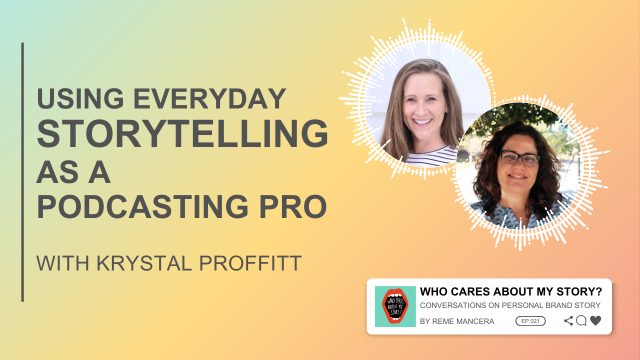
Using everyday storytelling as a podcasting pro, with Krystal Proffitt
Using everyday storytelling as a podcasting pro
Have you ever wondered if your everyday moments are worth sharing? What if the smallest stories could be the key to building deeper connections with your audience?
Today’s guest is Krystal Proffitt, a Podcast Coach, Content Strategist, and host of the award-winning show The Proffitt Podcast. She specializes in helping content creators create with confidence, and she recently hit the milestone of publishing the 500th episode of her own podcast!
In this episode, we cover how sharing your own story can help your business progress in unexpected ways. Krystal shares how her journey from stay-at-home mom to podcasting expert highlights the importance of relatable stories.
Krystal emphasizes that storytelling doesn’t need a big, audacious life event, because simple, everyday moments can create meaningful connections with your audience.
We talk about:
– The relatability of storytelling and how little pieces of your life can help your audience feel more connected to you.
– How getting practice with storytelling can make it second nature and help you share your journey in a way that feels authentic rather than flustered.
– Krystal’s approach to creating valuable, understandable content and why you don’t need to talk about every technical detail.
Join us for this episode as Krystal encourages you to find the fun in storytelling and shows you how even the simplest stories matter when they’re meaningful. Learn how they provide you with new ways to connect authentically with your audience.
Links and resources
🔗 Krystal’s links:
– Website: https://krystalproffitt.com/
– The Proffitt Podcast: https://krystalproffitt.com/podcast/
– YouTube channel: https://www.youtube.com/@KrystalProffitt/
– Instagram: https://www.instagram.com/krystalproffitttx/
🔗 Reme Mancera’s links:
– Website: https://www.rememancera.com/
– Instagram: https://www.instagram.com/rememancera/
-Linkedin: https://www.linkedin.com/in/reme-mancera-postigo/
-Youtube: https://www.youtube.com/@rememancera
🔗 Ready to gain clarity and confidence in storytelling? Let’s explore your 10 Story Connectors: https://www.rememancera.com/story-connectors/
Who is Krystal Proffitt?
Krystal Proffitt is a Podcast Coach, Content Strategist, and host of the award-winning show The Proffitt Podcast. She specializes in helping content creators create with confidence. Having published over 1,450 podcast episodes, she knows what it takes to keep creating year after year.
Krystal teaches content strategy, repurposing, branding, and marketing through her podcast, digital courses, and YouTube channel dedicated to content creation. She has also appeared as a Content Expert for brands like Podcast Movement, Buzzsprout, Ramsey Solutions, Amy Porterfield, and Streamyard.
Who is Reme Mancera?
Reme Mancera is a Personal Brand Story Strategist and the creator of the 10 Story Connectors framework, a strategic storytelling tool to choose which personal stories to share so they build trust, create genuine connections, and lead to clients.
She is the host of the podcast Who Cares About My Story? and the live series Intersection Chats
Who Cares About My Story? Podcast - Conversations on Personal Brand Story
Interviews with amazing guests about how sharing their stories has impacted their businesses. We cover the benefits and the behind-the-scenes challenges you face in deciding what to share, without oversharing or pretending to be someone else.
Subscribe now and don’t miss an episode!
Who Cares About My Story? Podcast 021 - Transcript of the episode
Reme: Welcome to Who Cares About My Story? I am delighted to have you here, Krystal. Thank you very much for accepting this invitation. After all this year following you, it’s such an honor to have this conversation.
Krystal:
Yes. Thank you so much for having me, Reme. I am delighted to be on your show today, but I’m really excited to just talk about storytelling and content. And this is this is one of my favorite topics. So thank you for having me.
Reme:
Nice. So before we start going into the topics, let’s introduce yourself just for those who don’t know you, who you are and please tell what you do.
Krystal:
Yes. So my name is Krystal Proffitt. I am a podcast coach and content strategist, and I’ve been creating content in some form or fashion for the last I mean, it is gonna sound so wild to me. It’s almost been ten years of having dabbled a little bit in blogging and had no idea what I was doing. I still say I’m not a great blogger, but it’s like that’s kind of, like, how I started and then eventually found this beautiful thing called podcasting where I could actually just speak into a microphone. I didn’t have to write anymore. Are you kidding me? Like, this was totally, like, a game changer for me. So I started a podcast in 2018.
Krystal:
It was about female entrepreneurship and storytelling, and then I was getting so many questions behind the scenes on. Wait, but how are you actually podcasting? How does this whole podcast thing work? What are the logistics? What content or, you know, software do I have to have? How do you make this work? And I was having more fun answering those questions behind the scenes than I was answering the questions on the interviews that I was doing or really engaging with you know, the people I was interviewing, they were so informative. They were so motivational, but I had to follow my heart and my passion, and that was helping people behind the scenes. And I’m so glad that I did because here we are. I mean, to this day, I’ve had multiple podcasts. I recorded over 1,400 episodes, which is wild to me. And I have a YouTube channel that also teaches about podcasting and tutorials and all kinds of things, and we have over we’re getting close to a million views that we’ve had on our YouTube channel, which is really fun. So that’s another piece of it is I just love content in general, whether it’s audio, it’s video, it’s visual storytelling, it’s just audio storytelling.
Krystal:
I love it in all forms. So I’m just happy to share more about my journey.
Reme:
Amazing. So how do you think sharing your own story has impacted your business?
Krystal:
Oh, that’s a really good question. I think for me personally, because, and I didn’t really even throw this into this part of the story, but I was a stay at home mom and, like, I had three my three little ones, a few of them were in school, but I had one that was home with me when I actually started my podcast journey. And in sharing that, I think that, you know, they’re all in school now. Like, you know, like, none of them are at home with me, you know, to this day. I’m so grateful that they’re in school because I don’t like, it was one of those things that’s really hard to balance, you know, like, caring for the kids and, you know, trying to get this thing off the ground. So if anybody’s listening and you’re in that stage of life, like, please don’t give up. Like, keep moving forward in your passions because it is very rewarding to have something that’s yours from a creative standpoint and something that you can do just for yourself because that’s what it was for me. Podcasting was a creative outlet.
Krystal:
It was something that I could explore. But back to your question, Reme, like, it really helps other people really feel relatable to my story. And that’s one thing that I’ve always had people tell me is, like, you’re so relatable or you always share stories. There’s one in particular, and you can stop me at any time if you’re like, Krystal. I know this is about storytelling, but stop telling so many stories. But there was one
Reme:
Please!
Krystal:
where I just, I just casually shared in one podcast episode, and it I did had not planned to share this, but I just said, oh, I was in my bedroom closet on the floor wrapping Christmas presents, and I was rewatching Emily in Paris. And I just so happened to throw that in there.
Krystal:
I don’t even know why. Why, like, why that had nothing to do with anything other than that’s probably why I was late to record that episode or why I got distracted. It was like, I was sitting in the floor watching Emily in Paris. I got so many people reach out to me and say, oh my gosh. I love Emily in Paris. Or, oh, yes. I was wrapping presents in my, you know, floor the other day too. So I think when people think of stories, they think that they have to have this big, audacious, life changing moment or this incredible story that is just like, oh, they’re gonna create a movie about your life because it’s so interesting.
Krystal:
And I think that’s such a big hill to climb, if you wanna call it that, or such a big mountain that it feels impossible, and storytelling can feel really overwhelming at that point. So I love to just share the everyday of how I love a almond milk latte, or I love to hang out with my dogs, or I spend so many hours of my life in this office. It’s like all these little pieces of your story that are relatable can really help your audience relate to who you are and what you do.
Reme:
100%. And I always, tell that to the audience how you don’t need an epic story. 100% agree with that. And then how you can look for stories, and meaningful moments in your journey that will help to highlight, like, who you are, your values and. When it comes to personal brand story, how that is related to your offering. So you can connect that. I’m finding that and using as a bridge to talk about your benefits and that. So I have clients using their Story Connectors in their sales calls because they want to address a specific objection, and they have their stories.
Reme:
And they know when to use them in the sense of they know why they are sharing that specific story. So when you have a reason, it’s so helpful to use your stories in that way because it’s not just about facts of data, but also that’s emotional element and relatability. Right?
Krystal:
Yeah. And I think that it also just it quickens the process of someone getting to know you that much faster. You know, we hear about the know, like, and trust factor or people, you know, like, maybe they see you online, but then they don’t really know anything about you other than your offers or this and that. But then they say something like, oh, I love to do pottery on the weekends, or I love to go to this specific restaurant and eat this type of food. It’s like these little pieces of your story that just in someone else’s mind make you a more rounded person automatic. Even me just sharing today that I was a stay at home mom and I have three kids. I actually have three boys, like and that’s another thing. It’s like, oh, somebody listening will be like, oh, a boy mom.
Krystal:
Like, I’m a boy mom too, and I understand what that’s like. And maybe they trust you a little bit faster. Or the other piece is maybe they’re curious to learn more about you because they’re like, oh, that’s and she does pottery. I actually don’t do pottery on the weekends. Let me let me, like, just clarify that. I don’t do that. That would be fun. But it’s just one of those things.
Krystal:
It’s like, oh, that that makes that person a little bit more interesting. I wanna learn more about them. So whether that drives them to, you know, your website, your podcast, your content, like, it just really gets that spark rolling and can help you differentiate yourself from other people that are in your industry or doing the same thing. Because now all of a sudden, they may know me as like, oh, Krystal, she’s a podcaster. She’s a boy mom. She likes almond milk lattes. Like, you already know so much more about me than you did when we first started this conversation.
Reme:
Yeah. Exactly. And sometimes it’s like, I am thinking of specifically one of my clients. She’s a web designer, and she used gardening as one of her topics because one of her Story Connector meaningful moments is her just sitting on her garden, having a glass of wine, enjoying the work that she did in the previous season, and how that’s connected to her clients when they get the website that she made for them, and they are just enjoying the results of that work that they did in this intensive. So you can play also for using it as a for example, analogies, and all that. So you can play a lot with the stories, and you know a lot about the stories. I know because all these episodes, so and all these content that you have shared all over the years. Right?
Krystal:
Yeah. But I also think it’s really nice because this is one thing I love about what I do is I get to get really meta in what I teach and what I talk about because even what you just did, Reme, is so beautiful is you bringing in other people’s stories to the whole framework of what you do and what you teach. So it’s like you talk about a client story in that way of how they do it, and it just makes it that much more in someone else’s mind. You immediately say, like, oh, Reme has clients. Reme works with people. Like, she is a trusted source. She is someone that so it’s like there’s so many layers and levels of how storytelling can impact your business. But at the end of the day, I think that the number one thing for me is to be fun because I love work to be fun.
Krystal:
So I always add in fun stories wherever I can. But, also, I think it’s just that authentic piece and keeping it very just real. I don’t like it when people start talking in, like, really ambiguous themes or they start talking about things that are like, it’s like it’s not like I never want someone to even question what I’m saying in a way that makes them doubt the words that are coming out of my mouth. So and I do think that that’s people that if they’ve learned online marketing or if they’ve learned a business from maybe they just found that wrong educator or that wrong person, wrong influencer, we’ll use influencer in quotes, online, and they told them a strategy to try, and it immediately just disintegrated all the trust that someone would have had in their brand. Like, it’s really hard to come back from that. So I just always default to do what feels true to you. If you were gonna say it to your mom, your best friend, your brother, like, that’s how you should also show up online because it makes a big difference in how you appear to your audience as well.
Reme:
Mhmm. And I love that you mentioned that, first of all, the fun and creativity because you can feel that being near your brand and your and your content. And then also, I know from the community how everyone is highlighting, how you make things so easier, and how you make the when you are explaining things about podcasting and you are you are making translating to us so easy to understand language, and that’s really appreciated, especially when you are a beginner and you are overwhelmed, by all the information that is out there. So that’s really useful as well as a way to help your clients and your audience.
Krystal:
Yeah. Well, let me let me give you a little behind the scenes, Reme, and for your audience. I don’t like complicated things. I don’t like things that are confusing. I don’t like it. I understand things at a technical level. I wouldn’t say I’m a total beginner when it comes to technical things, but I don’t like it when someone speaks to me in this really technical language where I’m also, like, googling words on the side or asking ChatGPT, like, what does that mean? What are they talking about? So whenever I’m creating my content and, again, this goes back to who I want to show up as authentically. I don’t want someone to watch a YouTube video or listen to one of my podcasts or even read one of my emails and say, what the heck is she talking about? Like, I need to go look up five other things before I can even translate this information.
Krystal:
So that, again, is how I’ve decided to show up in my brand. There are way more technical things that I could go into when it comes to podcasting. We could get into the audio engineer stuff or the really fancy technical, like, the decibels and the waveforms and, like, all that stuff. I don’t care enough about that, y’all. Like, that’s really what it comes down to is I don’t get excited talking about that, but I do have friends in the industry that do. So I will tell you, go watch their content, go check them out. Here’s a link to their podcast because they get into that. I don’t wanna get into that because it’s not fun for me.
Krystal:
So if you have a specialty or you’re in an area where there could be some technical pieces or things that you know you probably should talk about in your content, but you don’t really wanna venture there, it’s okay to touch on it lightly and then offer other resources even if it’s someone else’s PDF guide or a freebie or their podcast or whatever. Because I think for me, I just wanna be the most valued resource that my audience has when they think about podcasting. So even if that’s me just referring really awesome other resources, other books, other podcasts, other things to go check out, I’m still that main trusted resource, but my value just gets even higher and more increased in my audience’s mind if I continue to offer value in multiple different ways and not just this is my offer. This is what I’m selling. I think just show up and add value can just be an incredible place to start wherever you are in creating your content.
Reme:
Love that. Because it’s like, you don’t need to pretend to be interested in areas of your expertise that you are not. And you can chime talking about the things that are interesting to you and still provide value, and then having resources to go in other direction when they need to. So, yeah, I love that. Thank you for sharing that point, because I think it can be really valuable to think about, okay, what is what you are in really interested about your topics and going into that. Be, yeah, genuine about what you share. Right?
Krystal:
Yeah.
Reme:
So what would you say to someone that could be wondering who will care about their story?
Krystal:
This is a tough one because I think that, I think that this happens to everyone. So whether you’re a beginner or you’ve been doing this for a long time, like, maybe you’ve had an online business or you’ve been doing something and you’re thinking about sharing your story or maybe you haven’t shared as much of your story previously and now you’re deciding to open up a little bit. The thing for me when I think about who’s gonna be listening or who’s going to be a part of the audience, I think that I always go back to how do I wanna show up and how do I want my message to impact one person.
Reme:
Mhmm.
Krystal:
And this, you know, goes into maybe you’ve heard about an ideal customer avatar, an ICA. You’ve heard about customer personas. Like, all of those things we’ve thought about as business owners. Or if you haven’t thought about them, I encourage you to do, you know, go do an exercise with ChatGPT and be like, what’s a persona? How do I create one? Because that can really help you understand who you’re talking to.
Krystal:
When I think of the who behind who I’m talking to when I’m creating content, I always go back to a version of myself that is either a few years ago or when I very first started. So what I mean by that is I will create content and it’s different. It’s not the same for every single piece of content because some of it and I’ll call it out. I will call it out specifically and say, hey. This episode today is specifically for beginners, or this is a episode today specifically for more seasoned people. So if you’re if you’re just a beginner, you may wanna come back and revisit this when you you’re more seasoned, but there’s lessons in this for everyone. So it can be a little complicated when you’re trying to develop a story or you’re trying to develop content related to a place where a specific person may live. But I think if you only talk to one person and you don’t, like, really paint a picture of that one person’s whole journey, then that’s where it can feel like, I feel like I’m saying the same message over and over and over again.
Krystal:
And I think this is what I did by mistake when I first started. I kept talking to people that were on day one of a podcast journey. It’s like, okay. You’re starting. You’re starting. You’re starting. And then I got about six to twelve months into that, and I had several people that were like, Krystal, we know. Like, we’ve started.
Krystal:
We we’ve all started. Thank you so much. You helped us. Now what do we do? Like, now what’s the next step? So that’s what I mean when you can’t just talk to someone that’s on a day one journey forever because, eventually, they’re gonna be on day two or they’re gonna be on day 100, and they’re gonna need those next pieces of advice from you or they’re gonna need those next steps. So whenever you’re thinking about a person, even if it’s still one customer, one ideal persona, you have to think of them as a large just breadth of their entire journey and not just this is how they are and they’re never gonna evolve from this one place. Does that make sense?
Reme:
Yeah. A lot. And also because it’s also thinking about how the people that started with your content has evolved. But, also, there are new people coming that that beginner content will be useful. So you are extending the life cycle of how you are helping people, but it’s kind of the same type of group of people because they are in different stages of their journey. Right?
Krystal:
Yeah. For sure.
Reme:
So, you are a podcast coach expert. You have recorded so many episodes as a host, but also as a guest. So I would like to know your opinion. How do you think sharing your story help build trust with new audiences when you are a podcast guest?
Krystal:
Yeah. I think when you show up, it is different. Right? Because even in preparing for our conversation here today, before we started recording, I was asking Reme. I was like, okay. What can I do to, you know, really connect with your audience? Because I think that a lot of people, when they do guest on other shows, they just go in and they talk like they’re still on their own podcast or they’re still you know, it’s the same audience, but it’s not. And I think that you could really miss a lot of opportunities if you just talk to someone or talk to the audience in the exact same way because I will tell different stories on this show than I would to an audience that is more technical, but I’m trying to get them to come over to the more, like, content storytelling side. So I think that when you’re guesting on in anyone else’s content, having that approach of you could still tell the same stories or you can still have the same, like, let’s just call it your signature talk story that you go and you tell it on all every single podcast, you’re gonna adapt it to that specific audience because if you don’t, you’re gonna miss an opportunity to connect with them. And I think that, you know, Reme, to your point about just having guested on so many different shows, I think that there were a few where I just showed up as the same, and I kinda said the same stories.
Krystal:
And then afterwards, I listened to them, and I was like, oh, I kinda sound like a robot. This was early in my journey, and I was, of course, so nervous to go. Yes, you can believe I was nervous to tell my story when I first started because I didn’t really know what I was doing. And I flipped through it, and I messed up multiple times or got timelines wrong or got things switched around, and that’s okay. Like, I think that practicing telling your story can really help you just feel more confident in doing it and getting on other people’s content and guesting is the best way to continuously tell your story in new, fun, creative ways because your audience, they’re gonna know it. Like, after you, you know, there’s only so many times that you can tell the exact same story the exact same way every single time, and your audience is gonna get sick of hearing it over and over. So I encourage anyone that’s listening to get out and guest in other people’s content because it challenges you in a different way than creating your own content. It’s just different, and I think it’s good practice to get out there and try telling your story in different ways.
Reme:
Yeah. And something that I invite people to do is just checking how you are do because I believe that you do a really good job in adjusting your story on how you introduce yourself for the different audiences, because I have listened episode where you were in podcast for writers, and there you are talking about certain parts of your story that,
Krystal:
Yes,
Reme:
if you are in some other area of, more around businesses or mompreneurs or any other topics, you are adjusting how you are introducing yourself based on your own journey. You are not making up stories. It’s just based on the same journey, but highlighting certain aspect that will resonate more with your audience. So that I believe that’s really important to do, and I think you are a great example of, just checking how you are performing in in different podcast is a really good, exercise to learn how to try to apply that to yourself.
Krystal:
Yeah. And I think too, Reme, I don’t know if you teach your audience to do this, but one thing that’s really helped me in being able to do that is having a running list of stories. And I will have a Google Doc, and it just has a ton of stories that I can use. And sometimes I’ll use it in other people’s content. Sometimes I’ll use it in mine. Sometimes I have a specific, like, oh my gosh. This would make an incredible newsletter, or this would make a great Instagram post, or this would make a great episode. So I don’t really hold it so rigid as, like, a process that, like, oh, I have to have a spreadsheet and it has to be perfect.
Krystal:
It needs to be a, I just kinda let the ideas loosely flow because there’s things in there that I may never tell those stories. But there’s other ones that there are opportunities that come up, and this is so silly. I’m actually gonna tell this story. If you don’t mind, this one this one’s actually really funny because I was watching a movie last night with our 12 year old son. Watched a movie and he, like, his brothers were gone, and he was like, oh, let’s watch a movie that we can’t watch because he’s almost 13. So it’s like a PG 13 movie that he wouldn’t be able to see if his younger brother was home, and his older brother may not care to see it. So we were watching it, and it was a football movie where the football players ran and they slid in the mud.
Krystal:
Like, it was a super muddy field, and they ran and they slid, and they were having so much fun. And I turned to him and I said, oh my gosh. I’ve done that before in a cheerleading uniform. And he was like, what? What are we talk like, why did you do that? And I remember thinking, so this is an exclusive, like, first here. I was like, I have to I totally forgot. I had totally forgot that that I was 15 or 16 when that happened, but that made me think, oh, that’s a great story to tell. And I went and added it to my, like, story vault if you wanna call it that. And I just immediately thought that is an incredible story.
Krystal:
I need to go tell that somewhere. So I encourage anybody listening, have a, you know, Google Sheet, a doc, whatever it is, and have a running list of stories. That way you always having content that you can add to different pieces of your business where it will make the most sense.
Reme:
First of all, thank you for sharing the story. And second is, like and then you can go a step more. And for example, I know that you are in your content, in your About Me page, you are talking about you are how you are cheering others from a young age. So using that as a way to I keep sharing other to do good, to share and express their messages in a fun, creative way, and how that’s connected to that idea that we might have about being a cheerleader and supporting others and all that. Right? So even you share the story, but also you can go and share about the connection with who you are, what are your values, what is the skills that are natural to you, but are valuable for your clients and your audience. So all of that, yes, think about stories. Have a space where you save them. But then when you are going to share them, think about how they are connected to what you do, how they are connected to your audience.
Reme:
That way, you will be more certain about sharing them because you know the reason why they are connected to that and how they will provide context about who you are and what you like to do.
Krystal:
Yeah. Yeah. I love that. I love having the connection pieces because you made such a great connection. I’m like, oh, yeah. I do talk about on my about page as a so I was a cheerleader since four years old. That’s what it was. I was like, I know I put something on there.
Krystal:
So that is great. That’s such a great point, and I need to go and do that. So when I tell this story, I’m a be like and Reme reminded me that my about page has cheerleading on it, so there’s the great connection.
Reme:
It is. Yeah. So what about as a podcast host? How do you think sharing your story build listener like, build connection with listeners?
Krystal:
I think it just goes back to the relatability pieces. People whether it’s, like, you know, the concept of, like, mirroring to where someone can say, oh, Krystal talked about she’s a parent. I’m a parent. Maybe she understands those same struggles. Or if I talk about my brothers or, like, oh, I have brothers too. I understand those struggles. Or I live in Houston where it is very, very hot in the summertime. So it’s like I could talk about all of these different little pieces of my story.
Krystal:
Again, it’s not those big, robust, like, you know, someone should go write a movie about that tomorrow story. It’s really just those little relatable pieces of it, and I think that just continue to look at your, here’s an exercise everyone could do. Sit down today when as soon as you’re done listening to this and write down what you did this whole day leading up to listening to this episode. Maybe you drank a cup of coffee or a cup of tea this morning. Maybe you walked your dog, maybe you went to the gym or you went on a walk, maybe you put your you know, walked your kids to the bus stop or, you know, to get on the school bus, or maybe you’re a single person in your apartment and you got in got on a train and you commuted to work. Like, whatever it is, start writing down those pieces of your day because those could be the stories that you can share in your content. Again, in your Instagram posts, in your newsletters. It could be the beginning of your podcast episode or your YouTube content, but just really work that muscle and getting used to noticing pieces of your day that you can turn into content later.
Reme:
Yeah. I love that exercise. I think that also something that could be valuable is to have a space where you can share like, a safe space or safe group of people where you can share your thoughts and ask for feedback and have, like, a soundboard soundboard? How do you say that? Like, they they they can give you the feedback and you can practice, but it’s in a space where you are not just recording and sharing. If you are not comfortable, start by doing it easier for you with friends, with peers, if in a community, wherever it is that you feel that, okay, they will understand my point. They also give me, like, constructive feedback. Right?
Krystal:
Yeah. And I think another piece I’ll go one step further. And I actually have a friend who’s a speaking coach. I always give her a shout out. So shout out to my friend, Heather Sager, because she’ll say, once you’ve dialed in your story, practice it. So whether it’s you’re speaking in the mirror or you’re speaking to your dog, like, she was like, I’ve held my dog hostage and just, like, said, like, you’re gonna listen to me and, like, at him, like, just speaking at him or if you have you’re going on a walk and you speak to yourself. But doing the actual work of practicing it out loud makes all the difference. And I wish I would have known this sooner because for me, when I finally figured out kinda what my story was, I just wrote it.
Krystal:
I wrote it down. I was typing it, and I just had it in a digital form, but I was not actively practicing saying it out loud on a regular basis. So like I said, those first few interviews where I went on to other people’s podcast, I really stumbled through my story because I was like, well, I did this, and then I did this. And I jumped around, and I probably confused the audience because I was confused myself. But the more that you practice, once you you’ve nailed down your story, you know the important pieces that you wanna share that maybe ties back to your business strategically, start saying it out loud. Practice it. Practice it. Practice it because that’s the only way to get better.
Krystal:
It’s exercising that storytelling muscle and making it to where it feels like you’re almost doing it on autopilot.
Reme:
Yeah. Absolutely. And this is something that I also work with my clients closely because it’s like we are practicing. I help them to identify their 10 Story Connectors, but then before we finish the service, it’s like we are going to practice how to share it, how to see different angles. And you get to practice. As you say, start sharing it in different ways, thinking about if you are going to be in a podcast tour or going to different podcast. Think about how you are sharing for different audiences.
Reme:
And just trying to start with the story in the beginning of the story or in the middle or turnaround. So try to play with it and really integrate the story in a way that for you will be easier because you know. First of all, you know the story because it’s your life. But then when you are practicing how to express, how to articulate that in a way that is interesting, but not just interesting, but also is conveying the message that you want to share. Right? Because that’s, like, really important, especially in personal brand story. It’s related to our business. It’s related to what we do. So we want to convey certain elements.
Reme:
So practicing to in a way that is helping us to get used to that so it’s natural for us.
Krystal:
Yes. Yes. I totally agree with that. I think that that’s a great great approach for all of it.
Reme:
Mhmm. Thank you. So for those who think that they might be something natural, like storytelling is something natural, I would like to go to one of your stories. You shared that in a podcast about how you had this creative writing class, in high school.
Krystal:
Yep. Yep.
Reme:
So I would love for you to tell us a bit about that because I feel that there is a connection with how story now storytelling is so important to you and how you do all this content creation and helping others to create that. So please tell a bit about this story.
Krystal:
Well, it’s funny because now that I’m thinking about it, I’m like, oh, now that you specifically asked about that story, I’m actually gonna give you the even further behind the scenes. So this is like an exclusive. Again, you’re getting all the good things here, Reme. But I was taking classes in high school that could, I was so hard on myself. I was a straight a student. Like, I’m gonna, you know, do all this, make all these good grades so I can get into a good college because I was the first one in my family, my siblings and I, to go to college. So my parents never went, their parents never went to college, so it was a really big deal. I was like, I’m gonna get into college.
Krystal:
I’m gonna do these things. So I was taking all these really hard classes, and then I got to a point where the you know, went to a counselor at the high school office, and they were like, well, you actually need an extra credit because you’re missing a credit for I don’t remember what it was like an elective or something. And I was looking at all the options. I was like, I don’t wanna take any of these classes. I wanna take, give me something that’s gonna give me a higher grade so I can get into a good college. And then finally, my counselor was like, well, there’s always this creative writing class. Like, the teacher isn’t terrible. You know? Like, why don’t you try that one? And I was like, fine.
Krystal:
I did not wanna do it because I hated my English writing classes. I hated those classes. I was terrible at it because they always told me, your grammar is not great. You don’t have you know, you can’t go through all of these proper English exercises and do a really good job, so that was pretty disheartening. I thought that I just didn’t have a lot of really, really the skills in my mind to have an incredible writing career. So I was like, why would I ever take this creative writing class? Because I just was doing okay in my regular English writing classes or my English grammar classes. But what this teacher specifically did was she took all of the guardrails off of writing that I had previously been told. Like, you have to spell correctly and you have to have proper grammar.
Krystal:
It needs to be, you know paragraphs need to be structured this way. You need to have a beginning, a middle, and end. And she came in and was like, I don’t care if you just write blah blah blah blah blah because what that’s gonna do, we would have these prompts of, like, write about what you did yesterday. I’m like, that’s dumb. Like, why would I do that? And I was so against this class. I was so I was like, this is so stupid. I don’t wanna do this. This is not fun.
Krystal:
And that ended up being the class that changed my life. I still do the same creative writing practice today. I skipped a few years in my college days, and then I picked it up again later in life. But it’s something that I mean, I’ve been doing it for over a decade. I write a single page in my notebook every single day, and I journal. And some days, I still write, I don’t know what to write about, but something will eventually come to me. Oh, yeah. I stepped in dog poop yesterday, and here’s what happened.
Krystal:
Here’s how that unfolded. But to your point, Reme, I think it’s that constant it’s that storytelling muscle. It’s that writing muscle. It’s just getting ideas out of your head onto paper or if you wanna do it digitally. I still write in my notebook every day, And this is the part that everyone always thinks where I’m just totally bonkers, but I handwrite my emails to my audience every Friday. So if you’re on my email list, those are handwritten first in my notebook, and then I translate them to the digital side because I want my emails to feel like it is a pen pal. Like, I am writing directly to you, and that is still the only way that it comes out so naturally to me. So it’s I’m writing at 05:30 in the morning, and I’m journaling in there.
Krystal:
It’s my weekly email. I actually did it yesterday, so that that’ll come out on Friday. But I write it down, and then it just feels, again, so natural, so relatable, so real, and that those are the things that I’d lean into. So that was, again, the long story of my creative writing class, but I think it is an important one because it wasn’t something that I was excited about. I don’t think of myself as a gifted writer from the beginning. It’s been a muscle and a journey that I’ve had to go on myself, and it’s one that it’s just so fulfilling to me. Even if I stopped podcasting today and never picked up and, you know, recorded anything else, I would still continue to write because it has been that powerful in my entire journey in my life.
Reme:
That’s amazing for several reasons, but one that I want to highlight is how it’s connected to this idea of this is a muscle. You practice and you get better. And even if you are not a natural, you can get better at it just by practicing. So the same with sharing your stories. You at the beginning might feel like stuck. I’m not sure how to tell it, but, yeah, you keep the blah blah blah going, and then you get to get better and more comfortable and that. I do a lot of networking. I go to networking events, and I always say that that has been a really good practice for me for introducing myself. Because you are there, and every time you need to introduce in these small rooms, every time you need to tell who you are, what you do, you can add some story, whatever.
Reme:
So it is so helpful to practice, and maybe you are reading the faces and people are putting faces that they are not getting.
Krystal:
Yes.
Reme:
So you can go back. And the next time, it’s like, yeah. I need to get better at this because people are just not understanding what I do or how I help people. So the same for the stories and storytelling. You keep practicing. You will get better.
Reme:
You will see what stories give more, like, interaction from people in the sense of the response that you get, how it’s impacting others as well by sharing your own story. So yeah.
Krystal:
Yeah. And I think another piece of that too is I always like to say that I pay attention to what I consume as well. So I sit back and ask myself, oh, what are the stories that I love to hear? And what, like, what really connects me to the podcast that I listen to or the YouTube channels that I watch or the newsletters that I read? Like, what are those pieces? And I realized, like, oh, so much of it like, different ones serve different purposes. Sometimes it’s I want I listen to that because it’s funny. And sometimes I listen to that because it’s motivational and inspirational, or I follow that person because this. So if anything, like, start paying attention to the stories that matter to you and just ask yourself why. Why do these matter? And then you can ask how can I take that into my content and translate it for what makes sense for my audience and what I’m creating?
Reme:
That’s an amazing exercise to follow, just analyzing what you like and how you interact with other people’s content. So I love that. Thank you for sharing that that insights. So now a question that I like to ask to all my guests. Please tell us, which part of your personal brand story surprises people the most?
Krystal:
I think and this is this is so funny. I’m sure you’ve probably heard this before, Reme, but my actual last name is Proffitt, like, P r o f f i t t. And people are like, that’s gotta be, it’s a stage name or something. And I like to tell them, I met my husband at college. We were actually roommates or not roommates. We were not roommates. We were neighbors, and we lived in the same apartment building. I lived on the Second Floor here, and he lived on, you know, downstairs here.
Krystal:
And, when we first met, we both realized we were going to business school. We were going to the same business school. And when he told me his last name was Proffitt, I was like, show me your ID. I just did not believe him at all. It’s, like, immediately, and he does not remember this. He when I’ve asked about it, you remember that, right? He’s like, no. You didn’t ask to see my ID. What are you talking about? But it’s just so funny because people are like, Proffitt is really your last name? So I know it’s such a simple one, but people get, they’re like, why do you spell profit weird? I’ve had so many people ask me that.
Krystal:
Like, you know you misspelled it on your pod. I have my, my podcast is called The Proffitt Podcast, and people are like, you know you put an extra f and extra t in there. I’m like, no. That’s actually my last name. Like, that’s my real last name. So it’s actually really fun. It’s a fun icebreaker for me too is when I’m on stage or when I’m on guessing on someone else’s podcast, I can kinda throw that in there as, like, yes. Proffitt is my last name. Yeah.
Krystal:
It’s spelled with two f’s and two t’s. So it’s a fun way for people to remember me as the person that’s speaking to them, but also just kinda loosen everybody up a little bit and be like, oh, okay. Like, well, we’re gonna have fun in today’s conversation. This is gonna be a great segue.
Reme:
Yeah. I love that because it’s a nice way to just showcase your personality by sharing that in the way that you do because it’s also talking about. Because it’s not like someone is telling that you misspell and you were offended or serious about it.
Krystal:
Right.
Reme:
You just, like, take it easy and just, show how you are in, like, your personality. So I like that. Yeah.
Krystal:
Yeah. Well and I think too, you know, it’s one of those things, and this is another kinda trick for anybody that’s listening, is you’re calling out the obvious. Right? Because it’s like, my last name is Proffitt. It would be the same thing if my last name was cash or money or is that, like, something like let’s call out the obvious. Like, lean into it. Don’t lean away from those things. So if you have a name that’s different or unique or you have a part of your story that’s different or unique, don’t avoid it. Like, lean into it because I think that that’s the those are the pieces that differentiate you from everybody else on the Internet or everybody else doing what you’re doing.
Krystal:
Lean into those things that make you different because that is what will help people remember you and the content and the everything that you’re doing with your message.
Reme:
Mhmm. Yeah. And something that I invite my audience to do and I invite you too, is to think about your own work experience, like past work experience that is totally unrelated to what you do now
Krystal:
Yeah.
And look for lessons that you are still using today. I know that you were working on construction in your corporate, and it’s like, I’m sure there are stories there that are useful now in the sense of things that you learned or things that you know that you don’t want to approach in that way. Or so it could be easy.
Krystal:
That’s for a second I’m thinking of, like, things that I don’t wanna repeat, things that I don’t wanna do. Yes. You’re right, though. There are some lessons there that I need to share.
Reme:
So I invite people to go in that direction because it’s always, like, you will create examples that are unique because that could be other podcast coach, but they might not have the same life experience. So bring stories about your own journey that will make things easier for you because it’s just you know them. You can connect that them with why you were, like, in that past experience and having that moment of, oh, I don’t want to do this in this way. That’s telling things about your values. It’s talking about your approach to work in that past work experience, but also now. So it’s a nice way to talk about what is important to you and how you do things, and you don’t need to talk all the time about what you do now. You can bring that from different experience experiences in your life.
Krystal:
I mean, I’m thinking about this. Even just our conversation today, we went back to when I was 4 years old talking about cheerleading till I went to high school, 15, 16, to, like, what I’m doing today. So absolutely. Like, just tie in all those pieces because, again, just rounding out who you are to your audience or other people’s audiences will help them decide very fast. Like, oh, I wanna learn more about that person, or they may not be for me and that’s okay. But just being willing to show up and be exactly who you are, I think, is really the message to take away.
Reme:
Wow. Thank you so much for all this conversation, all the insights for being so generous, just sharing advice and things to think about and even exercise. So for people that are listening and they want to learn more about what you do and what you have in there to help them, please share where they can find you.
Krystal:
Yeah. So you can go to krystalproffitt.com. That’s Krystal with a K, and Proffitt has 2 F’s, 2T’s, .com. And you can learn more about. Uh Reme, she’s mentioned it a few times. So we have a podcast podcasters connect community, and it’s a membership that you can join as a free member. You can join as a premium member. But it’s really this place that we’ve we’re growing a culture of supporting each other and really leaning on each other to navigate this podcast experience because it is unique.
Krystal:
It’s not like any you know, it’s not like just showing up on TikTok and creating videos. It’s about creating those deep, meaningful connections with your audience and how you can really translate all the storytelling that Reme is teaching you and turn it into a profitable podcast that can help sustain your business while also bringing in leads for anything that you’re selling or anything that you’re trying to do with your business. So please come hang out with us. At least go over to krystalproffitt.com and figure out a way that we can connect together, but you’ll find resources to all the things that we have there.
Reme:
Thank you. I made sure that the link is in the show notes so this is easy for them to go there as well. So yeah. Just, thank you very much for this. Has been amazing.
Krystal:
Thank you so much for having me, Reme. This was so fun. I will chat with you about storytelling anytime because this is, it’s such a fun topic. So thank you for having me.

Want more conversations like this?
Explore more episodes of Who Cares About My Story? where my guests share how telling their personal brand story has impacted their business, and how they’ve faced the challenges of deciding what to share and what not to, especially pivots in their lives or businesses. Here are a few examples to get you started:
- Sharing your story as part of your healing journey, with Nancy Diaz | 002
- Overcoming fear of rejection when telling your story, with Kim Gross | 012
- Sharing your real story despite the fear of losing clients, with Laura Vegh | 027
If you’re ready for more, explore the full podcast library for honest conversations, real stories, and practical insights to inspire you to share your voice and amplify your impact.
WORKING REMOTELYInternational

GET IN TOUCHContact
WORKING REMOTELYInternational
CONNECTSocial links
Reme Mancera · Personal Brand Story Strategist
Copyright © 2018-2026 Reme Mancera. All rights reserved.