Shifting from arctic guide to wild brand expert, with Rebeca Hazelnut
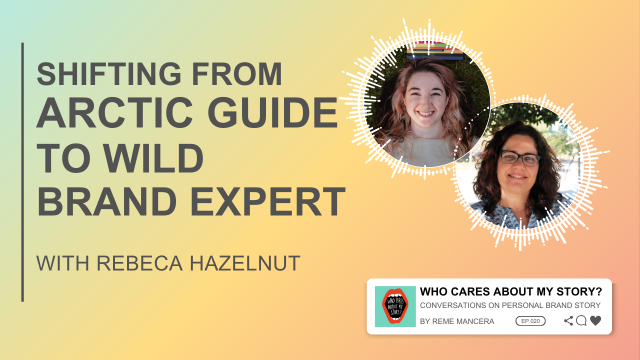
Shifting from arctic guide to wild brand expert
Have you ever felt like your past experiences had nothing to do with your current path?
Today’s guest is Rebeca Hazelnut, a personal brand guide and business mentor, specialized in brand identity and strategy.
She has a really unique background as an Arctic guide, so we talked about the transition into personal branding work, and how she eventually started using the power of storytelling to make her business stand out.
Rebeca, like me, is a Spanish speaker, but we recorded this conversation for the podcast in English. Aside from Spanish and English, Rebeca also speaks French, Russian and Norwegian. She has learned new languages as a way to connect with other cultures and people. This was useful in her life as an Arctic guide and now as a brand strategist working with people globally.
In this episode, we cover:
– How Rebeca’s career shift became the cornerstone of her personal brand, proving that every story has value, even the ones that seem unrelated to your current path.
– Rebeca lets us in on her initial hesitations to share about her background because she was worried that it had nothing to do with her current work. But embracing her full story ultimately strengthened her brand.
– We also talk about the power of transparency in business, from sharing financial realities to building a brand that’s both authentic and memorable.
Rebeca’s journey is an inspiration to any entrepreneur looking to weave their own story into their brand narrative. Tune in to explore how storytelling can powerfully impact your business and resonate deeply with your audience.
Links and resources
🔗 Rebeca Hazelnut’s links:
– Website: www.rebecahazelnutstudio.com
– Instagram: https://www.instagram.com/rebeca.hazelnut/
– Sign up for Rebeca’s newsletter (La Cara Norte) on her website.
– COTAS ALTAS is Rebeca’s business-branding-and-sales mastermind to take your business to the top of the peak: https://rebecahazelnutstudio.com/bienvenida-salvaje/ Note that Rebeca’s content is in Spanish, but you can contact her in English as she works with clients globally in English as well.
🔗 The podcast episode mentioned about looking up to people: https://www.emancopyco.com/podcast/mai-kee-tsang
🔗 Reme Mancera’s links:
– Website: https://www.rememancera.com/
– Instagram: https://www.instagram.com/rememancera/
-Linkedin: https://www.linkedin.com/in/reme-mancera-postigo/
-Youtube: https://www.youtube.com/@rememancera
🔗 Ready to gain clarity and confidence in storytelling? Let’s explore your 10 Story Connectors: https://www.rememancera.com/story-connectors/
Who is Rebeca Hazelnut?
Rebeca Hazelnut is a personal brand guide and business mentor, specialized in brand identity and strategy.
She is passionate about brands that are disruptive, that know exactly where they’re headed, and that focus on leaving their own mark: unique and inimitable. Brands that position themselves naturally when they recognize their authority and communicate it openly. Brands that create a world of their own that’s a joy to be a part of. People who are authentic role models, far from being a clone of a clone of a clone. That brand could be you.
Who is Reme Mancera?
Reme Mancera is a Personal Brand Story Strategist and the creator of the 10 Story Connectors framework, a strategic storytelling tool to choose which personal stories to share so they build trust, create genuine connections, and lead to clients.
She is the host of the podcast Who Cares About My Story? and the live series Intersection Chats
Who Cares About My Story? Podcast - Conversations on Personal Brand Story
Interviews with amazing guests about how sharing their stories has impacted their businesses. We cover the benefits and the behind-the-scenes challenges you face in deciding what to share, without oversharing or pretending to be someone else.
Subscribe now and don’t miss an episode!
Who Cares About My Story? Podcast 020 - Transcript of the episode
Welcome to Who Cares About My Story? I am so happy to have you here, Rebeca. Thank you for accepting this invitation. Thank you for inviting me. It’s good to be here. Thank you. So could you please share a bit about who you are and what you do? Sure. I am Rebeca Hazelnut, Rebeca Hazelnut for Spanish speaking audiences, which is usually my audience. I’m a brand strategist. I focus on personal branding specifically, and I’m also a business mentor and I specialize in brand identity and strategy. Cool. So can you tell us about your story? How did you get here? Well, my story or my background has almost nothing to do with what I do today. In fact, before becoming an expert on branding, I was an arctic guide, which basically meant that I was a guide for ice climbing tours, fat bike tours, anything that you can think of that is done outdoors in the cold winter especially. I spent some, some years in Finland, in the Lapland area. And that is what I used to do. So, it’s like sports and design has always been in my life, but I started with sports first. And how was that moment of pivoting front one thing to something totally different? I mean. It was not necessarily very, very new to me, but, I felt that at some point, I felt the end of, how do you call it, of an era, I guess, or of a part of my life, which had been very fulfilling. But you know, things need to end and things need to finish sometime. And I really, really wanted to reconnect with my artistic, creative side. So that’s, that’s what I did. And I started first with visual identity. You know, usually when we say branding, everyone thinks about the logo, the colors, so that’s the visual identity. But branding is a lot more than that. But I started with, you know, being a designer basically. And, you know, as time passed, I discovered that there was a lot more, and I got interested in the brand strategy and the verbal identity and, you know, everything else that has to do with brands, basically. I don’t know if that answered the question. Yeah, of course. So how do you think telling your own story has impacted your business? It has been the best thing I’ve done because when I started I just wanted to fit in. I wanted to, I wanted people to look at me and say, oh yes, she’s the designer. So I was, I guess trying to mimic what I saw from other designers. But soon I realized that that was not really for me, that I didn’t enjoy it that much. And it was also a moment in my life where I was missing a lot, this more adventurous lifestyle that I used to have, right? Compared to what I do now. And I thought that, you know, this, my previous life didn’t have to be hidden or didn’t have to stay in the past in a way, if that makes sense. So I decided that, or I guess I realized that that was a part of me. And that I was going to use it, and I felt very, I felt a little uncomfortable at first because I thought, you know, who is going to care about this? Right? Who is going to hire someone that had nothing to do with branding some years ago? But actually it has been one of the main reasons why people has hired me, among other things, of course, and also it has been the kickstart of my personal brand and my positioning as a personal brand. So it has impacted a lot in a very good way, I would say. Yeah. Nice. And I love that process of first maybe trying to hide and then embracing that. I work with clients that are navigating a transition and it’s like, that process is also helping you understand your own journey somehow, and then you can communicate that to the other people, to your audience and the power, the impact that that can have, right? Yeah, absolutely. And, and I think people get really. I didn’t mean it to be inspiring, but it, but it was in the end and I was very surprised when people were like, wow. It’s, it’s just funny the impact that’s something like your story can have, even when it has nothing to do or it might have nothing to do with what you’re doing now. It’s, it connects in different ways, right? Yeah. It connects more emotionally or, or you surprise people sometimes. And, and I think that’s great as a business too. Yeah. Like for a more remarkable, unforgettable brand that’s, yeah, an asset for your business, right? Yeah. Can you recall a specific moment when you realized how impactful it was to share your story? I cannot pinpoint a moment in like the beginning, but, recently, some months ago, I was a speaker in an event that was taking place in Amsterdam for Spanish speaking audience and a few internationals, like from Amsterdam and from other parts of Europe. I shared my story and people after the event came to me and told me, wow, I had never thought that this could be something that you could use in your business, you know, and people, they were a little bit like shocked because they never thought they could use their story in that way, right? And they were telling me like, whole world has opened now for me because we are very lost in the beginning when it comes, especially when it comes to personal brands I feel. Well, yeah, both personal and corporate brands, but I felt that it was worth sharing. I felt that it encouraged people to share their own stories and see the value on that it has, and the same impact that it can have on their clients as well. Like, it’s a win-win situation, right? It’s not only about me telling how cool I am. You know, but also encouraging clients and other people in general to be themselves and do things their way and embrace what they have lived so far. Yeah, And I totally agree on that. It’s like when you see how leading by example, right? You are sharing your own story, they see the value, they see how powerful can be, and then it’s like, okay, maybe it makes sense that I share my story and the way that I work on personal brand story is not just one big epic story, but 10 moments of your story and each of them, they are connected to a key factor of what you offer. So when you said that is like your past experience is bringing a lot of information about your values, about what is important to you, about your unique approach to work. So each of those moments of your story doesn’t need to be like an epic Hollywood style, how I call it, story, but it’s a moment in your life that is bringing lessons. You can share the emotions that you live there, and all of that is helping connecting that relationship with your audience. And it’s that human to human conversation. Absolutely. Absolutely. Yeah. So what would you say to someone who is wondering, who will care about their story? I would say more people than you think will care about your story. And, and I would say they will care because they will see themselves in your story. Yeah. You might tell your story out of ego, but in the end, people connect to others because they see themselves there as well. But it’s just natural, it happens with human relationships, right? So it’s not, it’s not something to be demonized because it’s business, because it’s used to a business. I think it’s something natural and if you do it well, you will. Very good things will happen to you, I would say. Yeah. And it’s also, since usually why we start our businesses there are an impactful why, there is a meaningful why there. So it’s like helping your business to evolve and to grow is also helping that impact to grow. So, yeah. Yeah, absolutely. So when sharing your own story, have you faced any challenges that you didn’t expect? I’m not sure. Challenges in the sense of maybe rejection you mean? Inner or external challenges that you were not expecting those situations. Well, I guess at the beginning, I guess it was a bit hard to find the connection between my background or my previous life, I guess, and what I was doing, what I’m doing at the moment. So there was some time where those two things were just separate. But eventually I connected them through my creative concept or brand concept. And then it was like, the perfect fusion, right? It was the perfect mix. And, yeah, but I don’t know. I didn’t face any rejection. I don’t know, honestly. Yeah. It’s okay. Bringing back what you just mentioned about your creativity, creative concept, because this is something that I wanted to ask you about. I read one of your posts where you were talking about that, which is like Marcas Salvajes [Wild brands]. I love it. And how this was born from reconnecting with your story. So could you please share a bit about that process of building that idea or creating that concept? Basically I, you know, my adventurous life before I became a brand expert, had a lot to do with the wilderness. So eventually I came up with this word, Salvajes, right? And before using Marca Salvaje [Wild Brand] as part of my brand, there was something else that was born that I launched and that was an adventurous experience for entrepreneurs. So we basically, I organized I think it was three nights, four days, kind of what would you call it? Well, yeah, adventure, because we were not going to any luxurious and comfortable space to just, how would you call ‘retiro’ again? Retreat. Retreat. Yes. Thank you. We would not go there. We would go to the wilderness. We would sleep outside and the participants did not know any of the activities or any of the schedules like it was just a way to reconnect with ourselves, with our brands. But, yeah, it was focused on disconnecting from the noise and the digital world. It was just after Covid, so we all needed it a lot. So, and that experience was named Salvajes. Oh yeah. Wild ones I guess. You would. And I think this is how it was born. And then from that the name I felt it was so much me, that I took it as part of the brand. And even though there hasn’t been any other experience again like this, at least for now, I took it for my main branding service, like the most complete one and which is Marca Salvaje. And after a while, I think like one year after that, I decided to take a break from social media. I’ve had enough. I’ve had enough of everyone telling me what to do. I’ve had enough of also being unhealthy consumer of social media, I would say, right? Like I was consuming more than I was bringing to the table, and I didn’t like it at all. So I took, I think two months and before I said goodbye for a while, I remember, I just changed my Instagram bio and I wrote La de las marcas salvajes, the Wild Brand one, something like this. And I did it just out of, I don’t know, I don’t want to think what to write, like I’m just fuck off. And, but it stayed there, right? And then people would remember it and it impacted a lot. And then when I came back, I had so much more clarity and I felt like I connected with my inner authority. And then I was like, yes, yes. I’m that person. This is my label for now. This is how I want people to remember me for now at least. So, yeah. Yeah. More or less that this is how it was born. Yeah. Beautiful. Something that I like because yeah, I am kind of collecting creative ways to use your personal brand story. And yeah, of course you have the About me page, you have the content creation, if you go as a guest to someone else’s podcast, or community, public speaking, so and so, but also how you can use it in a more creative way, let’s say in your photoshoots, let’s say in your onboarding processes or even in your sales calls. And I love how you use it for naming your services. And it’s not just the creative concept, but also how it’s everywhere. Even when you go to your website, there is this feeling there. So I love how it’s like, it’s so evolving when you go near your brand and you feel that. So yeah, congrats on how you have been able to share that feeling. Thank you. Thank you. It has been a process. Of course, this was not from night to day. Suddenly, I have this cool concept and I’m going to apply it everywhere. Like, namings have evolved and new ones have come. And it has been a more of a long process for me. I guess if you hire someone to do this work more intensely, then of course you can come up with something like this in a shorter amount of time. But I have really enjoyed it and it has also, it’s like I feel words are so powerful and names are so powerful. And the more I’ve become aware of this, the more intention I put to all the namings of my services. And I don’t have a lot of services, but people remember the name. Yeah, so yeah. Thank you. It’s like, yes. Yes. We’re doing it good. Yeah, we’re doing a good job. You’re doing it. So yeah. Back to this idea of the inner authority, I would love to know your opinion. How do you think sharing your story can help someone in connecting with their inner authority? I mean, in my case, my story is also a lot about not doing what I’m supposed to do, if that makes sense. It’s not like I did anything illegal, but let’s say people get surprised by the paths that I’ve taken sometimes and I have just followed my instincts, I would say. So for me, it is important that the people who work with me or whoever listens to my story that they connect with their inner instincts and that they follow them because yeah, strategy is great and planning is great and it’s important, but I think at the end of the day, you have to do what you want to do, not what everyone tells you. Yeah. So I think there’s a lot of, there’s so much information, there’s so much we want to learn from others that we sometimes don’t listen to ourselves so much. So I think that’s, that’s, What was the question? Yeah. It was about how sharing your story can be impactful for your own perception or your authority, that inner authority. Yeah, I think that’s what I would say. I hope that it inspires others to follow their own path and, yeah. And sometimes do things they didn’t imagine themselves doing. Yeah. And I think, because this is a topic that is coming back in different episodes about all the shoulds, when you run a business, all the different messages that you are receiving and how it’s important to stop and find your own definition of success and what is important to you. And then finding your own path because sometimes looks like there’s just one way of doing business. And that’s why I love to have the opportunity to listen from different guests. And everyone has a different story, but also everyone has a different way to finding their business path and make things work for them, even if it’s not like what the guru is saying about what you should do. Absolutely. Absolutely. I think we have too much noise. And it’s healthy and it’s good for you and for your business to sometimes take a step back and try to think for yourself. And I say it from my experience, I love to grow my business together with other people and to have mentors. And because I learn a lot, I get sometimes new ideas or other perspectives that help me learn and grow, but at the end of the day, it’s my life, it’s my business. And no one else knows better than you what you want. And, yeah, we hear a lot of things about earning 10K a month or earning six digits a year or whatever. It’s like, yeah, sure. But, for what? Yeah. For what? Like, yes, I want to, I want to be making 10K a month. Yes, I do, but is it only because I want to earn 10K or is it because I want to have more time and I want to have a team that helps me run the business a bit more smoothly? Do I want to buy a house? Do I want to have a garden? What do you want to do with that? Yeah. Yeah. I totally agree. Like. For some people, maybe the money is the goal, but for some others, and I include myself there, the money is the tool to achieve what I really want. So it is like, it’s a tool, is the way of doing it, but my goal is in another place, so I need to always make sure that how I’m doing things is helping me to move in that direction. Sometimes that means earning less money, but it is helping me to move forward in my real goal, even if it’s not the general that it seems like the right one to have. So, yeah, I absolutely agree. And speaking of, yeah, go ahead. I just wanted to add that I think yes, we do see a lot of those messages. But I think ultimately it’s your responsibility. Like there is nothing wrong with people saying come to my program and I will help you get to 10k a month, right? It is a matter of you knowing what you do it for. That’s it. So I feel that sometimes we blame them as well because of those messaging or those messages. But if you know what you want then, why the fuck not? Yeah. You know? Yeah. Maybe you want, maybe you want 20K a month. Yeah. This is fine. Yeah, yeah, of course. But you are right in the responsibility of when we are deciding with who we work, the message is that is also appealing to us in the way that is convenient for us in this moment or helping us to decide to move forward or to get to the next stage that we want to. And yeah, and speaking about money, I want to bring here, because I think this is something really different and I really like that approach of transparency that you do this money revision, the money of your business, the number of your business that you do every six months. How did you start doing that? What was like the first, How this idea came out? I think, I’m trying to remember ’cause it’s been, at the moment we were recording this, it’s been about two years that I’ve been doing this. And I think it just, well, as you said, just to give some context to whoever is listening, every six months I do a live, free live in Zoom, where I share everything, like everything of my business, all the numbers, the how much have I paid myself, what are my profits or not profits, what are my expenses, what is my income, everything and the decisions I’ve made, blah, blah, blah. So it all started, I think, because I felt and I still feel that there’s a lack of transparency in business in general, and there’s a lot of people unfortunately thinking that they are less because others seems to, other people seem to be doing a lot better than them and with experience and with talks and with and conversations, you realize that there’s a lot of appearances. Would you call it like that? Like, there are many facades for many brands, not all of them, obviously. And they’re not obliged to share anything like this, but I just felt it was very sad that in the business world, everyone is talking about how well I’m doing or keeping up those appearances while in reality it may not be true at all. They might be struggling a lot with money, with their team. They might not be having great results with their clients or the other way around. So basically I just wanted to say, okay, I cannot do anything to change them. I don’t want to, they’re free to do whatever they want and however they want with their business, but I can do this with my business. So it’s, I think it’s a way to, how would you say it in English to ‘poner mi granito de arena’ Like, making your part. Yeah, I guess. To do the best I can to improve that situation and to give some relief, some reality, some transparency to other people. And I did it first because I felt like doing it. And my numbers were not great at that moment, I can tell you that much. I was not paying myself a salary. My numbers were very far from whatever good numbers are in our minds for business. But I still wanted to show people that, yes, this is my reality and this is my context, which is different than yours, than yours, than yours. So in the end, it gave people perspective. It gave relief, not because I was doing bad or because I was doing good, but because I was telling the truth and they understood that there’s a lot that we don’t see. Yeah. And I did it once and people liked it. I loved it because if it had not been for that, I do graphics, you know, I do like, compare year after year. Not just with numbers, but with graphics. It’s so visual, it’s so easy to understand and to take, make good decisions based on that. That I just kept doing it. And then people have also, like, some people after that told me, oh, I’ve done the same graphics as well. It’s great. And I don’t know, I feel like I’m improving a little bit the situation just by doing that. And, it’s great. And now it has become like a recurrent thing in my brand. Yeah. Cool. And also something that you just mentioned about how important it is to have the context because we can see data without the context and we are not able to really understand what means that data for that business if we don’t have enough context. I was listening to someone else’s episode about this same topic, and I feel that’s so important to have that like really present when we are as a consumer, as an user, getting the content from others to think about, okay, do I have enough information about what is happening? Besides what I see here, I’m probably not. And in the same time, how important it is providing context to our audiences and how sometimes you can use your own story to share that, to show that context and so people can understand better your journey and how you have made some decisions that now make who you are as a business owner, right? Absolutely. Yeah, I think it’s very important and, and at least I want to lead by example in those things because yeah, I think otherwise it’s just very unfortunate that people compare themselves just by what they assume. And so many times it’s not necessarily wrong, but again, without context. Yeah. So we don’t have all the information. And those assumptions also are usually putting you down, right? You put the other person above you and you’re putting yourself down. Yeah. No man. This is not how I want things to work, so I’m not doing it like that. Yeah. Something that I listen also in a podcast, because of course I love podcasts. Someone was sharing how they have changed the way how they look after people. And instead of saying that they look up to someone, they look, they were after. It’s like they are more advanced in the path, but not above me. Just in the same level. Just they have been doing this longer or they have been doing in a more effective way or whatever, but this, like, they are ahead of me, but not above. Yeah. And I think that’s interesting, like changing the angle in the sense of Yeah, it’s the same, it’s not someone that I can admire people and, all that, but that doesn’t need to mean to me that I feel less. Yeah, exactly. And, also we don’t see the whole picture when we see someone else. So yeah. Context. One question more. Have you ever worried about sharing too much? And it can be about money, but also about emotionally or any aspect really. Yeah, not often. I’m a chill, I’m a chill person too, so that helps. But for, for example, in this live zoom that where I talk about money, some, I’m sure some would say that this is not strategic or that this is not beneficial depending on, well now maybe it is because now I’m doing good as for now. But when I started it was not great, not great numbers, and a part of me was afraid to people judging me or clients not buying my services because they might think, oh, you know, I thought you were doing better, so this means that you’re not such a good professional. You know, things like that. Also when sharing my story, I guess, sometimes, but at the end, I am, I guess I’m, I’m someone who’s a little bit stubborn, maybe more than a little bit, and I have a lot of, I believe in myself a lot, so I constantly want to prove myself that yes, I can do things my way. And this is how I want to do it. Because I feel it inside of me and then I don’t care about what people will say and it turns out nothing happens. You know? Or if there’s people who in fact think that I don’t like this girl, she’s sharing too much or whatever, then they’re not my clients and I’m okay with it. They don’t have to be. Yeah, and I believe that just from a strategic point of view, I believe that it is strategic in the sense of you are sharing, it’s transparency. And as a wild brand, I will hope for you to be authentic no matter what, and sharing. Like the nature has the amazing wonderful thing, and then the terrible and scary things as well. And both of them can give this awe but yeah, they are like, if you look at it as good and bad things and they bring both of them. So I feel it’s like really, really aligned with your brand in a sense. So, I know what you mean and I really admire because I think this is an exercise of vulnerability, like big exercise of vulnerability, but in an just strategically, I feel the connection there. I feel the value there. Yeah. Thank you. So, now a question that I like to ask to all my guests. What part of your personal brand story surprises people the most? Well, probably the fact that I was an arctic guide. And doing ice climbing surprises a lot because I’m a small girl, I don’t have a fierce appearance I would say, maybe the opposite for some people, and they don’t expect this wild side. I also used to play rugby, but I also used to play ballet, sorry, not play, dance ballet. So yeah, I have opposites that are not opposites that much, if that makes sense. So people get surprised by this. Yeah. Yeah. IWhen reading your about me page was like Yeah, the Arctic guide. Yeah. I don’t know any other Arctic guide that was surprising but then rugby and dance and it’s like, wow, there is a lot of different lives in your life. Yeah. I think that’s so enrichful, like this is bringing a lot of meaning and different angles and new perspective. Also you share at some point how you learned different languages to be able to connect with cultures and people. So yeah, there is a lot of adventure, but also this looking for connection as I can see from outside your brand. Yeah, yeah, definitely. Okay. So this has been a pleasure. Thank you very much. Before we finish, please share with us how we can learn more about you and your work. Yeah, I mean, my communication in social media is mostly in Spanish, but you’re most welcome to reach out to me in English. I also work for English speaking clients in Norway, which is where I live at the moment. But also everywhere in Europe and, and yeah, worldwide. So anyway, you can find me on Instagram mostly, @rebeca.hazelnut or if you go to my website is rebecahazelnutstudio.com And in my newsletter as well. It’s called La Cara Norte. It’s like the North face. Uh, not like the brand, but sort of also like the brand. But yeah, it’s where I share most of my inner thoughts about business, about branding, about life as well. This is where people can get to know me a bit more, I would say. Okay, perfect. I will make sure to share all the links in the show notes and descriptions so people can go and check it out. So thank you for this. It was a pleasure. Thank you. Thank you, Reme.

Want more conversations like this?
Explore more episodes of Who Cares About My Story? where my guests share how telling their personal brand story has impacted their business, and how they’ve faced the challenges of deciding what to share and what not to, especially pivots in their lives or businesses. Here are a few examples to get you started:
- Sharing your story as part of your healing journey, with Nancy Diaz | 002
- Overcoming fear of rejection when telling your story, with Kim Gross | 012
- Sharing your real story despite the fear of losing clients, with Laura Vegh | 027
If you’re ready for more, explore the full podcast library for honest conversations, real stories, and practical insights to inspire you to share your voice and amplify your impact.
WORKING REMOTELYInternational

GET IN TOUCHContact
WORKING REMOTELYInternational
CONNECTSocial links
Reme Mancera · Personal Brand Story Strategist
Copyright © 2018-2026 Reme Mancera. All rights reserved.