Personal Brand Story and Curiosity,
with Reme Mancera and Laurie Kozan
How do you make your personal brand feel memorable and human when so much online content sounds generic?
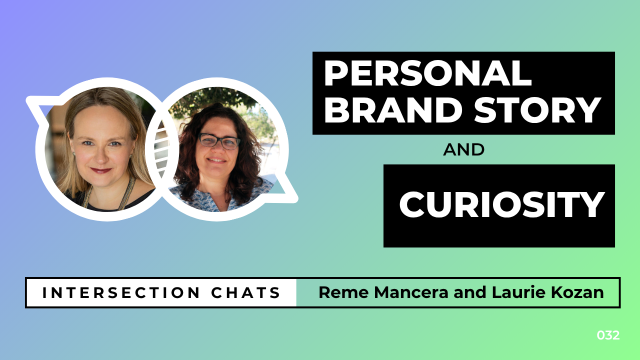
In this episode of Intersection Chats, I had a conversation with Laurie Kozan, brand strategist, about the connection between personal brand story and curiosity.
We talk about how curiosity can help you communicate your work in a more intentional, differentiated and aligned way.
We cover storytelling, positioning, self-awareness, boundaries, visibility and how to use your lived experiences strategically in your business.
Personal Brand Story and Curiosity
Here are 3 questions we explore:
1. Have you ever wondered what actually makes your approach different from others in your industry?
We explore how curiosity can help you uncover the experiences, values, natural skills and perspectives that shape the way you work, so you can communicate your unique angle more clearly and attract more aligned clients.
2. Do you struggle with the idea of storytelling because you don’t want to overshare online?
We talk about how storytelling can be intentional without feeling performative, and why authenticity does not mean sharing every detail of your life.
This conversation highlights how you can choose stories strategically, adapt them depending on the audience and communicate your message while still respecting your own boundaries.
3. Have you ever felt like your previous experiences are too unrelated to your current work to be relevant?
Past jobs, hobbies, childhood moments, cultural experiences and personality traits can become meaningful parts of your personal brand story and help people better understand your perspective and approach.
As always in Intersection Chats, this conversation is grounded not just in theory, but in real-life examples, client experiences and reflections from our own journey working with storytelling, branding and visibility.
Who is Laurie Kozan?
Laurie Kozan is a brand and marketing strategist who helps founders, experts and independent consultants attract more of the people they really want to work with, by learning what to say about what they do.
Laurie’s work is built around the conviction that the way we communicate has real power — to create clarity, community and change. Using her background in PR, marketing, graphic design, and intuitive coaching, she develops brands that align expert perspective with audience desires, so selling feels easier + business works better.
A mother of three, Laurie is especially good at spotting synergies, coaxing order from chaos, and taming competing priorities. Like any good parent, what absolutely lights her up is helping others figure out what they uniquely contribute to the world — and setting them up with the tools to do it really, really well.
Who is Reme Mancera?
Reme Mancera is a Personal Brand Story Strategist and the creator of the 10 Story Connectors framework, a strategic storytelling tool to choose which personal stories to share so they build trust, create genuine connections, and lead to clients.
She is the host of the podcast Who Cares About My Story? and the live series Intersection Chats.
Personal Brand Story and Curiosity - Transcript of the episode
Welcome to Intersection Chats. Today, we are going to talk about the connection between personal brand story and curiosity. I am really excited about this conversation. I am Reme Mancera, a personal brand story strategist. I am here today with Laurie.
Thank you so much for accepting this invitation. Oh, it’s great to be here. Thank you for having me. So please tell us a bit a bit about yourself. Okay.
Well, as you said, I’m Laurie Kozan, and I’m the founder of Source Marketing Studio. And I am a brand and marketing strategist, mainly working with solopreneurs, and founders. So I’m really excited to talk about, how our work intersects because there are lots of synergy between what we do. Yeah. Absolutely.
So let’s start there. What has been in your experience, the connection between personal brand story and curiosity? Curiosity. Well, I think it’s just, it’s a matter of making it feel more real and more and more relevant, because it’s about kind of digging into what’s actually going on behind behind the scenes. You know, these days, we’re in in such a wonderful time when there’s so much opportunity because of the Internet and social media and just, you know, all of the the access that we have to connect with people outside of our, kind of daily lives, you know, in person daily lives is it’s it that’s not new.
But what it means is that to take advantage of that opportunity, we we need to say something, and that connects with the people that are right, that helps us actually find the right people for us to work with. I mean, there’s there’s so much opportunity there, but you do have to kind of take advantage of it in a particular way. And I think that’s where the curiosity comes in is that you you really kind of have to dig a little bit deeper, to find the stories behind you know what you do and also the stories behind what makes kind of other people tick and what and and and how they think about what it is that you’re offering and I think that’s the thing that’s the key, and it’s it’s it’s personal brand story in terms of, like, where you’re coming from, but I think it’s also finding that intersection. There’s that word again, between, you know, where you’re coming from and also where you’re kind of right fit clients or customers, are coming from and finding the intersection between the two to really create that connection that you need. Yeah.
I feel like that’s, so key using the personal brand story as a way to highlight what you do and why you do that. Mhmm. And I always like to to invite people to think about their unique angle. How they do things in a different way. No matter if you are doing something that other people offer, you have a unique combination of your values, your personality, your background.
So bringing that to the attention of people so they know and they understand, okay, why this is important to you and how you do it in a specific way. Exactly. Because I think, you know, there are as you say, there are lots of people doing your your type of work, but no one will be doing it in exactly in exactly the same way. And I think, you know, because that’s so inherent to us, you know, that’s the way that we’ve always been. That’s not that’s not new to us.
So I think a lot of us actually have, trouble recognizing the fact that we do actually have something interesting to say about why we do what we do or how we how we got to be the way that we are now or why we approach something in a particular way. And I think that’s where the curiosity comes in is is that ability to kind of stop and think, well, where did that actually come from? Because that’s then when you understand that, that’s how you can actually explain it to other people. And I think there’s something actually quite magnetic about being that self aware. I think it helps people trust you a bit more if you can actually you can actually really explain the why and the and the kind of detail and the the justification behind why you do what you do.
You know, you didn’t just pull it out of thin air. And it gives them more of a reason to choose you, specifically because there will be other people. You know, no one has exactly the same set of experiences, but there are kind of parallels in our lives, sometimes. And there’s, you know, different people who’ve maybe experienced something similar, that will actually resonate with them, whether that’s, you know, something about, you know, how you were earlier in your career or your family or, you know, the fact that you’ve traveled a particular, you know, to particular places or you’ve lived abroad for a while or, you know, whatever whatever it is. I’m thinking of my own experience now.
But, you know, that all of those things have kind of fed into, why you do what you do. You know? So so thinking about that, you know, I have working in branding and marketing and, I started my career earlier in, public relations. So there’s lots of it’s all kind of related, but having those different perspectives and the fact that, you know, I’ve lived in a few different countries, I have, you know, I’m married to someone from a different a different culture and and background and, you know, having traveled there and lived in different places and and raising a family. It’s just given me lots of different ways of understanding that you can look at life from a few different perspectives.
And that now really informs my work because this idea of creating a brand strategy is about that in finding that intersection, that kind of sweet spot in between where you’re coming from as the person making the offer, and the person who is on the receiving end of that. And knowing that there are often two different ways of looking at things, but it’s that you can meet at the sweet spot in the middle. And, you know, having lived life with having to understand different perspectives, that’s really helped me with skills really so that I can apply that to working life. And I think that’s really helpful because oftentimes, we do need that translation piece. I often talk about my work in sense of in the sense of being that translation piece because oftentimes, when you’re really good at something, you forget what it’s like not to be good at it, and you need to be able to kind of step out of that perspective and put yourself in the shoes of someone who actually needs help with that and doesn’t know, you know, the terminology or the real reasons behind something.
And you have to be able to find different perspectives. So, you know, that’s just kind of an example of how but it it’s taken me a long time, you know, so through learning about, you know, coaching processes and just different exercises of of being very self aware, to kind of get to that point. So Yeah. And I love that you bring this idea of how things can be so natural for us that we overlooked. Because this is something that I love to to explore with my clients is, like, how something that is a natural skill that you have.
You even know you don’t notice because it’s so natural to you. But then it’s so valuable for your clients because it’s something that is really, really in the way that you work is really valuable for them. And I love to analyze with them, like, okay. Let’s go to your journey and identify other moments when Mhmm. This skill has been useful for others.
Maybe your family, maybe in different work experiences, or in your academic background, and how that same skill was useful there. Because Yeah. I feel that that is helpful to understand that maybe you know some methodology or some framework. Yeah. But on the top of that, you have natural skills that are combining with that, really bringing a lot of value to the way that you work with your clients.
So for them to understand that that’s something natural, using something unrelated, but bringing that idea of this is a natural skill that they have. Yeah. And also asking friends and family and formal colleagues and things like that. What are the things that you always help them with? What are the things that they look to you for?
Because maybe it’s maybe it’s slightly different than what you thought it was, or maybe what they’re getting out of that thing that you did is something maybe a little bit different. Like, maybe you’re the person who always organizes the events or something like that, and you were thinking of that as just a, you know, a really practical skill. You’re, you know, making maybe, you know, making things a little bit easier. It’s an organizing type of thing. But, actually, for them, it makes them feel really seen and looked after in quite a deep kind of way.
And that kind of level of emotional insight behind it, that’s a different type of connection and that makes what the way that you talk about your work resonate in a completely different way than just saying, oh, well, I, you know, make sure all the boxes are ticked and and the reservations are confirmed and things like that. Like, it’s it’s a whole different it’s a whole different level. And it’s, you know, might not apply in every situation, but when it does, it’s really quite powerful. Yeah. Something as well to think about is, like, what your clients are telling you and, let’s say, analyzing the testimonials on how there are certain words or sentences that they keep coming.
And I have an example from a client of mine. She has this innovative way of looking at things. She help people with, clarity, especially around career coaching. And she has this innovative way of looking at things, outside the box. And when exploring her journey, something that came up was how when she was a a child in one of these school projects, she was, combining a rainbow doll with a remote control car because she want to to create something different and to put this together and that.
That’s a little story, but this is so powerful to highlight how her brain was looking for other ways of looking at things and make things happen. And, again, this idea of how this a natural skill, and she’s a solving problem person. And this can be a little story, but it’s a meaningful moment. It’s something that highlights certain skills that she has. She can explore these and share the same story in different angles in a way that is highlighting certain things.
The same can happen for for other people. I I always like to think about what are the different angles that you can share the same story. Maybe you are highlighting specifically something different there depending on what is the who is the audience that you are talking to at this point Or who is the environment? What is the goal of that conversation or that communication? So I feel like there is also the the aspect of curiosity.
Not just in bringing a visual scene that you can remember, of course, that will help with memorability. But I feel like also, you know, when you create open loops and then it’s like people get interested and get curious to hear more. How you can I invite people to think about, okay, how you can do that when you are sharing a story in a way that you pick people’s curiosity, make them, I want to learn more about this? I am curious now. So Yeah.
I feel like that we can play with that. This is something really important to me, and I would love to know your thoughts on that because for when I would start in my business, I feel so overwhelmed by the idea of storytelling. Because I feel this was something see use, and I need to do in a certain way and and all that. And then through my work, I have explore different ways to do storytelling and how this can be something intentional, but at the same time, true to yourself. You can put your boundaries, sharing the things in a way that makes sense for you and you’re comfortable.
Yeah. But then I went deeper and I was like, this can be something actually joyful. If we can play with the idea of storytelling and sharing stories in a way that we enjoy, because we play with how we tell the same story. We play with how we be in the senses to to the story nuances. So I would love to know how has been your process around storytelling and and trying to make it more enjoyable, if you will.
Oh, that’s really you said so many things that I went that I wouldn’t follow the tangent on. Okay. But let’s let’s talk about that, like, in terms of a process. I think what you said, you said something about, like, the different angles and and and playing playing with, how you approach different stories. And I think that and and also you said something about boundaries.
And I actually think that they kind of go together because oftentimes, as you say, not everyone wants to share everything about their life. And it can feel quite overwhelming and you don’t know and also you don’t know where to start. It’s like, and what does storytelling even mean? So I think there are a few things there and I think it’s really helpful to think about. And this is why it’s so important to come at it from especially when you’re when you’re talking about storytelling, you know, from a business standpoint, if you’re, like, you know, creating content around your, to try to try and build your business.
It’s important to remember that lens, not from a just because it’s it’s helpful to funnel, you know, to not to have a sense of focus. It’s all that’s always the case. You know, it’s really hard to create from a completely blank page, but it’s actually easier to create within constraints. So you’re thinking of it in terms of almost like a puzzle, you know, putting together. Okay.
Well, what is what is the this the the brand story that I wanna tell you? You know, kind of, like, the bigger picture angle. What’s my positioning? What am I trying to convey? How do I want people to see me?
And that’s not that’s not like from an icky or inauthentic place. It’s just it’s just strategy. You know? It is it is business at the end of the day. You are trying to convey a particular impression.
You want a a particular type of person to hire you to do a particular type of thing. You know, you know, it’s positioning. So how do you want people to see you? And you can shape your stories around that. You can then you’re you’re picking and choosing, the stories that support that.
So maybe you are telling the stories about what you did as a child or a particular challenge that you overcame when you were, you know, training for the marathon or whatever it is, you’re showing different parts of your life that show how different parts of your personality came about. And maybe you’re not talking about the tantrum that your kids had at breakfast or whatever it is. Like, you’re not you know, you don’t have to be telling everything. It is okay. And I think, you know, these days we talk so much about being authentic and showing our personalities online.
And I think, I understand why people talk about that so much. And I think I do think it’s important, but I also think that some people can find that really, you know, it’s really quite overwhelming to think like, I don’t want to share all the bits of my personality. I don’t want to, I don’t have everything figured out yet. No, I haven’t overcome all my challenges. And if I’m talking about something that I’m in the midst of it, You know, some people can can talk about that really really well and they’re quite comfortable with that.
And some people would rather talk about it on the other side. And I think that it’s important for us to realize that that’s okay and it is okay to kind of, you you know, you’re not being inauthentic if you’re picking and choosing what you’re what you’re sharing. It’s it’s okay, you know, to to keep some things for yourself or to choose, you know, when you’re ready to to share those things. So I do think, you know, you can think of it like, you know, you’re talking to, you know, people on the internet who you might end up developing lovely relationships with, but, you know, you’re not talking to your therapist. You know, so I think I think it’s okay to be shaping the story that you’re telling.
And that’s part of why it’s important to have a good sense of, you know, what your what is your core brand? You know, when you’re when you’re telling when you’re talking to people about their their personal brand stories, you’re helping them choose the particular stories that support the overall brand, you know, image positioning that they’re trying to convey. You’re not trying to tell everything about their life. You’re you’re doing it in quite a strategic way. And I think that’s I think that’s really important.
And also, you know, you might have your kind of 10 big stories, your story connectors that you talk about. But when you’re doing your daily storytelling and your content, of course, you can be repeating those and it’s good to repeat yourself, in terms of brand consistency. But storytelling can also be just be like a little line or a little, you know, a little opening moment, a little vignette, something like that. It doesn’t have to be, you know, you don’t have to write a fairy tale every time you post on on LinkedIn. It can just be a little moment that makes your point a bit more colorful.
It makes it resonate a bit more. It brings some you know, you were talking about, I think, like, the senses. You know, what what were you tasting or or seeing or, smelling? What did it you know, what did that moment look like in a quite a vivid way? So I think there are different I think I I love the idea of thinking about it like a puzzle.
You know? How are you having these these kind of real human moments to support, maybe the the bigger picture that you’re trying to communicate? So Yeah. I love that. And this idea of how you can be authentic and respect your boundaries.
And also, I always like to bring this idea of how you can share the sensory in different ways. Mhmm. Mhmm. I like to use an example of, a surgeon. How she might have a surgery that went well and how she’s sharing the same idea Yeah.
Okay. This is going well with the family of the person that she made the the surgery to. It’s going to be different, the conversation with her peers and how she’s going to share about how this going well. Very interesting. How she’s going to share with their family and with her family when they are having breakfast.
She Yeah. And, yesterday was super good. I did a difficult, thing and was super good how the result was. Yeah. So the same moment and it’s something important to her, but how she’s going to share totally different.
The same for you, for us when we are sharing the story. What is the environment where we are sharing? What is the main thing that we’re going to highlight for this specific group of people? And this idea of you can share the same in so many different ways. And I love what you say how it can be just briefly mentioning.
And with this idea of open a loop, you let’s say, I I for example, email marketing. You can open a loop in one email and just mentioning briefly something. And then maybe in two emails, on the road, you go and go deeper into that story and bring, okay, how this story is connected to what I offer with the benefits of how I do this work. So Mhmm. You can use that to bring the curiosity to start the conversation different ways.
So I I love this idea of how our stories, our personal stories, when we choose them intentionally, they are like a set of tools that we can play with. And it’s like, okay. In this moment, I want to bring this one because I know that I want to talk about this specific thing that I want to highlight. Yeah. Yeah.
I think that’s absolutely true. And I think it’s it’s just so helpful, I think, to when you do know these things about yourself, it really also builds your your confidence. And it it just reinforces that sense, oh, wow. I do have something, you know, real and valuable that I’m offering. And the way that I it it just it helps you believe in yourself of your own.
And it’s and actually having done the work to kind of excavate the specifics of the stories, you know, because all of us will, you know, will have chosen our our work kind of having this kind of vague sense in the back. We, you know, we’ll know what’s what’s brought us there, but we might not necessarily be able to articulate it. But when you do articulate it, and take the time to really spell it out and lay it out and see your path, I I think it’s really powerful. Again, I think it builds your confidence. It builds people’s trust in you.
And it just helps you when you have that kind of established sense of, these are the stories. You can then I think repeat them more easily in different situations. And that really helps build your brand because the brand, you know, you should, if you’re doing it right, you should, at some point, almost start to get tired of your of yourself and what you’re saying because, you know, you you should be repeating yourself and showing up consistent. That’s what helps people remember you and and helps you kind of stand out because we’re all just exposed to so much, along the way. But when you’ve established those stories intentionally, it helps you be more consistent, and more memorable.
Yeah. Absolutely. And I feel that this also helpful to stand out in the sense of if everything sounds, like, similar or blended, using your stories, bring that nuances, is helping you to to make your point and highlight. And I agree repetition is so important and it’s something that all of us, we tend to oh, yeah. I I am repeating myself again.
Yeah. It’s Yeah. But It’s okay. It’s okay. I have if anyone has been close to me, I have been talking about personal brand story and the story collectors for months and years by now.
And yeah. Yeah. This is the point. This is the topic and and that’s why I am interested in in this conversation, the third session chats because it make me think about the same topic from different ways. And always, I learn new things, and with the conversation, I I hear other perspective and that’s, like, getting more more in, like, again, it’s information is something that they really enjoy to learn from others, but also to think about my own experience.
Before coming to this call, I have been thinking of the samples with clients and how has been in my experience the connection with personal brand story and curiosity. By myself, maybe I will go there, but this not that probably that I will go in that direction. So I invite people to think about, okay, how we can talk about the same, but bringing some different angles, bringing some different perspective. So, something else that before, we move different ways. Because you have mentioned this idea of self awareness and self confidence.
I am totally 100% with that. I work a lot with people that they are kind of navigating a transition in their business. Yeah. And for some of them, they are doing a big pivot. So they kind of feel like, okay.
If I bring those stories now here, does it make sense? Maybe they are not relevant for my audience or my new positioning. So I’m really curious to to know your thoughts on that process when you get someone that is in that situation, when they are, like, maybe pivoting, how you support them in that process. Have some examples on that, but I would love to know your thoughts. Yeah.
Well, I think, again, it’s it is a little bit about the curation. You know, if you you might not wanna put everything out there if it’s if it’s kind of confusing. But at the same time, all of those experiences have shaped you in some way, and you are the kind of consistent golden thread through your life, through your path. So so they will be relevant in some way, but maybe maybe you tell the story in a different way. Maybe the takeaway is a little bit different.
Maybe, you know, it was, say you are, like, leaving a corporate career and it’s it’s a really common thing for someone to come out of come out of corporate and, feel a little bit scarred. Maybe they were not in a great environment. And, you know, at the time, it felt like that role in the story was just, it kind of built their, you know, it built their skill set and, you know, maybe the the silver lining of a bad situation is it encouraged them to go out on their own and now they have more freedom or whatever. So that might be the story kind of what it felt like in the moment, but then they’re they’re looking back on it, and, you know, from from the perspective of a couple of years out, maybe they’re refining their personal brand, they realize that they got something else out of it. Maybe it was a type of resilience or something that they learned about leadership that now they’re now taking and and using in a different way.
So I think that that’s, you know, just looking at different thing different stories that might not feel relevant. Is there a different way to look at them? And also just thinking about the role that personality plays a bit too. You know, one of my, one of my clients is, was a, a merchandising consultant. So she had a really successful corporate career working with, you know, some great high street brands, but very kind of immersed in that.
Like, it’s a very jargon heavy kind of career profession. And that was fine in her day to day life when she was in the big, you know, the big High Street, High Street brands because everyone spoke that language. When she went out on her own, you know, she wanted to be working with and you know, and what she does is like the kind of, it’s not like visual merchandising in the shop windows. It’s like the spreadsheet type of merchandising. Like, how much of this type of product do I buy for this shop in this color at this timing, whatever.
It’s very, like, it’s like an art and science kind of thing. It was like very spreadsheet focused kind of profession. And she was really good at it but she was finding that the people that she wanted to work with, they were more of like, you know, independent retailers. Real estate, you know, someone who was amazing at pottery and just wanted to make pottery and sell it to people and that and that was their life. So that type of person would need help with merchandising.
They don’t always know that what it’s called, because it was just so that was part of our, challenge in working together was kind of that was a really good example of needing to create that kind of bridging, find that kind of bridging language. And that was that was part of what we did. But the other part of what we did, that was so gratifying because it was bring her personality into it. You know, you think of that as being, you know, it’s it’s like spreadsheet oriented. But what was so cool is that now that she was out on her own and working independently, she could bring her personality into her work in a different way that that, hadn’t really applied so much when she was in the corporate world.
So she what my client is this really warm, friendly type of person that just, you know, you you you kind of trust her. And that actually, when working with these independents, it actually became really relevant because these were people who had kind of bootstrapped and started something out on on their own, out of passion that it was like their business baby. You know? So and and for some of those people, it could be really hard to trust someone else with even Mhmm. This this particularly sticky aspect of it.
It doesn’t come naturally to a lot of people. That can be really hard. So what we could, kind of created for her when I when when I work with my clients, I often create, like, a custom archetype for them. I kind of blend different you know, you’ve probably heard of the archetypes in your work. You know, you’ve got, like, the ruler, the creator, whatever.
Mhmm. I like to blend them. You’re not really supposed to blend them or mix more than two, but I often mix, like, two or three because I think it’s more that that’s how I like to do it. I think it creates something that’s truer to the person. So we called her I I called her the business big sister.
And it was actually quite emotional for her because she felt kind of seen in a different way. And it was really because she had all of her career in corporate, it was really, quite profound, I think, for her to be seen in that way and be able to bring her personality in. And it wasn’t, like, in a superficial way. It was actually very much intertwined in the way that she was working. So that, I think, can be a really important part of the process and seeing, you know, again, like, even if your career’s you know, her her career was pretty linear and it was just a matter of it wasn’t a big pivot.
It was just going on to to her own. There were definitely changes involved in that, but it wasn’t, wasn’t too disparate. But I think just that idea of being able you know, you’re bringing your personality with you as it develops over time and finding a way to look at the different lenses, look through different lenses at your experiences and see, you know, if you can look a bit differently at what you took away from those to tell your story because, you know, our perspective evolves over time. And I think that personality and how your personality is developed and what that brings with you is, is a really useful way to look at it. Yeah.
I love that. And I feel like it’s so special when a client share with you this idea of, yeah, you really saw me, you got me, and you understood. And it’s, like, deeper than these first thoughts or superficial or assumptions that we may have with someone. I I like to say, like, when we start working with someone, it’s like the cover of a book. We don’t know what’s behind or the, journey that has, bring this this person to this point.
Right? So Mhmm. This idea of how, it touched her that you said that this is a big she was a big sister brother. So it’s really beautiful. And then also something that I would like to highlight, as you say, it’s like, no matter what has been your past work experience, there are takeaways that you are going to find valuable today in the work that you do.
Sometimes it’s because we do things in a certain way. Sometimes it’s because it taught us what to we don’t do we don’t want to do in that way. Mhmm. Sometimes. But this is like, okay.
Even just doing the exercise of going through your own past work experience and see like, okay, which is one takeaway from this work that I did that is useful today or that this somehow, something that is valuable today. Sometimes, yeah, it’s a a progress in our career is natural because they are kind of connected, but sometimes it’s totally totally different. When I was at the university, I was, working in a supermarket. And what I do now is totally unrelated, but at the same time, I still remember how the clients shared their stories about why they want certain fruit in a certain way because they’re sound like in this way and they were coming and they want to have the perfect fruit for them because it’s their favorite and things like that. So still, the behavior of the consumer, if you put it that more marketing way of saying things, still this was based in stories.
They were sharing with me that because in that way, I will take care of picking the right ones because they were sharing with me that what was the reason that they were asking me. Yeah. It made me not picky because Yeah. It made me care. Exactly.
So even something that at the first site can be unrelated, you can look for, okay, what has been a takeaway or a lesson that’s still relevant today? And when it’s something that is totally unrelated, I feel like these are an opportunity to bring this aspect of memorability, curiosity, and all that. I have Mhmm. Some really nice samples from clients of mine where it it’s something that at the beginning is, like, shocking. I for example, one client is a transformational coach.
But before that, she was working as a scientific in a lab. Totally related. And then bringing stories there can be useful. People can think about interest. Like, what do you like to do in your free time?
Mhmm. And I have another client that she likes to do stained glass. Mhmm. She now is a life purpose coach. And for her, when we were working together, it’s like, how you need to you put an assemble pieces together, but you need to respect the essence of each piece.
And the same for her work. And for her was this click moment of, yeah, I love that. And I can use this, bring different examples and analogies. So, again, this idea of making your content or your communication unique because you are combining your experiences there and bringing that. So I I and for example, when you were sharing about your cultural background, how that is is shaping how you see the world and how you are interacting with others.
I’m sure that’s really valuable in the work that you do with your clients because you bring that lens. And and that’s going to be a way to make people feel seen, feel understood. Mhmm. And I love that aspect of how our experiences, our backgrounds can bring that to the work that we do. Yeah.
Yeah. It’s it’s I think it’s so important, you know, it’s, you know, that kind of multicultural experience, it’s made me so aware that there are multiple different ways to look at different things, you know, things that I it never occurred to me that you can look at that in a different in a different way. It’s it’s made me very aware that there there can be lots of different ways to look at something. And that’s really useful when you’re thinking about communication. And I think that your personality is is super relevant too.
And you see even, in how like, in my about page, I talk a bit about the fact, like, you know, I I love people and I love talking to people, but I’m also quite introverted. So what that means kind of in practice is that I wanna be quite strategic about the networking and, you know, social content and, like, you know, how I show up on social media. I wanna be quite strategic and intentional about that because that to me, that’s, like, managing my energy, and I need to understand, you know, what’s going on behind it because there’s only like, that’s that’s energy expended for me. It’s not that I don’t enjoy it, but it does you know, you only have so much to give as a person. So that’s made me quite intentional about how I approach that, and that also informs how I, work with my clients and I tend to attract people that feel similarly.
You know, I’m not I’m not super extroverted. I’m not shouting about everything. And is it, you know, there are people that that that’s their that’s their approach and that’s that it it works for them and, you know, it’s it’s just a different way of doing it. And there are lots of there are lots of different ways to to get it right. So it’s being open about that aspect of my personality helps me attract people that it’s gonna feel more satisfying to work together.
Yeah. So Yeah. It’s Yeah. I I am also an introvert, so I totally, understand that point. And I feel like that’s going back to this idea of self awareness because it’s like knowing yourself and knowing how you interact and what is the the spaces, how you feel more comfortable, and how you feel, like, more empowered to do your work in the way that you know is the best way and the more effective for people that you work with.
So it’s like, why not you don’t need to force things. Just like, okay. I’m sharing my personality. I’m sharing what I stand, for I’m sharing my angle of working because that’s going to help me to get in front of people that will feel aligned with that and will be a better, fit for both of the sides, Gordon together. Yeah.
I think that self awareness is it’s actually quite a helpful tool for just kind of coping with all of the, information that’s available to us if we’re to if we’re to look online. You know, in looking looking back, so I I I think a lot about this is that, say in school, you were quite a good student. Right? You learned that the kind of way to succeed is to get all of the information, to know all of the information, to be able to tick all of the boxes. You know, that’s just that’s just how schooling works.
And I think that past a point that’s actually not been very helpful, from from me for me personally, anyway, that’s not been a particularly helpful part of my personality in trying to build a business. To an extent, it was, and maybe kind of in the earlier days before there was quite so much information out there. It was helpful to have a sense of I know how to learn and I can figure things out. However, it becomes a trap after a certain point, especially as the amount of information and perspective has increased. You know, you started to feel like, well, I have to it’s attempting to feel like I have to kind of learn all the things before I can I can do, you know, have this business that I wanna have?
And it can be a little bit of a trap too if you’re feeling a bit nervous. You can you can tell yourself that you need to learn more things, and it’s it becomes an excuse. But I think what’s what’s when you have a better sense of self awareness and self trust, you can be like, no. It it it’s it’s easier, and you feel more empowered to be like, no. I’ve got enough.
Now I’m gonna work out my way of doing things. And I think for for me in particular, that’s been, quite helpful recently because I feel like, you know, so I had, a good career in PR, and then I had a a long career break and started raising my family. And now I’m kind of back at it, approaching the my marketing work from from this kind of brand strategy angle, which is really what I always wanted to do. But what I’m finding is that leaning into that self awareness, a sense of self awareness, is actually really helpful because I feel like with the way that marketing has been moving so quickly, I feel like there’s a real sense of wanting actually to get back to basics and fundamentals. And I’m actually leaning on more of the things that I was doing early in my career or even back in education, you know, kind of getting back to fundamentals and first principles.
And that’s actually being being self aware, and feeling kind of grounded and confident in that aspect of my background has actually been really helpful in kind of navigating all of the noise out there, which is I feel like even in the last couple of months, it’s gotten even even noisier. As everyone has, like, professed to having, like, you know, solving the world because they worked out how to use Claude or something like that. Don’t get me wrong. I love I love AI, but it’s, like, there’s a lot of experts out there now. And it’s really helpful to, again, have that sense of self awareness, have done have to have done the work, have applied that curiosity lens, and understand how you got to where you are and and feel grounded and comfortable in that.
So that, you know, it’s not that you need to shut out everything else because we all have things to to learn, but to not assume that everyone knows more than you. Yeah. And when you when you have a bit of a wobble, it’s kind of easy to go in in that direction. And it’s if you’ve done that work to be self aware of what your story is and and how you kind of your your where your earned wisdom came from, and trusting in like your own lived experience because we all have it in something. I think that can actually be really helpful these days when it is so noisy out there.
And, also, it helps when we do make the choice of putting something out there. It helps it be more considered and more useful, and we’re not just adding to the noise. And I think that’s important as well. It’s not that I don’t think because it’s noisy, we should you know, people should stop contributing, but I do think it would be good for everyone if we were all more mindful of what we were, you know, sharing and putting out there and being a bit more intentional about it. Yeah.
Yeah. Yeah. Absolutely. I I agree with that. With a different path maybe.
But this is like yeah. But this is, like, so important, this idea of being intentional. This something key for the stories that you share, for the content that you create, for how you show up for your business. I feel like and I sometimes for some people, they strategy sounds for them, like you are trying to manipulate or doing things in a a cheesy way. And I always like to tell them, you can put the word intentional instead of strategic, and I am seeing in the same way.
And for me, being strategic is being intentional. Yeah. And sometimes, I yeah. This idea of being intentional in how we show up, this kind of things that we put out there, if we are trying to just, yeah, put something out there that is showing what we stand for and how we see things, but not just in a way that is for me, it’s more about the quality over quantity kind of stuff. Yes.
And I feel that’s connected to the idea of, intention. If like I prefer to put something out there that is based on what what I believe and the way of, I see things on on that. And for me, for example, this idea of you don’t need an epic story, that’s huge for me. And and it’s why I created this way of okay. Let’s choose meaningful moments and several of them.
You don’t need just one. And Yeah. It’s changing things and doing things in a way that makes sense for you. So, what you said before about the again, this idea of self awareness and trust Mhmm. I feel that’s so important.
And as you said before, this how sometimes working in your own brand identity and story is helping you to understand your reasons of why you do what you do, and it’s kind of reinforcing yourself. So this idea of trusting yourself, I feel is a is for me, creating a business has been a a way of a journey of self knowledge as self self knowledge. A lot of people say that. It’s really true. So this idea of how you can build the trust, how you trust in yourself is so important.
Especially for me, I haven’t been someone trusting myself all the time. So it has been really, really good to to build up that. So so yeah. I know that we can stay talking a lot more about this and all the touches that that has been open. But, let’s start wrapping up.
I don’t know if before we close, there is some message or some idea that you want to highlight. And then I will ask you for a way to summarize the the connection. Oh, yeah. Well, I think I think it’s really interesting actually what you say about, that kind of journey of of self discovery and and and, you know, we’ve been talking about be being more self aware. I think that’s actually really important.
When we’re talking about, you know, we we both work with solopreneurs, a lot. And I think solopreneurs are in we often talk about the fact that you have to wear all of the hats, you know, your finance department and your the marketing and operations alongside of whatever it is, your actual expertise and, you know, zone of genius is. And for a lot of people, it’s not, you know, finance or or marketing. And I think in this, that’s always been the way to an, I think, an extent if you were starting a business. But these days, I think since we’ve had social media, because social media has such a low barrier to entry, it’s made people think, or or have the the kind of opportunity to not actually think too much about what marketing actually means.
And they could say some people not not everyone, for sure, but I feel like some people think, okay. Well, I can just have a social media presence, and that’s my that’s my that’s my marketing, and I can just put something up there. And there’s there’s not, like, a filter or, as as you say, like, a a strategy behind it. And because we talk so much about having to have you know, it’s a good thing to show personality in in your brand. And we, you know, we talk about personal branding as being like, that’s that’s the thing.
You know? Everyone needs a personal brand. And it’s true. But I think sometimes the message gets a little bit muddled. And we think, we we feel like that that if we put a business focus, a business lens on it, some people feel like that that starts to feel a little bit icky.
But it’s not. You know? What you know, we’re we’re here, you know, because we want to build a business, because we want to make a living on our own terms, and it’s okay to be showing our personality in a way that makes sense for how we want to position our business. And, you know, the whole, like, marketing strategy still applies even if you are even if you’re the product, I suppose, is what I’m trying to say. You know, you’re the product.
It’s okay to think about your position. When when you’re when you’re talking about your business, your business for which, you know, it’s you. So you, yourself, or what you’re trying to say, it’s okay to think strategically about how you want to position yourself and share yourself. And it’s okay if that is is a slightly different angle than what you would share with, you know, your family, your in laws, your friends from university. It doesn’t mean that you’re two completely different people, but it can be a different angle, a different lens on it.
And I think that’s okay. And I feel like for I think that’s actually a good thing. And, you know, there there are definitely people out there who would who would disagree with me. But I think for a lot of people, maybe it’s especially for people who are more introverted. I think that’s really helpful.
I don’t have a big personal social media presence. I’m on social media for my business and that’s mainly it. There was probably a time when I shared more personal stuff on online, but these days, my friends are all we’re old and we’re busy. That’s just kind of fallen fallen by the wayside. So when I’m on there, it’s for it’s for a business.
And for me, it actually makes it feel more manageable to think, okay. Well, here’s the lens that I’m that I’m kind of looking through for that for that purpose. And I think it’s okay to, be a bit strategic. And, in order to do that, it’s you know, you’ve you’ve got to be kind of curious about yourself and and what what are the parts of your story that are relevant. But I find when you do that, it actually makes your job a lot easier because if you’re asking the right questions of yourself, you’re, like, pulling the threads and finding, oh, I actually have a lot to say.
Oh, and that’s really and and that actually becomes really exciting because once you, you know, if you’ve got too much to choose from, you know, your your whole the whole of your life, the whole of everything you’ve ever thought ever, that’s too that’s too much. It’s too big. It’s it’s almost like blank page syndrome. Whereas if you start to kind of focus it and have a bit of a lens, then you then it starts to kind of funnel everything and and crystallize certain ideas and perspectives and you start to see, oh, okay, this is actually how this all fits together and it starts to become like a more coherent puzzle. And I think that’s really the key.
I actually talked a little bit about this. I have a resource that helps kind of explore this. It’s on my website is justsourcemarketingstudio.com. And at the top, there’s a there’s a little bar where you can you can find this resource. I call it it’s ask good questions.
And it’s really meant I created it initially, because I was talking to a group of people about how to react write a credo. So I also call them the credo questions. But it’s really just a series of questions about how you can kind of poke into, you know, how did you get this way? What bothers you? What do you think that’s maybe different than what most people what most people think?
Like, what I was just saying about personal branding and it being okay to be a bit strategic. You know, it’s it kind of helps you poke into that a little bit and just start to think a little bit more deeply in a way that might start to feel a bit exciting. So, yeah, hopefully, you know, that’s useful to some people listening. Yeah. I’m sure.
I will, add the link specifically to the results so so they Thank you. They can go there. So yeah. Yeah. As you said, this idea of understanding your own path as a way to make sense for you, and then you are able to share it in our different way.
Trusting that this is the way that you are going to help more people and people that you are going to be excited to to work with. That’s the thing, isn’t it? Is it if you’re offering something useful, it’s it’s truly I feel like this is almost a cliche in some ways, but it is truly a service to be marketing to them in a way that helps the right people find you. If you if you really believe in what you’re offering, which I’m sure anyone who is listening does you know, it’s it’s it’s useful and helpful to other people to help them find you. Yeah.
100%. So, to at the end, I always like to ask for a way to summarize the connection between our topics. So this, this intersection between personal brand story and curiosity. What will be a few words to summarize that for you? Oh, I think, well, I think it’s about making it personalized.
You know, kind of your your kind of digging deeper into what you, what you are all about. And I think it’s, again, about having that, you know, so personalized. And when things are personalized, you feel a bit more grounded in in what that is. So, grounded, and that makes you more magnetic, I think. You know, when you’re quite grounded and aware, that sense of confidence makes you magnetic to other people.
And it also, if you flip that on the other side, you know, we talked about those two aspects of connection, you know, your own curiosity about yourself and creating self awareness, but also cure genuine curiosity about other people, you know, the other the other people you would potentially work with and creating that connection. And I think when you are genuinely curious about other people asking good questions, you know, that makes a good that makes a good conversation, and it just kind of lifts the energy. So I think that’s really, that energy, that magnetism, and just that kind of grounded self awareness as well. That’s a lot of words, but Let’s do it. They’re flexible.
The con the concepts are there. That yeah. The the energy, the magnetism, and, you know, self awareness. Right. For me, the idea that’s, came to mind was how is like a way to stand out, be memorable.
And then for me because personal brand story for me is a way to start a conversation. For I feel like this is a tool for starting conversations that yeah. You get connected to people. You build trust, and you provide the context of who you are. But at the end of I feel like everything start with a conversation.
Someone is listening to you. Someone get is new to your work, and then they get closer until you start the conversation together. And using your stories can be a great way for that. And using the the curiosity intentionally, I feel that can be good. And I love how you say, being curious about the other person as well.
Yes. The kind of questions that you ask, with the kind of stories that you are sharing based on having them in mind as well. So Yeah. I love that two sides of the of the curiosity. Yeah.
I think that’s really important. Really important as both sides. Okay. So thank you so much. This has been wonderful.
I I know that the the conversation, we are going to stop here just because, but, yes, there are a lot of ideas going already. The clock says stop, so what’s up? So what’s up? Thanks. But, yeah, thank you.
Thank you so much for for this, Laurie. It’s a pleasure. This was really fun. Thank you for having me.
Until next time.

Want more conversations like this?
Explore more episodes of Intersection Chats where I invite guests to talk about how personal brand story intersects with their expertise. Get real-world insights from experts across different fields on how personal brand storytelling builds trust and genuine connections; plus tips to use your personal stories more strategically in areas like PR, email, SEO, content creation, and beyond.
Here are a few examples to get you started:
- Personal Brand Story & Conversion Copywriting, with Reme Mancera and Mimi Zhou
- Personal Brand Story & Market Differentiation, with Reme Mancera and Marj Martirez
- Personal Brand Story & Video Storytelling, with Reme Mancera and Paige Burns
Whether you’re just starting to explore your personal brand story or want to apply it more strategically, these chats offer real-world insights from experts across different fields. Don’t miss the opportunity to get the most out of it!
WORKING REMOTELYInternational

GET IN TOUCHContact
WORKING REMOTELYInternational
CONNECTSocial links
Reme Mancera · Personal Brand Story Strategist
Copyright © 2018-2026 Reme Mancera. All rights reserved.