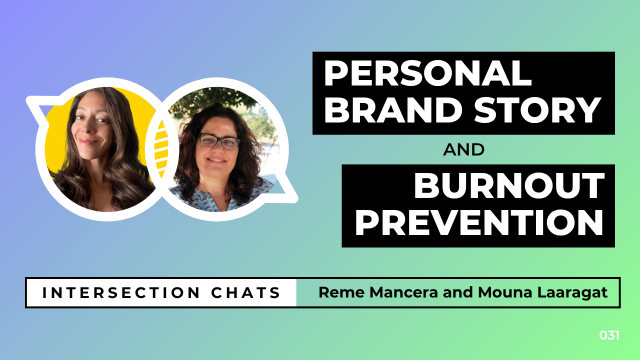
Personal Brand Story and Burnout Prevention,
with Reme Mancera and Mouna Laaragat
If showing up for your business has been feeling heavier lately, this might resonate.
Service providers and coaches often think burnout comes from doing too much, but what if part of it comes from how you’re showing up and the stories behind it?
In this episode of Intersection Chats, we explore the connection between personal brand storytelling and burnout prevention. We look at them not as separate topics, but as something deeply intertwined in how you build and grow your business.
If you’ve been navigating a pivot, feeling overwhelmed by visibility, or unsure how to share your story in a way that feels right, this conversation offers a different perspective; one that’s more aligned, human and sustainable.
Personal Brand Story and Burnout Prevention
Here are 3 questions we cover during our live chat:
1. Are the stories you tell yourself contributing to your burnout?
We explore how internal narratives, expectations, and past conditioning can create pressure, misalignment, and exhaustion. Rewriting those stories can actually shift the way you show up.
2. Do you feel pressure to have one big story to share?
You’ll discover a different approach to storytelling, using your Story Connectors, meaningful moments instead of one epic narrative, so sharing your story feels lighter, more flexible, and aligned with your capacity, while being really intentional and strategic to highlight the benefits of what you sell.
3. Would having more clarity on your stories make showing up easier?
We talk about how knowing what to share (and why) can reduce content overwhelm, help you communicate more naturally, and make your visibility efforts feel more sustainable.
If you want your storytelling and visibility to support your energy instead of draining it, while preventing burnout and honoring your capacity, don’t miss this conversation.
Who is Mouna Laaragat?
Mouna is a trauma-informed resilience mindset coach, writer, and podcaster who guides women to move beyond survival patterns and reclaim their self-worth.
For 33 years, she chased success and love, but nothing ever felt like enough because she never felt enough. Hitting rock bottom forced her to see how childhood abuse shaped her life, relationships, and self-worth.
She learned that defense mechanisms are superpowers until they cripple us. True resilience is built with softness, not the rage we carry along our suffering.
Mouna’s motto is to heal out loud for shame to dissolve in the light of our shared stories.
Who is Reme Mancera?
Reme Mancera is a Personal Brand Story Strategist and the creator of the 10 Story Connectors framework, a strategic storytelling tool to choose which personal stories to share so they build trust, create genuine connections, and lead to clients.
She is the host of the podcast Who Cares About My Story? and the live series Intersection Chats.
Personal Brand Story and Burnout Prevention - Transcript of the episode
Welcome to Intersection Chats. I am Reme Mancera, a personal brand story strategist. And today, we are going to talk about the intersection between personal brand story and burnout prevention. And I am here today with Mouna. So excited to have this conversation.
Welcome, Mouna. Thank you, Reme. Thank you so much for having me. It’s exciting to be here with you today, especially exciting topic. Yes.
First, if you won’t please introduce, you about what is your work. So, essentially, I’m a mindfulness teacher, and I specialize in burnout prevention, really helping others to recenter and be grounded when everything is on fire so you can, like, make clearer decisions and navigate life and business from a little more peaceful space. Nice. So let’s go to the topic. In your experience, what is the connection between personal brand story, burnout prevention?
It’s a very, very deep question. So it’s a deep question that is also very interlaced. That’s what I loved when you approached me to talk about this topic. When we think about burnout, we often would define it as something that is very much just overexhaustion. When you physically, mentally, emotionally, you just can’t take it anymore and you break down, and your body will remind you how important it is to take care of yourself.
The burnout is just a symptom, and it’s kind of like the tip of the iceberg that shows up when we’ve been ignoring certain things for too long. It can be indeed, of course, because of some hard stuff we can deny, like if you’re being bullied at work, have very toxic environments. It can be also due to personal circumstances, juggling too much personal life and work issues and everything at the same time. At the end is when you’re getting very overwhelmed and that the stress and the challenges of life are higher than your own capacity. And we’re gonna come to the stories we’re telling ourself.
So a lot to do with storytelling comes to be shown very obviously when we start digging in these conditioning that we have and the stories we are telling ourselves and therefore end up telling others. So when you work closely with your clients and you tell me a little more about it, you probably would have seen some kind of, like, trauma flaring up and some burnout because it’s getting too much to handle everything and looking at the strategy of your personal brands. Most people get stuck because of those stories that they grew up with or they have been conditioned to and they believe about themselves, which become limiting as opposed to something that serves them. How is it for you? Like, do you get to debunk a little bit of that?
Yeah. So we the thing with my clients is, like, of course, we go deep into their own journey. So it’s like there are certain moments that has been tough and and things that show up in the sense of how we are just exploring every pivotal moment and things that has been important for them. So, of course, there are certain things that even if they are not going to share as part of their personal brand story for their business, is are things that we talk about because there are important things in their lives. And that’s why for me, it’s so important to have this space where I work one on one because they are deep conversations, and I feel that’s the the at at least for me, it’s like the the easier way to create a space where people feel comfortable sharing those those kind of topics.
So, yeah, totally see how even I work a lot with people that they are pivoting in their business, and they are you can see how in their times that they have been building, how there are parts that are, excuse me, that are connected to burnout in the sense of how they have changed things, leaving even businesses that they look as something successful from outside, but inside, they they were misaligned, and they feel like I need to stop. So I have several clients that this kind of stage make them to change and make a big change. I have in mind someone that she was a manager in Nike and, super high level in the in the corporate. And she left that and start her own business. So she needed to to make the change because that was what makes sense for her.
And now she’s helping others to to unless their full potential. So I totally see the connection, especially how these pivoting moments in the sense of how you you need to check your priorities and your body is telling you to to stop and to to make sense. Look at what is what are you doing and make decisions. So I see how that’s, like, something big in in the lives of my clients and how that is important. And as you say, sometimes it’s just something that is showing a symptom, but the root is totally different.
Yeah. And when you start thinking of the narrative of how am I gonna build my brand, how I’m gonna show up on social media, how I’m gonna show up as a business owner, It’s and and personal branding doesn’t need to be just if you’re owning your business. You can be building your profile, you know, like a thought leader in your industry whilst being employed. It’s still it’s getting personal. And when you have unresolved stuff, they tend to come up because this is this is, like, the story you’re getting ready to tell others.
But are you very clear about it with yourself? Is it really true and aligned with who you you are and who you wanna be, or is there, like, this misalignment, like you say? And I think that misalignment is what’s creating friction. Like, when you try to fit in a box that isn’t yours to begin with, then you started seeing those symptoms flaring up. Yeah.
And something that you mentioned about the clarity about, yeah, the inner stories that you are telling yourself and the stories that you want to share and how you want to show up for your business, sometimes especially, I feel like when you are in a moment of pre burnt out, let’s say, it’s like you if you don’t have really clarity on how you are doing this, this is just overwhelming you more because it’s like you don’t have the capacity to to think clearly and to to be able to articulate your thoughts in a way that is connected to your goals. Because first of all, maybe you are in a moment where your goals are not clear anymore, and then it’s like you don’t have the the mental space to to think about these, and make decisions. So I feel like is is connected in a way that if you are if you have the clarity on what is the narrative that you want to share, that’s going to help you in a way to make things easier because you know what you want to highlight, you know what stories you want to share, and how you feel comfortable with them because you have thought through these and decide, okay.
Yeah. I feel comfortable this. I set the boundaries in this part. I don’t want to share about this one. And then you have the clarity.
But I feel that this is work that is more interesting to do before as a prevention. Because otherwise, in the middle of the storm, let’s say, it’s difficult to do that because you don’t have the capacity. And you need to I feel like this, like, in terms of priorities, there is something else that you need to take care first, and it’s like yourself in a more general way, and then you can look for, okay, my business, my strategy, and all of that. I would love to know your thoughts on this. Yeah.
The thing is, like, it’s gonna sound really bad when I’m gonna say, but it’s just, like, when I started and I was very much focusing on burnout prevention, there was a reality that as much as some companies, we’re happy to talk about, you know, burnout prevention workshops and start ups accelerators because everyone knows roughly now what it costs for you to completely break down and then needing to take a year off. You can’t run your business if your burnout gets that bad that you’re in the hospital. However, like many things, especially especially when it comes to illnesses, until you get sick, you don’t really start taking the medication for it. And that’s what it is when it comes, like, to the prevention side. I think a lot of the prevention is done by people who know what it is like.
And even when you burn out, you tend to repeat the burnout circle until you kind of, like, go really deep down to the roots. And also even when you go down to the roots, like, you don’t resolve your entire life story and overnight. So it takes work and time and patience. So you might be juggling some time with that friction of extreme exhaustion, like, finding your finding your way to navigate things. So I understand that, ideally, we wanna be clear about our origin story, you know, before we need it, or we want to constantly be taking care of ourselves before we hit, like, big life challenges.
But in reality, I see a lot of clients that are actually almost doing their brand work as they are discovering themselves, And I see a lot of brand strategist that are having to face that are coming to ask me about resilience or have these conversations because they find themselves becoming a therapist almost. So when you have someone breaking down facing that frustration of who am I? How the fuck do I share, like, the true story of what I’ve been through? And, yeah, it can be triggering. But I think this is what I think is just we need to give ourselves grace no matter what we’re doing, whether you’re working on yourself, on your own self development, on trying to get to know yourself, or whether you’re trying to grow and build your empire.
You know? Both journeys are extremely challenging, and we can only enjoy our life if we learn how to enjoy it and learn how to enjoy the fun of getting to know your personal story or getting to know a side of yourself or building something complicated. You know? So, yeah, that’s what I think. I think, of course, it’s challenging, but we gotta cut ourselves some slack.
Based on what you say about the big origin story, this is something that I have thought a lot about. One of the things that I yeah. A lot of my clients feel overwhelmed because they feel they don’t have an epic story. And that was the the origin of me thinking about this in a different way, and I’m thinking, okay. How I can do this in a different way?
And what I decided to try was instead of looking for one big story, looking for meaningful moments. So I created this framework, which is the time story connector framework. And there, I help them to identify meaningful moments. And from outside without context, they can look like doesn’t make sense even or they are small. But when you share the context, it make a lot of sense when you are trying to to talk about your business and what is important for you and your values and the way that you approach your work.
And I like to use one specific example because I feel it’s really, yeah, it’s really illustrating this. One of my clients, she’s a web designer, and one of her story connectors is her, drinking a glass of wine in her garden. So that doesn’t look as a epic or dramatic moment at all, but it’s helping her to explain how in one season she’s working on the garden, and then in the next season season, she’s enjoying the garden and having this, being there, just enjoying, this the nice place. And it’s connected to her work because she does intensive, web design services where she gets all the tools that she needs, all the resources in a season to do for them in a intensive way. And then her client is enjoying the result, enjoying the garden.
So for her was a moment of, oh, I never thought about using this, but total makes a lot of sense. So the idea is how something that could look as small or without sense, when you share the meaning, it has a lot of sense. So what I mean with that is, like, for personal brand story, sometimes we tend to think of something that is, like, huge in our life, this turning point. But I feel like, why don’t use these smaller moments? And some of them are big.
Don’t get me wrong. But you are the one deciding how you approach them and how you share them in a ways that, as you said, you take it you give yourself grace. You are doing things in a kind way for yourself and for your own capacity. So that’s an approach that I feel in the work that I do can make things a bit easier for people that maybe are navigating a tough time. Is, like, don’t expect you to have this one perfectly, package story.
It’s like, let’s use these moments. Let’s connect them. And some of them are big, but some of them can be smaller, but really meaningful for you to use as a bridge. So even I feel these are something that I I feel a lot when working with clients. How having clarity on the stories that you are going to share is really useful to, like, make peace with the stories that you are telling to yourself, like the inner narratives.
And I feel like that must be something really important in the work that you do, these inner narratives, the stories that we tell ourselves. So I would love to know what has been your your experience around that, around the inner stories. Mhmm. I think there’s, like, three folds that resonated with what you said. This, first of all, this thing that people are obsessed about the big origin story, the big mountain, the big milestone is what get some people frozen when it’s like when they try to do goal setting.
There’s just, like, the perfectionism that kicks in trying to be, oh, this needs to be perfect. I need to nail it. And they forget that this is just the direction. Your goal is just the direction. You can amend things.
Things can change. Things can grow. And in the meantime, you have little milestones that these small wins. So I feel like it’s really the framework works well for storytelling, personal branding, goal setting, getting better. It’s like focusing on one step at a time instead of trying to climb the mountain in one go, but really going, like, this little step, these next five minutes, this next hour.
And when it comes to the stories we tell ourselves, personal branding gets triggering because it echoes to this traumatic narratives that we either might have been growing up or are trying to compete with. There’s almost this trauma competition where people feel like they didn’t have enough interesting things in their lives or enough big traumatic things in their life. And your glass of wine example is just so beautiful. Like, I think it really represents that it doesn’t always need to be that deep because a life can be very simple if we simplify it, if we cut down these milestones. If we shorten the step, it gets easier.
And most coaches, for example, will have this, like, rags to riches story. I came from nothing. I built myself on the ground up. Not everyone needs to have that type of story. And if you when you hear the same story over and over again, it’s not almost not personal anymore.
I feel like it became public knowledge. You know? That’s what happens. So when you hear something a little different, I’d be more inclined to remember the glass of wine story of someone who would be able to remind me of this precious little moment and to enjoy life as opposed to the same good old story everyone else is repeating. So I guess that’s echoing as well with what you’re doing, right, when you have, like, people freaking out, trying to figuring everything in one go, almost like the life story in one go and being like, well, let’s start from the first step.
Yeah. Yeah. I feel that’s, something that we need to remember, all of us. Like, you it’s at least for me, it’s like, yeah, you approach things in a way that are, like, easier to digest, not try to the whole thing at once. Yeah.
So I think that is I think as well, like, making it real. Mhmm. Like, that glass of wine in the garden is real. It’s there. You can look out the window and see the garden or your balcony or your front door or your cozy sofa, whatever it is.
And, like, one framework that works in, like, mindfulness, for example, when it comes to gratitude, which I use, is, like, being able to focus on something very, very tiny and very specific. Not, oh, I’m just grateful to be alive, but, like, be as as specific as I’m grateful to have a roof over my head allowing me to put music on and then dance naked in my living room because that makes me feel alive. Yeah. I love that. Like, that little tiny detail.
Yeah. Because then it’s like, as you say, more real. It’s like it’s not this abstract big thing. It’s something real that you can feel and you can, make in your in your mind. And I feel like and I would love to know also your your approach in this.
It’s like, for me, becoming a, my own the business owners, my own business and all that has been a real personal growth development in the sense of knowing yourself and all the things that are you are scared of. There everything is coming out in a way that is like, even if you haven’t faced it before, it’s going to show up in the way that you are building your while building your business. So it’s not that you are going to separate, but it’s going to be, yeah, a great way to self knowledge, I believe. I don’t know. That’s has been my experience at least.
I would love to know your thoughts. Yeah. I just posted about it, like, last week on LinkedIn. Like, solo especially solopreneurship. I think in general, even if you’re a founder and have a team, like, this entrepreneurial adventure is gonna trigger the shit out of you.
Like, all your wounds are gonna come out. Like, imagine if you have abandonment wounds. Right? You have to face rejection constantly trying to put your your business out there, promote your business. Every person that you see that liked what you that that saw what you did and didn’t like it feels like a personal insult.
Like, it is just so triggering. And, sorry. I like to work with entrepreneurs as well because we get to be playful with these. And you can be like, oh, this is so triggering, or you can, like you do, get excited about getting to know these parts of yourself and getting to grow from it. Like, oh, cool.
Now I’ve got the chance to look at this shit in the eye and start working on it. Yeah. This is something especially around visibility for me because all my life has been this shy, a person that wants to hide and and not having the spotlight. And now I in a in a in a business that I need to put put the spotlight on myself because I want more people to know about my business. And then there is like that’s like explosion of feelings there, and it has been a a growth process for sure.
So yeah. But this is a I I’m for a lot of people that so the people that I work with, most of them are in two groups. One of them is those feeling they don’t have an epic story, and the other group is feeling that they haven’t lived they have so many differently lived experiences. They don’t know which one to choose and how to make sense, that different theme for what they do now. So those are the main groups that I work with.
And for both of them, storytelling is overwhelming. And I connect with that overwhelm because for me, I remember when I started my business, I was so have so much pressure on this idea. You need to share your story. You need to be vulnerable online. You need to show up.
And he was, I don’t want to be vulnerable. I want I I don’t have an epic story to share. So I feel so connected to that overwhelmed. And has been a process of, yeah, you are the one deciding what you share. And and for me, which is really important is, like, connecting each story to something related to my service, my offering, my business, my audience.
Because then I have a reason why I am sharing that, and I know why. And that’s something that is really helpful also for my clients. It’s like, they know, okay. I am sharing this story, and it makes sense because it’s connected to this specific part of my business, and it’s connected to the people that I want to talk to and and want to help them. But I remember at the beginning for me was really, really challenging because all the the advice that I got was totally against my the things that I want as a person.
He was like, no. I don’t want to do this. And then it’s like changing the the perspective and say, okay. How we can do it in a way that makes sense for me? How can I do it in a way that I feel comfortable, but at the same time, I am sharing my values?
I am showing up for my business, but in a way that I feel comfortable, and I am the one setting the boundaries around my privacy. But at the same time, I am letting the people know why this work that I do is important to me. Yeah. I really see what you mean. And that’s like, what I try to do when it comes to well-being is, like, you take the rules, you learn from them, and you break them to make them fit you instead of break yourself to try to fit them.
And and storytelling is a beautiful discipline. It’s been so helpful for me to get guidance from my editor as I’m writing my memoir. And it’s a big, big exercise, especially when it comes to your stories and everything you describe about these little scene. And one of the most helpful part of the work, working with, like, a a book coach and learning to develop your stories is learning to romanticize my life. So now I try to do it.
It’s practice. Right? It’s just practice. How you can get better at telling stories is by practicing. So I practice with myself, not only when I’m writing when I’m writing the book or when I’m editing the scenes, but I go I live in Bangkok.
I order a a a taxi bike. The bike arrives. As I’m waiting at the lobby, I take the time to look around me, and I describe using my five senses. I describe how green the plants are in the garden, how fresh I can feel the aircon from the lobby slowly reducing behind me. I I I romanticize the breeze in my face despite the pollution that whilst the wind is blowing, I can still look around and see the details like the path of the shop owner laying at the front door like a carpet.
And it is these details and how we use our senses that help us make our stories more alive even if it’s details. And that’s that’s, like, one of the I think one of the best recommendation I can give to anyone who wants to get better at storytelling is that just take any moment of your day to day and romanticize it using your five senses, and you’ll get already something drastically different just from a commute in the in the tube. Love that. Thank you for that exercise. And I totally agree on the idea of how storytelling is a practice.
And I feel like, especially around business, there is a lot of feeling that storytelling need to be serious, and it’s something like you need to approach in this professional serious way. And to me, I want to bring the idea of this can be joyful. It can be playful. We can play with our stories. And one exercise that I do, I I have a session that is a storytelling game session, and there we have a wheel.
We spin the wheel, and there are different storytelling styles, like from the point of view or something, like if it’s a theater play, sharing a suspense or fantasy and so on. So we have one story, one little story, and we, spin the wheel and choose the the whatever the the storytelling style is. As a group, as a collective, we play our imaginations together, and we build up that story but in that style. So that’s a way for us to practice around storytelling. It’s joyful.
It’s playful. But at the same time, it’s making our muscle work. So when later we go to our own storytelling, we can think about, okay, how I can share this same story. Maybe it’s a story about how your client feels before working with you. What the what is their stage?
And then there, you can think, okay. How I can share this same story from a different perspective? Let’s say, one of the samples that it was around how my potential clients feels after a a podcast interview. And it’s like, okay. How the the point of view of the mic that goes there during the interview and after that, that was making myself look at the scene in a different way and needed to narrate in a different way.
So I invite my clients to do that, and the people that I work with is like, okay. Some object that you use in that scenes, this is the object that is narrating the scene. How will be it? And that plays with your brain, and it’s like a way to exercise as a muscle, as you said. So I love that exercise of, just whatever is the situation, music to try to narrate this and romanticize this scene.
I love that as well. And I love your wheel. It’s definitely a good there there’s definitely a good inspiration here, that I’ll also share with my network because it’s it’s reminding me in pro theater and how in pro theater is just a great reminder of how to take things less seriously because I think that’s what we need. Most of the time, we make ourselves sick because we put too much pressure on ourselves and for a reason. Okay.
We want to succeed. We wanna get things right, and it’s fine. But when you strip the joy out of it, you make yourself miserable. So is life worth living if you’re miserable every step of it? Or is it worth fighting for a life that can be more joyful, more giving, that can make you more happy?
And I think this is it. We say that we don’t burn out because we’re doing too much, but we burn out because we’re not doing enough of what we love. Mhmm. And I think it’s just trying to remind thyself constantly what do we love? What do we enjoy?
Can we bring more of that? And I love this, you know, that I can picture even in a very serious corporate office, people playing with the wheel and telling different stories, and it’s a great team bonding exercise and why we need to be so serious. Like, this is so fifties, you know, type of, like, work office environment imagination. Yeah. And this, you may you said something on this.
I I want to ask you about that. But, yeah, I totally agree on bringing the playfulness. That’s something big for me. It’s like, how we can make this more fun and enjoy that because it’s I want to be enjoying. I don’t want to be, as you said, feeling miserable.
I want to ask you because you mentioned how, when we are doing something that we love and the the connection with burnout. I’m really interested because I feel like sometimes of course, there are situation where it came from something doesn’t have meaning for us and all that. But I would love, you know, to know how if in your experience, how has been like, people that are really trying to to to build something that they love, but they are putting a lot of pressure on themselves and they are just running into burnout. But this is for something that they actually love for a project or a business that they is actually fulfilling. And and they want to be more of that do more of that, but in the process, they are burning them out, themselves.
I would love to know what has been your your experience into this and your thoughts. Well, see, that’s the thing. It’s like, are they really enjoying the building phase of their passion, or are you actually just enjoying the idea of the final result? That’s what makes the biggest difference. Right?
You can be very passionate about your job, but, eventually, work is work. So your passion is gonna kind of, like, be themed over time because what you’re doing for passion is becoming your day to day. So it’s kind of like stripping away the fairy tale, which is okay. It’s fine. And you can still be very passionate about your project, and you can still lead yourself to burnout.
But it’s like, did you incorporate enough of recovery moments? Did you incorporate enough of these moments that help you fill up your cup? So if you’re constantly it’s very, like, cliche. I don’t wanna sound like chat gbt, but really is you’re running on empty. It’s like a battery that is being sucked out of all its energy.
And we think we think willpower does everything. We always talk about motivation, willpower, but that has it’s like a battery as well. You have a limited quantity of it. And maybe you have so much because you’re so passionate, you’re gonna have three years worth of it. But, eventually, if you keep on just draining the same battery and not filling it up or if you fill it up a tiny bit but you drain it even more and you go in minuses, it’s not it’s not gonna work.
And that’s what I’m saying about doing stuff you love is doing stuff that replenishes you. So if you love the work you do, you you know, you’re supporting others with their stories. But in parallel, if you have one month where you’re just doing accounting every day and you’re doing content creation every day, but whilst what you actually love is supporting people with their storytelling, spinning that wheel, giving them workshops and exercises, you are passionate about your work, but your day to day is not filled by stuff that you love doing. So your challenge would be to look at how can you delegate these tasks that you don’t like to do, and how do you fill your day with that stuff that you enjoy? And there’s plenty of different avenues for this even, like, outside of, oh, I cannot a fortune hire.
Yeah. But you can build automations or system. It’s like I’m not forcing good response, but it’s just questioning yourself, how can you bring more joy in what you’re doing? It’s not stopping don’t stop what you have to do, but what can you bring in your day that can give you more energy to do the stuff that you like the least? I love that.
Yeah. Because one of the things that I got a lot from my clients is, like, they are passionate about what they do, but they are dreading about creating content for social media or, yeah, as you say, admin stuff and so on. And I always, relate it to the way of communicating. I always invite them first to analyze. Okay.
What is your natural way of communication? Because maybe you are sending audios with your friends, and now you are trying to do something totally different in the way that you communicate for your business. Use things that are feel natural to you because probably that feel easier and funnier than something that you force in there. And for example, for myself, my way of communicating, I love conversations. If I knew to record by myself a a conversation around the same topics that we are talking today, I will be procrastinating, overthinking, over editing.
But here, I am just having a conversation with a nice human being and just talking about the topics. I make my brain goes to places that otherwise, it will not go by themselves. So find ways that make sense for you that’s somehow bring like this excitement to you. And as you say, how you can bring elements of fun and joy into the scenes that maybe they are less appealing to you. How you make, some kind of rewards or little treats after you do something that you don’t enjoy.
So even if you don’t have the capacity to bring someone to help you, it’s like, okay. How I can do things in a way that feels less as a punishment and just something that yeah. It’s going to have in the wrong ground. So yeah. But I I know that sometimes that can be challenging, especially around content creation as a big, huge topic.
And there, of course, I will tell people that think about your stories, and then at least you have clarity on which kind of stories you can share. And then it’s easier for you to bring new ideas because that’s a topic that for some people is like, yeah. I don’t know. I feel I need to share, but I don’t know what to share about or I don’t know what to talk about. But, yeah, I feel that having that clarity, at least, is taking one pressure off and then decide looking of the ways that you feel more natural communicating, I would say.
You know, this is like it’s definitely something that I see as well in coaching people just to develop their resilience or work on their traumas or recovery. You know, when you come to recovery and well-being as well is presented as a one size fits all. Even if we talk about adjustments and stuff, there is still this thing that I see people saying, well, meditation has never hurt anybody. It doesn’t hurt to to work out and move and stuff and yada yada. But it keeps, like, bringing me back to the days where I wasn’t meditating.
I wasn’t working out. And one of the main reason was going back to this thing of wanting it to be perfect and it not working for me or me not enjoying it straight away. It was making me feel more like a failure. Like, oh, well, I can’t get this. And it was adding more to my already full plate of guilt and shame and exhaustion because what everyone was raving about as a solution, I couldn’t get my head around.
I didn’t know back then that, well, there was different ways you can enjoy it and that what worked for me wasn’t what actually what I discovered. So it was just seeing techniques that I wasn’t really enjoying, and that’s it. And I believe that it wasn’t made for me. And I didn’t learn about what mindfulness truly meant, how I can make it my own, how I can break out of, like, those rules. And I think this is exactly what’s happening for life in general, which is trying to fit with rules that are not working for us.
And I see people and we talk about journaling, for example, and some people enjoy guided journaling or guided meditations or guided stuff. They need that support and framework. Some others don’t, and it’s okay. And in the same way, some people love to write, And for some people, they just can’t. And because they can’t do it, if you force them to do that exercise, it’s just adding up another thing.
Like but, for them, it’s easier to record a voice note. So some of them have just, like, been like, fuck. I never thought about this. I can just yeah. You don’t need your journal on paper.
Record your voice notes. Make a little cheer up message for for yourself, and then when you feel bad, like, bring it out. Like, it doesn’t need to be what someone said. So opening the door to reflecting and see how you can make the world work for you as opposed to trying to fit in what somebody else told you to do, I think that’s what making the difference. And that’s what make people resilient is they see a door that closes, and it’s like, okay.
What can I learn to find another way? Mhmm. Love that. And thank you for all the ideas and little exercise that you are sharing already because I feel that if someone want to start, that’s already a starting point, a great starting point. So before we finish, I would love if you can summarize that connection between personal brand story and Bernad and Sean in a few words.
Rewrite your narrative. Love that. Yes. Love that. I was thinking about it, for myself, would be awareness of capacity because I feel that’s a key thing in both of of them.
Thank you so much for for all this conversation, Mouna. I have love it. How can people, connect with you and learn more about what you do? You can find me on every platform. Lucky for me, I do enjoy creating content.
So, you can read everything by just searching Mouna Laaragat on every social platform or the grit makers on YouTube. You’ll find my meditation there. Gritmakers.com is also my website, and I am also an insight timer. If you like to listen to meditations or get acquainted with where the body is. There are so many different ones.
So, yeah, I look forward to connecting. Drop me a DM as well if you have any question or leave a comment on this video, and I’ll be happy to continue the conversation. Amazing. And if someone is interested in learning more about the 10 story connector framework, they can go and visit my website. There are resources there and ideas to how they can implement that into their own stories.
Yeah. I would love for people to comment, in this, video if they have some idea, if, this conversation bring them some inspiration, we would love to to hear from them. So thank you so much, and see you soon.

Want more conversations like this?
Explore more episodes of Intersection Chats where I invite guests to talk about how personal brand story intersects with their expertise. Get real-world insights from experts across different fields on how personal brand storytelling builds trust and genuine connections; plus tips to use your personal stories more strategically in areas like PR, email, SEO, content creation, and beyond.
Here are a few examples to get you started:
- Personal Brand Story & Conversion Copywriting, with Reme Mancera and Mimi Zhou
- Personal Brand Story & Market Differentiation, with Reme Mancera and Marj Martirez
- Personal Brand Story & Video Storytelling, with Reme Mancera and Paige Burns
Whether you’re just starting to explore your personal brand story or want to apply it more strategically, these chats offer real-world insights from experts across different fields. Don’t miss the opportunity to get the most out of it!
WORKING REMOTELYInternational

GET IN TOUCHContact
WORKING REMOTELYInternational
CONNECTSocial links
Reme Mancera · Personal Brand Story Strategist
Copyright © 2018-2026 Reme Mancera. All rights reserved.