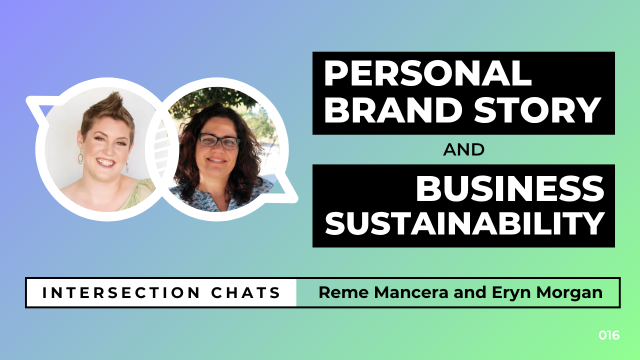
Personal Brand Story and Business Sustainability,
with Reme Mancera and Eryn Morgan
Have you ever wondered if the way you’re sharing your story is supporting you in building a sustainable business?
Sustainability in business can look like consistent income, scalable offers or long-term strategy.
But a key factor that sometimes is overlooked is clarity and peace of mind. Knowing what you stand for, how you make decisions, and how to communicate your value in a way that truly connects with aligned people.
This is where some business owners feel stuck, especially those navigating a business transition.
You might have years of experience and a wide range of skills, but when it comes to explaining your work or showing up consistently, it can feel unclear, overwhelming or disconnected.
The good news? Your own personal stories can become a powerful tool.
In this episode of Intersection Chats, we explore how personal brand story intersects with business sustainability.
Whether you’re repositioning your business, refining your messaging, or looking for a more aligned way to show up, this conversation might bring you the clarity you’ve been looking for.
Personal Brand Story and Business Sustainability
Here are 3 reasons to listen to this episode:
1. How can you share your personal brand story without oversharing or losing your boundaries?
If you’ve ever hesitated to talk about your story because it feels too personal or not relevant enough, this conversation offers a refresh perspective. You can choose what to share with intention, focusing on meaningful moments, lessons, and emotions instead of private details.
2. How do your past experiences connect to your current offer (especially during a pivot)?
You don’t need to start from scratch every time your business evolves. This conversation shows how your previous experiences, even if they seem unrelated, can support your current positioning and help your audience understand the value of your work in a deeper way.
3. What does your personal brand story have to do with long-term business sustainability?
It’s not just about content or visibility. Your story influences your decision making, your values, your messaging, and even how you build a team. When your personal brand story is clear and intentional, it becomes a foundation that supports consistent growth and a business that actually fits you.
If you’ve been wondering how to make your visibility feel more aligned, your messaging more clear, and your business more sustainable, this episode will give you a practical and thoughtful starting point.
Who is Eryn Morgan?
Eryn Morgan is a Business Coach, Strategist & Kolbe Certified™ advisor for Creatives. She uses a suite of scientifically validated assessments that measure how people are naturally wired to take action. She focuses on helping them run a consistently scalable creative business that they actually enjoy.
Who is Reme Mancera?
Reme Mancera is a Personal Brand Story Strategist and the creator of the 10 Story Connectors framework, a strategic storytelling tool to choose which personal stories to share so they build trust, create genuine connections, and lead to clients.
She is the host of the podcast Who Cares About My Story? and the live series Intersection Chats.
Personal Brand Story and Business Sustainability - Transcript of the episode
Welcome to Intersection Chats. I am Remi Monterra, a personal brand story strategist. I am delighted to have here today, Aileen. Welcome, Aileen. Thank you for accepting this invitation.
Oh, I’m so thrilled to be here. Thanks for inviting me. I love having little chats and casual conversations. This is gonna be fun. Nice.
So before we start with the actual chat, feel free to introduce yourself about, what you do and what is the work that you do. Yes. I am Erin Morgan, and I am a catalytic business consultant and coach. I work with a lot of creatives, a lot of teams, founders who are really leading amazing teams, but, maybe they just need a little bit of support in getting the right people into the right roles or really figuring out exactly how to get everybody to work well together. So So I do a lot of that, a lot of offer design, a lot of really fun stuff I get to do in my business.
So it’s, it’s been fun to meet you because you are a creative at heart. So that’s how we know each other, and that’s been fun. Yeah. Yeah. So let’s go, to it.
How in your experience do you think business sustainability, personal brand story, how do you think they interact with each other? Well, for for me personally, it’s had huge intersection points. Just absolutely huge. So I think that my business has been the greatest opportunity for my own personal growth that one could potentially have. And as I’ve evolved and, you know, my story has continued to deepen and add layers just like, you know, life happens, and that’s that’s how our story continues to evolve.
It’s absolutely intersected with how I run my business, how I create offers, the the types of, you know, offer terms I might put out in the world, based on my energy and what’s happening in my life. So, I’ve definitely also started to notice this desire for me to be able to go out and be on bigger stages. Right? And I’m not big define big, right, in this case. But to be able to be known both as me, but also as a brand that is me.
And, I certainly have team helping with offer delivery. It’s not just me running the company, but really knowing that my personal story is gonna be the thing that connects people to me and gets me into those opportunities for speaking and stages and even a book that’s that we’re, you know, in the in the foundational workings of of deciding what that book’s gonna be. So the company as itself doesn’t have a person. It it it is just sort of this entity. But when I put my personal story into it, it becomes something that truly can come alive.
So that’s what I’ve experienced, personally, but I’ve certainly seen this with with clients as well. So, I I can’t imagine. It and it’s hard too sometimes to be vulnerable and to bring pieces of my own story that I may not really wanna share. Like, it gets really tricky to figure out how do I weave this into something that is audience appropriate, that is, you know, matches with my comfort level around sharing and vulnerability, but also has serves my audience, has a has a way to connect into my audience that helps to take them on a journey, help them feel a certain way, whether that’s encouragement or, hope or, you know, inspiration or just having having a laugh. Like, there’s there’s lots of ways that those things intersect for me.
Oh, so many thoughts. So yeah. I I know it. I love it. So, yeah, I will pick the the idea of how to decide what to share or not Yeah.
And how and because I this really important topic to me because I am really private person. So I am really, like, concerned about keeping things that I don’t want to share to myself and then deciding what to share and what not to share. This, challenge that, I help clients all the time with that because this a big topic on how to decide what to share and what not, and how to see what is relevant for your audience, for your business, for for the offerings that you have. That’s why I approach this, work in a way where you are the one in control of deciding how level of detail are you sharing. So you are the one, like, if you want to share in a superficial level, if you want to go deeper.
And I always use the example of, someone with an, health issue in their family and how they might share. All my priorities in my business are changing because a big health issue of someone in my family. They don’t need to share who are who is this person or what is the disease or what is happening. Everyone feel connected to the this idea of having someone that you love having a a health problem and how you connect with that, like, how that change everything and everything, goes in post. So this idea of how you are the one deciding the level of detail.
And then on the other hand, how to decide what to share, I use I created a framework to to approach this in a way that feels less overwhelming because that was a feeling, people that I work with was feeling this idea of, okay, I don’t have a epic story to share what I am going to decide, how I’m going to decide what to share or not. And this idea of, okay, less split and less identify specific meaningful moments that you know how they are related to your offer in a way that they are highlighting what you do or a skill that you have or something that is important to you, using your stories for that. So the idea here is like, okay. I know exactly why I’m sharing this story because it’s a bridge with this specific skill, with this key factor. That way, you know why you are sharing.
So you feel confident, and you have the clarity, and you have the strategy. And I always like to to mention this, like, strategy in the sense of intention. Mhmm. Not in the sense because some people, when they hear strategy or strategic, they feel like, it’s kind of manipulative. And it’s like, no.
It’s having an intention and doing the things, not just randomly, but deciding why you’re sharing that thing or why why you’re doing certain things in your business. And I feel there is a lot of connection there with the idea of sustainability in your business and profitability, the things that you work with, people with in the idea of, okay, you make a plan, you have intention on what are the goals of your business, the things that you want to achieve. And then you are not just randomly doing things. You you have a certain, like, direction that you want to to to go. Yeah.
Yeah. Okay. So I can speak to this in a couple of different different layers here. So the first thing I always think about when when it comes to my clients. So I recently worked with a gal who had been in corporate for about ten years.
And so when she was coming online to start her web design business, it was hard for her to figure out what kind of content she wanted to share. Because in corporate, the fact that she had two kids, she didn’t even tell me she had two kids. For several months of us working together, she really this was we were all business, and I respected that boundary. I didn’t wanna, like, you know, feel like I was prying in. It was pretty clear where she stood.
But then as we got to know each other more and we got more comfortable with working with each other, she started to tell me a little bit more about her family life. So she was married. She did have two kids. I started to learn more about her her very international based family. But because she was a in corporate and they needed in order for her to be successful there, she really had to keep her personality and her personal brand, if you will, under wraps.
It was a really hard, and I think it’s something that she’s still continuing to work on, transition for her to be able to figure out, well, how do I even share this stuff online? What’s gonna allow me to be safe, but also then to be relevant? So one of the hooks that we found for her in her personal story was she she chose a vegan lifestyle for herself. And so we were able to use that. It’s something she truly believed into her core, but it also became the hook of her business because she was totally comfortable talking about being vegan and being willing and able to work with clients who had that, that angle in their business, whether they were service based or even products, that were vegan products.
And it was her intersection that we were able to find for her to continue to develop how she talks about herself and her personal brand story inside of her business. So, like, that’s a an an example of somebody who really just had a lot of private desires to, you know, to to keep things very private for her, but we’d still were able to find a place of intersection that we were able to use. So that’s that’s one example. For me, I’m sort of known as an open book. I’ll I’ll tell you just about anything you wanna know.
And I have also gotten really, really clear on how deep to go in during a hard time. So even right now, a a lot of people in my audience know I I am getting divorced. It’s not my all time favorite thing to talk about. It is sometimes relevant. It affects my day to day life.
It affects how I show up for my clients. I don’t need to get into the nitty gritty down and dirty of the story. But, a lot of people relate to me because it’s the you’ve experienced before. And so what I’m very conscious of is sometimes the moment or the situation needs a light share, but I’m not I’m waiting to see. I I’m literally waiting for time to show me where the lessons are that I need to through and apply to my business.
So it could be a lesson like trusting myself. You know, you hear that little voice inside where you’re, you know, thinking, like, should I marry this person? Yes or no. And your gut is saying no, and your heart is saying no, and your head is saying no, and you say yes. What’s that about?
Right? What do we need to dig into in terms of our deepening to self trust? So this is one of the things that I have to work with a lot of my founders on because they realize that they don’t have a strong self trust type of relationship. And this is very core for how we make decisions and lead teams. We gotta trust ourselves.
So we can have these moments in our lives that we’re able to pull out, but I tend to pull out the lessons sort of after the fact. It’s a little bit more post mortem than it is when I’m in the middle of it because I I remember way back in the day, way back in the day when Facebook first came out. So it was, you know, coming out for college students, and I was on a college campus. And so I was getting getting access to it pretty early on. And I was working in a department of, very expressive creatives and writers.
It was in the writing department. And I remember saying to some of them, don’t wear your heart on your Facebook sleeve. And, like, they would just bare their souls on Facebook, and I’m like, this is forever. Like, you don’t get to take this back. So you need to think a little bit before you just start emoting online and just telling the world.
It’s like, you’re curating as an author and a writer. You’re curating a brand even if you don’t know that. And and then Internet is so new, and it’s hard to think about. But I’m like, just be really thoughtful about what you post and make sure that you want it to stick around for the next decade or two. Right?
Like so there’s a lot of these layers that we do. This is a this is an intentionality as you’ve said. So, yes, it’s strategic in the sense of the point of having a business is to make money, and you need a strategy in order to draw people to you. But this is deeper than that. It’s more about intentionality and, and really how does your story become a tool for transformation?
So my my road has been incredibly rocky the last ten years. I’ve made a lot of mistakes. A lot of great stuff has happened too, but I can use my ups and downs as as evidence of what it looks like to be resilient inside of running a business. And so, like, that’s one of those core lessons that I always pull out and have the willingness to share because other people need to hear that, and it is inspiring and encouraging to other people. Even though it’s sometimes just like that little me, like, really?
Really? Why me? Like but, ultimately, I know that that I’ve been told enough times by others that it’s important. So I I tend to do it. Yeah.
I really like that approach because this is something that I always, invite people to think about this. Like, you don’t need to share the some details if you don’t feel like, but if you focus on the lessons that you got from that moment, on the emotions that you are living experiencing in that moment, that will help you to resonate with the people that are listening. That will help you to build that trust with the with your audience, with your potential customers. And then it’s like as you say, it’s like when is the time to share the story, but also what is the the situation where you are like, who is the audience that you are talking to? It is more like a collaboration, peers, environment.
This is more like potential customers. This is more like you participating as a speaker. Like, there are different situations that that also take into account how you’re sharing the story. Even if it’s the same specific moment that you’re sharing, you are going to have some different angle or some nuances will be different even if you are sharing the same. And this something’s really relevant, especially for people that are somehow pivoting in their business.
I tend to work a lot with people that they are refreshing their messaging. As you said, you are changing, like, the offering. You are maybe, adding new offering. You are pivoting your niche, having some kind of transition, and then you need to refresh how you use your story. But there are stories that are still relevant.
It’s just that maybe the angle or how it’s connected to what you when you offer that you have will change a bit, but it’s not that you need to refresh and start from scratch. All that evolution is really important for who you are now, and it’s building who you are as a business owner, as a person. So that evolution is in really interesting to understand what is the context of you as a person that has gone through things. And then I always say that personal brand story will help you to build connection. It’s going to provide context explaining who you are, and it’s also providing contrast.
It’s showing why you are different, what makes your angle different. Using your story for that is really powerful because maybe you have worked in something totally unrelated, but you get a lesson learned that is super relevant now, and it’s helping you have a different perspective than maybe someone else offering a similar service or a similar offer. So sharing those is going to help you to be memorable, to, really make people see what has been your journey and how that will help now for the work that you would do for them. Yeah. I love this.
There’s three c’s. That’s that’s a really, really good way to frame it up so that your so your clients can deepen into it. And I’m curious to ask you this. When we think about brand story, often, I think we think big, broad, sweeping stories, like patterns in your life. Right?
And I think those are useful, but I would love to hear how you also think about what I would call micro stories. So sometimes just a social media post as an example, like, you need to pull a little micro story from your life. And so for somebody who they might have those big sweeping brand stories, how do you help them mind their life for the more micro stories? So the framework that I created is called the 10 story connector. So I have them to identify 10 meaningful moments.
And then when they when someone asks you to share your about me story or more general, I I work with them to put together, like, a concise way, maybe choosing three or four elements of those. Mhmm. But then you have this set of stories, 10 of them, that you can use, like, different ways, combining them, focusing on different angles. So the idea is that you have a set, like a library of stories, and then you work with them. The powerful thing when we work together with my clients, I have them first of all, I am really, grateful because they are so generous to share with me their journeys, and I don’t take that for granted.
And then so we explore their journey and start looking for points of connection with what they offer. And, usually, what happen is they understand the way that I look for those moments, and then they can find in their daily life or going through them is like, oh, I can connect this specific moment with this value, with this key factor of what I offer. So they kind of have this, tool for themselves to they have the set of tag, clarity with clarity, like, what are connected to, but then they have this mindset of k. And now I am building my list of different stories that I can keep using, and then they are also, they can see how to how to look for new stories because, of course, you can make you know how it is. Sometimes you receive an email and you see how the person is really trying to connect to topics, but they are not really, like, flowing.
It’s just, yeah, they have this nice story that they want to share, and they have this offer that they want to promote. But they are not tiding. They are just jumping from one to another and somehow feels like it’s not slow not slow smoothly. It’s like something is off. I I see this in my own writing and often, a lot.
So I’ll have an idea for a story I wanna tell, and then I I will, you know, have the offer. And I was mentally say, like, to myself as I’m reading it back, did I land the plane? Right? So I get the story and the story’s up in the air, and I’m telling the story and I’m, you know, getting all the high points. But at the end of the day, like, for me, landing the plane is, did I connect the dots to the did I actually hit the runway in such a way that people go, oh, okay.
And this is a natural extension of why she told me this story and ultimately how this offer could help me. And so I I that’s where the little, like, mini phrases. I’m like, reading it back and going, did I land the plane here? Or, like, did I just leave the story sort of hanging in midair? And it really does help me to visualize the way that I connect those those dots.
I I love yeah. I love that that angle of because I always say that if it’s a bridge that you it makes sense from here to there or you go to the other direction and everything is nice or you need to push. If you need to push, maybe keep that story. It’s not that you are not using it. Maybe just share the story and connect that with the emotions that you felt, but not with the offer because maybe it’s not connected to the offer.
Or maybe just wait because sometimes the things needs a bit to go through them, and then maybe you now are forcing and you don’t get it, but then, I don’t know, maybe tomorrow you are having a walk and then it’s like, okay. Now I know which is the anger that I think makes sense for me. And sometimes it’s it’s also that. It’s like how you share the same story. This is something that I like to to play with, and I actually have this get storytelling game sessions to help people to play with that idea.
Then because it’s like how to share the same story in different ways. And this based in a in a book that they did this exercise of styles. They share the same story in 99 ways. Oh my gosh. Cool.
And then I took that and it’s not 99. It’s just a, a wheel of 16 ways. And then but it’s like as a theater play, as in fantasy, as if it’s an ad in a news all newspaper. So Okay. You need you practice that.
Yeah. Like, sharing the same story in different ways. So the same when I am working, like, putting together the story, it’s like, okay. What can be the angle? Because the same story 10 times can be, like, in the middle of the situation, like, when you open a book and that book is in the middle of the action and you are like, like, I want to keep reading.
I don’t know what is happening, but I want to keep reading. Yes. Yes. You can tell your story in that way. Then it’s like picking the attention of people.
Or let’s say you want to go more like before the moment happened, then the moment, then the consequences, and then the connection with the with the key factor of what you want to highlight from your offer. Or you can go to the opposite way starting with the key factor and then moving to the story. So you have the options to to play with that and see different angles and and share the same story. So I did something that I’m really interested in looking for ways where we can play with that creativity. And I I know that this is really important topic for you on how to incorporate not just in what you do, but also in the way that you run your business, the creativity.
Right? Yeah. Absolutely. 100%. One of the things that I think is really neat I love your idea of, you know, taking a little story, telling it 16 different ways.
One of the things that I think that creatives struggle with is this idea of feeling like we’re repeating ourselves. And we’re trying to always gonna be new, and it’s always gonna be fresh. But, ultimately, if we think about some of the biggest and most successful brands, they honed in on core brand stories, core brand messages, and they just say it again and again and again and again and again until you’re like, oh my gosh. Nike, just do it. Alright.
Fine. I get it. Like but that was that was intentional. Right? This was not them playing playing with with 12 or or 20 different ways of saying it.
They they landed on you know, obviously, that’s a tagline. But a lot of times with with our creative business owners, it’s like I everything has to be new, and that’s exhausting. Right? I love the approach of let me get 10 sort of milestone moments and and 10 really core stories, and then figure out how do I splice and dice them and look at them from different angles because that gives you the idea of repurposing, but with, an area like, at a an angle for creativity on each story. So I love that.
But I think you also get this cool opportunity when you do this process that you’re that you’re sharing. You get to test different angles, different stories, different hooks with you get to test it with your audience. Right? So I publish content on LinkedIn mostly three times a week. Some of my sometimes my my content does well.
Sometimes it does average. Sometimes it really, really, like, gets people excited, and I get to use this as a laboratory to test and see what’s resonating. What writing styles resonate? What hooks resonate? How do if I talk about, you know, certain elements of my overall bigger brand story, which ones connect the dots to people.
People love to hear my failure stories because I almost always then sort of rise from the ashes and have success out of that. And those stories always do well for me. I don’t love telling my failure stories, but I know they’re gonna do well. I know people resonate more so than anything because the comments blow up in a way that people feel seen, they feel understood, they feel like they’re not alone. And that’s the core of how people will remember.
They’ll remember how I made them feel, not necessarily what the story was about. So that’s really what we’re trying to take our our stories and and and our personal brand and connect it in so people feel something. Because that feeling is what makes them go, Maybe I need to find out what it would be like to work for with her or how she could help me get a similar result. But if I just start talking about the offer, the people don’t they don’t care. Yeah.
And this is something and I love that you bring the idea of the repetition because I feel that’s one of the mistakes around personal brand story. Like, the lack of repetition It’s something valuable that you repeat the concept. And then yeah. Especially if you are a creative person, you will like to not get bored of yourself, and that’s why, yeah, I I I like to to role play with my clients about because they are going to be in podcast, and they are going to be more about telling the same story the same way with the same expressions. So, okay, let’s play with it how we can put together.
But I feel like something really important, and I’d love to talk to see your point on this, is, like, how sharing your story can help you to, talk about your values, what is important to you, why you started this business, or why you are running this business. And I feel that for having a sustainable business and and a business for the long term. I feel that sorry. My mic get you off and off it goes. I feel that’s, like something that will help you to really connect with people that feels aligned with the way that you run your business, with your values, and so on.
So I feel there is an opportunity there to use your your stories for that business strategy and how you want to run your business. Yeah. And I think that for a lot of the creatives that I think you and I both have around us, they did really start their business out of a place of personal passions. They’re they’re really passionate about the work that they’re doing, and so their personal brand is super close to the work they’re doing. Right?
So they’re they’re a, you know, a very small business when they first get started, and their personal story is very intertwined. Right? It’s very closely aligned. And I think that initially, this is key because you at you are your greatest differentiator. I just actually saw real and social from one of my former clients and and great friends, and she’s talking about how you are your differentiator.
You are the thing that sets you apart, from your competitors in the marketplace in general. So that personal story when you’re first getting started is mission critical to have it developed in a way that you’re confident sharing it out because it’s good. It’s gonna get you the attention that’s then gonna get you the opportunities to serve your ideal client, with the things that you do. But I think one of the things, and this is kind of where I am at this point in my in running my company, is that it started like this. And what it is slowly evolving into is my company is here.
My personal brand is me. And the way that the personal brand shows up for the company is is becoming more evolved and more, sophisticated, if you will. And I have disconnected me as a person and a human who lives her day to day life from my personal brand in a way that allows me to have the healthy boundaries. So I used to feel like I was my business and my business was me. And now I have a company.
I’m the founder of the company. My personal story matters for the company, but I am not the company. Right? And so it’s become more evolved as I’ve gone. But that journey when you’re first getting going and and really trying to establish yourself as a creative, founder, you you need to find the place where you can bring your story to to your business in more of that tightly, tightly connected way because otherwise, you just are plain you’re just plain vanilla in this very, very, populated, you know, ice cream shop.
You’re just vanilla. And it and you can can’t find that spark and way to stand out, and so people don’t choose you. So that’s I think where depending on where you are in your in your phases and stages of business growth, that’s really key. Yeah. I I think this is really interesting how how you share this because I have think a lot about how when you evolve as a business owner, as a brand, it’s like how you need to, at some point, pause and reflect on, okay, how I am regardless my business, what is my especially with I feel that this is especially relevant for the social media content because sometimes we are yeah.
Everywhere, every looks, everything looks so, polished and so, like, shiny. And then it’s like, okay. I am just putting my my polished version here, not the one that is more real, not the one that I feel aligned. So feeling like, okay. What is part of my personal brand and I want to share?
And it’s helping people to understand what is my personality and also what are my values, what is my approach to work, and then certain aspect aspects that are personal, but this they are private, so I am not sharing those. And how through the evolution of your business that’s going to evolve as well. And it’s not that you you are the same person, but you have grow. So the same with your brand. It’s like, as you said, this sophistication feel like when you get more mature in your business, you feel more comfortable in the way that the styles of communication, how what are the channels that you prefer to to to communicate to your clients or other people in your business.
And I feel that’s also relevant when you want to incorporate people in your business as we were talking before. It’s like, okay. If you are looking for scaling your business or growing your business in a way that you are bringing people to your team, how having clarity on the foundations of your personal brand or the brand, foundations are key because otherwise, how people in your team will know what is the statement and how how is the way to to run this business. So I feel that’s also something important as well, to have clarity on the foundations, and then you can share with the people outside your business, but also with the people that are collaborating with you. Yep.
Absolutely true. And it it evolves into, you know, your personal brand story does have your core values infused in it and the way that you show up for your business. But those values should be the ones your personal values, your personal core values, it they should inform the brand value. And the brand values are the things that we’re gonna use to attract in the correct team members who are gonna resonate and align with the brand’s values and by extension, the founder. And and and so these per we are we are in a space of very our personal brands evolve.
The people that we hire really are gonna align with us because we are the foundation of the business. It’s really different than some of the bigger more corporate brands out there that don’t have the founder at the core of it. So we’re working from a different vantage point from the start. And I think knowing that as you as you’re continuing to to find the ways to incorporate and infuse your core values, you get that like attracts like type of vibe. Right?
So you go out into the world sharing who you are, and it becomes this magnet for people to come to you who are the right match. And your vibe attracts your tribe. I’ve heard them people say that a lot in kind of the wooie, communities. But, I think that you’re you’re right to get underneath it foundationally with your clients because that’s something that is gonna stand the test of time. I’ve changed a ton in ten years.
My core values have not changed. And so when I use those as my foundational DNA of my business, it allows me to stay consistent and stay on message and stay on brand, if you will, even as my stories evolve and become, reflective of where I am in my life. Yeah. And even if your offering is totally different to what you did before, and, yes, like, there is that foundational like, I always love when when in in a in a personal journey, you see the common thread. No matter if they have done super different things, there’s something that is still important for them.
And in a way or another, they are trying to to, solve a specific situation or they are helping a certain group of people in a way or another. They they got back to that. And the same with this is like when your business is evolving and how you you show your values, could your stories different stories, but the values are are core to that. When you have clarity on that, I feel that’s, like, really powerful for for your business no matter the the states that you are in. K.
So I think we can keep talking about different topics for long, but to give it, like, a certain Yeah. Yeah. Absolutely. We wanna respect the fact that people are busy. Yeah.
So, first, before we finish, I don’t know if there is some, other thought or something that we haven’t covered and you feel is important to to highlight. Yeah. You know, I really think that what you’re working on with your clients is is critically important. I actually have a client right now who, for lack of a better word, she’s really struggling because she does not have a solid base of personal brand and messaging. And it doesn’t matter how long you’ve been in business.
If you don’t have that, you’re just gonna struggle. So the earlier you can work with somebody like you, Remi, to to really define what those stories are, the easier it gets. So it’s like, oh, I don’t wanna spend the money. It’s like, you’re gonna regret it later. This is foundational work.
And if you find it that it comes easily to you, well, great. And if it’s something that really you struggle with or or you you feel like having that thought partner and that companion along on the the ride to to really define and discover what these are, like, this is something it’s worth putting money in because you can invest in all kinds of beautiful window dressings. And at the core of it, if you don’t have strong messaging and if you don’t know who you are and how to share your story, you’re gonna struggle in this market. So I think that I’m just really glad that you have a unique approach to helping people who might be a little bit more reserved around it. So how do you draw things out for them that help them show up and be seen and be known, but still be able to stay in the in this realm of of being comfortable?
Yeah. This is really important to me because it’s like and I think your approach in into that is is similar. It’s like respecting who they are. It’s like if the when they have this clarity, they will gain the confidence. And they like, it’s like the other way.
When you have clarity in your goals and and in what you want to achieve, you get that clarity is going to help you with the confidence and and the self trust as going back to the beginning. Self trust. Well, yeah. Important. That’s exactly it.
Yeah. A lot of people will come to me, and they’ll they’ll say, oh, I just wanna feel confident. I was like, well, I can’t sell you confidence. I I won’t sell you confidence. What I can do is give you a pathway for clarity and to give you courage.
Mhmm. And when you have courage and you are posting and showing up and being seen and doing things that make you feel uncomfortable, that courage will ultimately turn into confidence because the reps that you put in as you take courageous action, that turns into all of a sudden you feel differently, and it’s subtle. It’s it’s the process of of being in motion and taking action that gets you to this place of feeling confident. But just because you have a great session and you’re very I feel so clear. It’s a great what action are you gonna take?
Because if the if if you take action, even if you feel shaky, those courageous actions are gonna help to give you the reps, put the time in that gets you to a place where you’re feeling confident and can just show up no matter the the scene or the situation. So I love so glad that you’re here in the world. You are. This is so key, what you just said, because, yes, no matter what you are learning or what you are someone is telling you or if you are not taking action, it’s like that’s then you are not it’s not going through you. It’s it’s like diluting.
So, yeah, take action. Think of the next little step that you can try, but do something with it. It’s like even with this conversation, maybe it’s about thinking about one specific moment in your journey that is connected to the way that you that you show up for your clients. Think about that and see how you can articulate that in a way, practice these different angles. That could be the step.
Practicing how to share the same story in two ways. That could be a a step to practice and to see how maybe I can repeat the same messaging in a way that doesn’t feel like I am just being so repetitive. People would get bored. You know, they don’t. Yeah.
Yeah. I can think I certainly can think of, one of my core brand stories. I I’ve told it 11 different ways. And depending on what thread I wanna pull inside of the story, what thing I wanna illustrate from the story. And that’s not something that, you know, you don’t just wake up one day and know how to do that.
You practice it. You tell a lot of bad stories, and you go, oh, wait. That one landed. That, you know, it’s like the comedians that we see doing Netflix specials did not start out with Netflix stuff specials. They started in little, you know, like, backroom comedy clubs, and they were doing their jokes and doing them over and over and over to see what would land, what would make y’all laugh, what would resonate.
And you start you she they didn’t the the joke you’re hearing for the first time is hilarious is, like, not the first time they told us that joke. Right? So I the it’s that practicing and taking the action knowing that it might flop, and then you change the delivery a little, and then it hooks people in and and can really resonate. And the whole point of doing it is to help them find you so that you can help them transform their business, their life. Whatever their focus of your business is, you’re in the business of offering transformation and support.
And so that’s why they need to see you because if they need that kind of transformation and support, you want them to know that you’re an option, that you can be there to help them. Absolutely. Okay. So to wrap up this conversation, I always ask to summarize, like, the connection between our our, topics, like, in this case, personal brand story, business sustainability. So how will be, like, from one to three words to to explain that that combination for you?
I would say curated, really curating your story, curated, intentional. Mhmm. And then really putting the I, I would say, transformation. Mhmm. Because, you know, you might be sharing your transformation, but you’re really in the business of helping others.
So, transformation or transformation, another good word. Yeah. I I really like that because it’s like it’s transformation even when you share your story, you can see how that comes, make the the mindset shift some time and can help people even to think about the next steps that they can be do. And sometimes even that this is possible. This idea of the possibility, I feel like sometimes with our stories, even if we see them as small or that that they are not epic, sometimes sharing those is helping someone else to see like, okay.
This is possible. This is an idea that I had. And may there are someone else that went through something, that made me think about myself. Yeah, maybe this is possible. So I I really like that.
For me, I will choose, long term focus because I feel that both of them, like, a sustainable business, a profitable business, the personal brand story, you really have you are working on the strategy for the long term, and you will evolve. Yeah. If your business keep going, you will evolve for sure because I don’t know any business that stayed the same from year one to year 10. And then it’s like but you have in mind not short term things, but the long term and how the impact that you are focusing on the impact. Because I feel like, as you say, people that are working on transformation, on support others, the impact, you want to amplify the impact of your business.
So having that mindset of long term will help you with that. Yeah. I love it. Great words. Okay.
Thank you so much. This has been really interesting, and I really appreciate you saying yes to this conversation. So thank you for searching. Yeah. You bet.
Thanks so much for having me. For anyone watching, if they want to check out how you work and how you can help them and if they are curious about what you do, the links are in the description, but feel free to send them in specific way the best way to connect with you. Yeah. I just I I hang out here on LinkedIn, so don’t be shy. Send me a a DM.
Connect with me here. And then my website, erinmorgan.com. Amazing. And if someone has an idea of the next step or something that they want to try, or a question related to what we just mentioned, they come just coming. Feel free to to tag us, and, yeah, I would love to to see your insight or what you did with the information that we have, shared today.
So thank you for watching, and see you next time.

Want more conversations like this?
Explore more episodes of Intersection Chats where I invite guests to talk about how personal brand story intersects with their expertise. Get real-world insights from experts across different fields on how personal brand storytelling builds trust and genuine connections; plus tips to use your personal stories more strategically in areas like PR, email, SEO, content creation, and beyond.
Here are a few examples to get you started:
- Personal Brand Story & Conversion Copywriting, with Reme Mancera and Mimi Zhou
- Personal Brand Story & Market Differentiation, with Reme Mancera and Marj Martirez
- Personal Brand Story & Video Storytelling, with Reme Mancera and Paige Burns
Whether you’re just starting to explore your personal brand story or want to apply it more strategically, these chats offer real-world insights from experts across different fields. Don’t miss the opportunity to get the most out of it!
WORKING REMOTELYInternational

GET IN TOUCHContact
WORKING REMOTELYInternational
CONNECTSocial links
Reme Mancera · Personal Brand Story Strategist
Copyright © 2018-2026 Reme Mancera. All rights reserved.