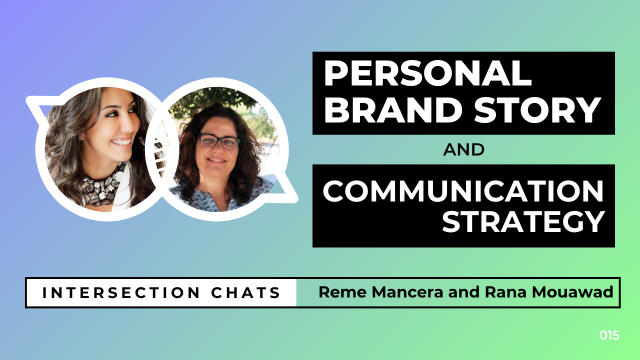
Personal Brand Story and Communication Strategy,
with Reme Mancera and Rana AlBasri Mouawad
What if your visibility isn’t the problem? Is your message actually clear to your audience?
You might be showing up consistently, sharing content and trying different platforms… but if your message isn’t grounded in something deeper, it can feel scattered or disconnected.
When your message isn’t fully aligned with your story and your strategy, it can feel like something is missing. People are seeing you, but not really getting you.
In this episode of Intersection Chats, Rana and I explore the connection between personal brand story and communication strategy. We cover why aligning both can completely change how your message lands.
Personal Brand Story and Communication Strategy
Here are 3 topics we explore in this conversation:
1. How can your personal brand story strengthen your communication strategy?
We talk about how your story acts as the foundation of your messaging, helping you clarify what you stand for, communicate your value, and create a more intentional strategy.
2. Are you focusing on visbility tactics before building strong foundations?
If you’ve been tryind different strategies without seeing results, this will help you understand why clarity comes first and how stronger foundatioins make everything else more effective.
3. How can you be authentic in your business without oversharing?
Rana shares her concept of “curated authenticity” and we explore how choosing meaningful parts of your journey can help you build trust, create connection and stay aligned with your goals.
If you’ve been feeling unsure of what to share in your communication, this episode might bring you a fresh perspective.
Who is Rana AlBasri Mouawad?
Rana AlBasri Mouawad is a Personal Brand expert and Communications Consultant. She is a board advisor and a speaker, with 25+ years of international experience under her belt.
She works with founders, working professionals & organizations, helping them build reputation and personal brands to better communicate their value and directly grow their businesses.
Rana is the host of Let’s Make Waves Podcast, where she talks about Personal Brand, Marketing and Content Strategy. She shares actionable tips, tactics, and resources to guide listeners in finding their professional voice, attracting an interested audience, and gaining confidence for better business opportunities.
Who is Reme Mancera?
Reme Mancera is a Personal Brand Story Strategist and the creator of the 10 Story Connectors framework, a strategic storytelling tool to choose which personal stories to share so they build trust, create genuine connections, and lead to clients.
She is the host of the podcast Who Cares About My Story? and the live series Intersection Chats.
Personal Brand Story and Communication Strategy - Transcript of the episode
Welcome to Intersection Chats. I am here today with Rana. So excited for having this conversation. My name is Remi Vancera. I am a personal brand story strategist.
Welcome, Rana. Thank you for accepting this invitation. So excited to having this conversation today. Thank you so much, Remi. I’m really excited to, to do this with you.
And, honestly, it’s been long waiting. We’ve been planning to do stuff together, but I’m really happy that we’re we finally aligned our schedules and I’m here with you today. Yeah. Please, before we start into the conversation, tell us a bit about what you do and and what this should work about. Well, I’m a communication strategist.
I have international experience in working with organizations or with, individuals, with professionals. Specifically, I enjoy working with them on building a personal brand, building their reputation in such a way that it positively impacts their business or their career. So I help them basically to become better communicators of their value. And, I have a consultancy, and, this is basically the work that I do every day. Amazing.
And this is such a in interesting opportunity because, both of us, we work around personal brand strategy. You have a lot of expertise around the topics. You have, a a really great podcast around personal brand strategy and all the the, size and and fields that are connected to that. So really, looking forward to this chat. Me too.
Me too. There’s a lot of intersection there, so we’ll definitely dig in. Yeah. So okay. Let’s start by you’re telling us your experience on how when you work with clients, there is a a connection between communication strategy and personal brand story specifically.
Yes. There is a huge connection between personal brand story and between the communication strategy. And in its essence, actually, the story is basically the foundation. It’s the DNA of who you are, as a person, and that’s your your personal brand. Your reputation is built on that story.
So the the connection between, communication strategy and the personal brand story is basically like two face to the same coin. You know? They are, the the the story is the filter where all the messages go through, and communication is basically the platform that kind of elevates that message to and broadcasts it. So to to kind of simplify what does what does this intersection looks like, your story is basically your why, your what. The communication strategy becomes the how, the where.
So if we if we have the alignment between your story, your personal brand story, and your communication strategy, this is where the magic happens. This is where you’re able to articulate your messages correctly. You’re able to connect with the right people, whether they are your clients, your customers, or whether they are peers within the industry or other people within the industry. You’re able to basically be in a position where opportunities come to you. The right opportunities come to you.
When there is misalignment, this is where the chaos happens. And from my experience, my work with with entrepreneurs, with business owners, is that when there’s that misalignment, this is where they see a lot of the as I mentioned it as chaos. So ver basically, they they start struggling. They are unable to articulate the message. They’re unable to showcase the brilliance that they have experienced, the, the the way of thinking, their values, their their mission, even articulating what they are all about as a business owner.
And at the same time, the this misalignment, this chaos happens where then you start collect connecting either with the wrong type of customer or you’re not being heard. You’re not being seen. You’re you’re basically invisible. So this is where, the the connection between communication strategy and personal brand story happen. It’s it’s they’re one they’re one and the same if you want.
I love that approach, and this is something that I feel like is so important when and I know that you have talked about this in your podcast, and and your content is like, when you don’t have the foundations, you might be doing tactics to try to get visible, but then you are not actually working on the strategy first and having an intention and your specific goals to have, okay what do I want to achieve with that, how I am going to communicate, what is the the goal of this communication, and then how I use my personal brand story, my personal brand foundations in my strategy to put that into the communication that I do. So everything, like, makes sense, is aligned, and then you can highlight that those things that make you different, though those things that will help you to to make, to showcase your authority, your trust, and your credibility. And and something that I want to because with the with the work of personal brand story and that is like the authenticity, you’re you’re showing who you are and why this work is important to you. Yes. But I know that you use this term of create creative authenticity.
I would love for you to share a bit about that concept. Yes. Okay. So let’s just let’s just put it this way. When you again, that’s the story is you.
This is what you know, my personal brand is basically if we take the the words out. My reputation is built on who I am. That’s my story. Who I am, what do I do, what do I stand for, what are my values, and what are what are what are certain things that are authentically me that puts me apart from the competition out there. So that’s where the story is.
Communication plays, this is where the story plays a role in the communication strategy. So, having a solid story, and I wanna make this clear before the authenticity part. Having a solid story, having a really you really know which parts of everything that you are that you need you need people to know to know about without having a good communication strategy. Basically, the result is that you’re invisible. You’re great, but nobody knows you.
You know, you’re the best kept secret. Okay? Having a great strategy. You have someone maybe on board or you, yourself, and you you just know what you wanna do in terms of strategically communicating your points, but you don’t have a solid story. You’re, like, all over the place.
Your thoughts are all over the place. The result of that is basically hollow. This is where, it’s inauthentic. So that’s where authenticity plays a role. So if you wanna look at it, how does the your your story impacts your communication?
I believe it impacts it in different ways. The first one is in your positioning. It’s basically your reputation. And this is where the story or what you are, who you are, this is where the story helps you in controlling the narrative. So when we say I have a reputation for x y zed, it’s because of parts of my story, parts of who I am, makes me have that kind of positioning.
And controlling the narrative, just to be clear, it’s not manipulation, but it’s exactly highlighting parts of who you are and your story that will get you to the goal that you want to get to as a business owner, as a professional, whatever it is. So the first thing that the story plays in communication for that authenticity is your positioning. This is your reputation. The second part that it plays a role in is in the content. It’s in the communication.
And so it’s in the messaging. When your story when you have clarity on who you are, what do you stand for, and all of that, your messaging automatically becomes clear because you are able to connect the gap in the middle and the end consumer, but whether it is your audience, your clients, your, your peers within the industry, if you’re building, you know, thought leadership, they will they will be able to see that connection of what you stand for and what kind of impact that you are trying to make or a dent that you’re trying to make or what will make you unique in in in the place that you are working in in that in that space in the market. And the third way that your story plays in communication is for anything that is external communication. So we’re talking here about media relations. We’re talking about putting yourself in a position where you are a key speaker, keynote speaker, for example.
You are in a interview, in a podcast. So your story helps you to become memorable. So it helps you in in your positioning. It helps you in your, messaging, and it helps you in connection. So by having this trifecta, this is where when we say authenticity, this is where you’re being authentic.
It’s not it’s not the same kind of authenticity that is being being put out there, which is equivalent to social media influencers. You’re not you’re either a business owner or you are a professional working in a in an organization and your goal is to, you know, reach a certain c level position. Or you are a person who are at a c suite and you’re building your thought leadership because that’s how you want to, not only, push the messaging of the company that you work in, but also attract the right clients, become a player in the in the industry that you’re in. So authenticity is very much different on a professional level. And curated authenticity is when you pick and choose from your story the things that will help you to connect in the right way with the audience, with that particular audience for a particular message or a particular goal.
Now remember, the way you articulate or you communicate your message on LinkedIn while you’re connecting is very different than when you are, creating content. It’s very different when you are a keynote speaker. It’s very different. The story is the core. The story doesn’t change.
But the way you articulate that message depending so context is really important. And that’s where when I say curated authenticity, it’s like you you you pick and choose from that box where you’re getting that message to the right audience in the format that is correct for them to accept and take that message and then take an action after it. And that action could be whatever the goal of that message is to build trust, to build connection, to, to take an action on a particular thing like working with you or to take an action of your hiring. So people seeing the culture and the, you know, the background of the company and applying to work with you, that would be the end goal. Mhmm.
Yeah. Yeah. I I like I really like that, angle because it’s like explaining how you can be authentic and you don’t need to overshare. You can be authentic and you don’t need to pretend to be someone else or make up things. It’s just about who you are, but it’s about choosing specifically what you want to share and having, like, the strategic point of view of deciding why you are sharing certain thing and how that is connected to the work that you want to do or how it’s connected to that goal that you have.
And this, like, so aligned with the way that I work, you know, around stories because it’s like the 10 story connectors, they are basically connecting, like, okay, what is your audience, what is the your proposal, and then having that in mind, let’s explore your journey and identify which of these meaningful moments you want to share and how each of them is connected to something that it will show who you are, it will show why this work that you do is important for you, how your approach is different to other people that are offering something similar. So I feel that this something so important to have in mind, like, again, back to the strategy point, like Yeah. Who is the people that you want to talk to reach out? So having that in mind and then choosing what you are sharing in a way or sharing in a way that makes sense for that connection that you want to build. And context.
Context. Exactly. This is like one of yeah. One of the three factors that I highlight that you you, use your personal brand story for is, like, connection, context, and contrast. Context because show what is different, and connection with could is showing that you are someone relatable, and, of course, context because then it’s understanding.
Okay. What has been the journey of this person and how I I trust them for that journey of Yeah. Positioning. You know, I really love that you said connection, context, and, you Contrast? And contrast because it it translates exactly to what I’ve what I’ve just said.
The contrast is your positioning. Yeah. So you’re not just any consultant who works on, helping entrepreneurs do a personal brand. You are, for example, the consultant who works with entrepreneurs who want to build a personal brand that, you know, impacts their lead generation. So the more, you know, like, dialed in that you are, this is the contrast.
It keeps you apart. It’s your positioning, and you’re not lost in the crowd. The, context is the one that you’re basically in your messaging. Because then again, if you wanna say this, if you wanna say one story, let’s say you went you, you know, but let’s make it more lifestyle. You went on holiday and you’re coming back and you wanna share what happened on the holiday.
The way you share what happened with a group of friends over dinner, the same story. The story stays the same. But the way you share it and what you pick from what happened in that story with friends over dinner is very different from what you would share parts of that story. It’s still the same story with, let’s say, your grandparents or your boss. You know?
And it’s very different if you’re trying to explain something to a to your nephew or your niece who are, you know, I don’t know, 11. So this is the this is the, the context. Context is really important. And where where do you share it? Is it an online discussion?
Is it on social media? Is it in front of video? Is it in person? That’s all part of the context. And the connection is there in the end, we communicate to connect with people.
We wanna build a network of of, you know, a a really strong network around us. That’s part of the communication. We want to, have a, you know, a reputation where people see us as, you know, an option to work with. This is a kind of communication whether it’s going to be through content creation or publicity or, you know, anything of that sort. You’ll want to be taken as a thought leadership.
You want to publish a book. You wanna, you know, be a keynote speaker. It’s another level of communication. So your strategy is a mix of all of those tools, and it’s not just content on social media. Just to be clear.
Yes. Yeah. That’s not just that. Yeah. I feel that that sometimes because there is kind of a misunderstanding around what is communication and how, again, the same with, what is a personal brand.
Sometimes people think that it’s an Instagram account that’s or it’s a logo or it’s like yeah. There is so much, there, and I love how both of us, we go deep really deeply to the foundations that’s so so important. And then from there, you can adjust. And as you said, depending on the context, depending on the platform, you are adjusting the that story to the to that space. But when you have clarity on what is what is the message that you want to convey and and what are your key factors in what you offer, then it’s like, okay.
No matter if there is a new social media channel that now is a new platform there, you you will adjust and will know how to how to present your your message there, but the foundations will be the same. So you don’t need to start. Yeah. And and we can’t forget consistency because in the end, your reputation is built on consistency. And consistency in that form means that the person that they’re gonna see in real life is the person that they see online, is the person that they see, for example, in a social gathering.
Again, contextualizing, of course, but it is the same person. So this is when when we talked about the alignment between your communication and your brand story. This is where authenticity happens. Because if you’re trying to emulate someone else without putting your, you know, like, your personality into it and this happens a lot on social media where they say, oh, if you you know, because because a lot of people kind of unfortunately, we’re at a at a place where, you know, number of followers is equal to a reputation. But but it isn’t because, if you have if you emulate to try to get certain number of followers or a certain number of whatever status that you want on social media without having a core at it, without having really, you know, the solid base over there.
It’s a hollow it’s a hollow creation you’re making. You know? And you you will be put in a position at one point, sooner or later, where for you to kind of, commercialize this relationship with the followers. If you wanna if you’re a business owner, you wanna you wanna get, clients. Or if if you are a professional, you want to grow, so you want to be introduced to executives in other companies so that they you can go up the hiring ladder.
You you won’t have that kind of connection because the connection did not occur on a, on a core that is really solid. So in the sense for entrepreneurs, for example, this is where their services becomes a commodity. So they become just another consultant or they they become just another graphic designer. And when you’re just another x, you the only way to survive as a business owner is basically to commoditize your your services. So this is where you get unaligned customers.
This is where you have conversations where it is just rotating around pricing. This is where you might not even attract any kind of, the clients that you’re or the projects that you want to, to to take or to create a network around you that is the network that you will need. And they you know, it’s like a a reciprocatory relationship where they need you and you need them for everyone in that community to grow. So it’s really important to to really understand that those foundations are not are not, something that is not pragmatic. It is very pragmatic, and it is very realistic because, you know, I’ll give you an example, which is really which is really funny, but you’ll understand what I mean.
The first time I got a personal trainer, he told me I need three months. That’s what he said. The first month, the changes, you will be the only person who’s gonna see it. The second month, your close circle will be able to see the changes. By month three, everybody will be see will be seeing it, which means everything that is sustainable and that is ready to grow needs time.
You know? And I know that I know there’s a lot of talk out there about, you know, you need to do this and you need to do that except for your reputation. It needs time, and it needs trust. And without that trust and, of course, the communication and having a solid base or the DNA has to be solid, then it’s it’s just, it’s just hollow. It’s absolutely yeah.
Yeah. I feel, this, having that solid core is like a fundamental. Even it make in it makes things easier because when you have that clarity, it’s easier for you to plan strategy and to decide on your business or on your project. Because it’s like when you have not clarity, you are trying things, okay. This person is, suggesting that I do this.
This other guru is telling me that I should do this. And then it’s all the shoots and you are just jumping from one thing to another, but you don’t have that clarity or, okay. This is my path. I know that I want to try this. As you said, you give that thing some time, and then the consistency, that doesn’t mean that because sometimes feels, at least for me, feels like, when people, hear consistency, they think, oh, I need to share.
I need to be publishing every day in in my social media or I need to be, I don’t know, what doing, like, an email per day or whatever it’s like. Doesn’t mean, like, what type of consistency. It means that you are consistently be in front of that audience or that or in the in the path that you want to build, in that road map that you create with your strategy. And in Spanish, we have a say of, starting the house, building the roof. So Okay.
Which is like you are doing things in the in the no. The other way around. Yeah. I like that. I like that.
I’ll use that one time. So you start the house, you don’t build the roof. Yeah. I like that. Because it’s like how you are, let’s say, planning a quota, a social media content, planning, but you don’t have the foundations of, okay, what is your strategy in communication?
What is the the messaging that you want to share? What is the goal that you have with this specific, actions? So sometimes we go to the yeah. I have this planner that yeah. You can have it in play or whatever.
That’s not, that can be something that is useful, but first think about, okay, what is actually what I want to to to share? What is the goal of my communication? As you say, it can be different things because you can have different goals. So having that how if you don’t have a communication strategy or a strategy in general, how will you check if you get results or not? Exactly.
Exactly. You are just trying. Yeah. And this is honestly if we if we turn it the other way around, like so we spoke how the the your story. So your you.
Your your brand. You. The the personal brand, your reputation. So your personal brand story affects the communication. If we just turn it around and say, what does what does communication strategy the strategy of communication affects your personal brand story in a positive way or or whatever.
And a caveat before I I kind of say what they are. When we say communication strategy, it’s everything that you need to communicate. So it’s not just content marketing. It’s like a toolbox of things. So it’s between, anything that is in person or online, content strategy, email marketing, you know, media and publicity and PR and media relations and all of that, speaking opportunities.
There is a whole list of things that you have within your communication strategy. So what a communication strategy really helps in your story, it’s that it helps to it helps you when you have a solid communication style. It helps you to dictate the platform that you’re going to use and how you, how do you how can I say? How do you adapt your story to that platform? So that’s what a communication strategy helps your brand story.
So that this is this is really important because the platform that you’re gonna use, it could be any platform. So it could be as I said, you could be speaking on a stage. That’s a platform. You could be connecting with, with people and trying to build a network on LinkedIn. It could be, anything to do with media relations and publicity.
Your email, newsletter, and what do you do to create that kind of community. If you have a paid community, how do you do it? So any platform that where you need to communicate the communication strategy helps helps the person know which platforms are the right platforms for them, for their goal, for their north star, and how to adapt that story to that platform. So that’s the first thing that communication strategy plays really important role. The second thing that it would definitely help is that it will reveal the holes in your story.
And let me just say that. So we have we there we are who we are. We have our experiences, our our thoughts, our values, everything. And, of course, what do we offer that is that is uniquely to us? When we share our story, some parts of our story will land, and some parts of our story wouldn’t.
And that’s not because our story is, you know, wrong, but there’s a hole in that part that didn’t land that will need some kind of refining. So the more consistent you are in utilizing the different tools in your communication strategy, the more refined your story will get with time. Because you will be able every time you communicate, you will be able to have that feedback where you know which part of your story could be a previous experience. It could be a personal learning, a struggle that happened, and it could be something that lands so well. And, you know, this is something strong.
I know that I can use this when I am trying to achieve a certain, you know, outcome. But then part of your story, it’s not landing, and you just need to know what do what do I need to do not change the story, but what do I need to do to best articulate that part so that I can help it to land better for the outcome that I want in return. So communication will help you to do that, and the consistency will help you to do that. And this is a very important role. This is a very important thing.
Why? And I I wanna be mindful of saying this. This kind of articulation will help you find your voice. And when you find your voice, voice in writing or a voice in verbal, when you find your voice, this this is what again, the third thing that a communication strategy does, this will make you memorable. Because then things that you would say people would know to refer it back to you.
Oh, I I I believe Rena said that, or I believe Remi said that. Or, the way you say things, people will will remember it. And we know that storytelling or having a different way of articulating a particular message will help people to kind of remember certain things much faster than a list would do or, you know, a quick reel would do or a quick post would do. You know? So these are three things that your communication strategy will help your your brand story.
And, again, we go back to when I said said in the beginning, it’s the same coin. It’s two faced to the same coin. Your story and your the way you communicated within a strategy or within the toolbox that you have is it’s one of it’s one and the same. Yeah. Yeah.
And I really, like this, idea of how when you communicate your story, you see the holes, and then you use the feedback or you see the interactions that or they’re not interactions in the same for example, I remember when, like, practicing how I introduce myself, I was doing a lot of online networking. Yes. So every time that I introduce myself, I can see the faces that they are not understanding, they get attached, they are interested or not. And I was, like, every time refining my message in there when I do because of that feedback, even if they don’t see it say Exactly. I was, like, noticing if they were like, what is good with us?
Or they were, like, really leaning to, oh, I want to hear more. I can see how she get excited, and then they are curious about it. So and I really, appreciate you explaining this idea of communication is more than what maybe people might think at the beginning because it’s like this idea and I feel like nowadays it’s even more important how communication is, like, only channel. You are yourself and how if I interact with you in a platform, I want to be a consistent experience if I go to your email newsletter, if I go to your YouTube channel. It doesn’t mean of course, there will be nuances and and I just fix the platform, But overall, they will be a similar experience because I am interacting with you or getting your communication.
Yeah. And I feel like that is really important especially when you are trying to convey a certain value. Let’s say innovation, creativity, approachability, how the interaction with you is showing those values is so important. If you want to be looking some something of someone approachable and then your email are really cool, and it feels like it’s a It’s a different person. No human there.
It’s like, okay. How this is connecting with this other approachable side in in my social media that I am, seeing of that person. So I feel like that’s something that sometimes we don’t take into consideration and I feel like it’s also important how the being the coherence between the different channels as well in terms of the communication that you are trying and also what are their values and how you are applying those into the things that you do, into how you share your messaging. I feel that there there is also something to think about. Yeah.
Go ahead. Yeah. No. I was gonna say and there are a couple of, like, couple of things that would happen that could happen that results in this disconnect also. One of the thing is, like, I don’t wanna say crisis communication or reputation management.
But, when when you’re doing let’s say, you’re doing everything by the book and your communication is consistent. And it’s across the board consistency in terms of the really proper reflection of who you are, your personal brand, into everything that you communicate. But there’s still a disconnect in terms of the connection between you and the audience. This is where we need to kind of stop and and reflect. And this is honestly, I’ve especially the last few clients that I had, even the most recent ones, a lot of entrepreneurs feel that kind of disconnection.
And that is because and we have to be re really mindful of this. Your story is you. And you as a person, you evolve. So you evolve as a business owner. You evolve as a professional.
You grow. You you you evolve in terms of not just skills, but just also in terms of mindset, in terms of learnings, life lessons, work lessons, all of that. So you evolve and so does the, your story should evolve with you. And that disconnect, that first type of disconnect happens when your story hasn’t been evolving with you. So this is where you have, for example, business owners who are brilliant and great, and they were doing really well, and they started with a particular niche.
But few years later into their business, either their niche expanded or they have added other things or changed or pivoted, but their story and their communication did not pivot with them. So this is where the disconnect happens. So sometimes you are consistent, but you’re consistent with an outdated message. And it doesn’t mean that you take what you you’re not gonna take who you are and just dump it and start over. But this is where your communication, strategy will help you to find out that, wait a minute.
There is a disconnect in my there’s reputation management. We need to manage our reputation. This disconnect could also happen because of market dynamics. So the market changes. And this is where I’m we’re gonna talk about it.
We have to. This is where AI plays a role. So here we are, and there’s market dynamic that changed, and there is the the, you know, the presence of AI. And this is where consistency, if it’s not put under the microscope in the sense that your you don’t lose your voice to the market changes, okay, and you’re not consistent by losing your voice because of the market changes, again, you will have a reputation management issue. So when you gave the example of this is me as a person, but for examples, in the emails, it’s like a different human.
It’s it’s a robot or something. This is when the reputation management might happen where we are leaning so much towards AI without having the tendency to make sure that we don’t lose our voice in the process. So, I mean, we we all, as business owners, we have to use technologies to to grow. Grow in whatever way your goals are of growth, whether you are, creating a SaaS business or whether you are a lifestyle business. You know?
There is. Every everybody has a kind of, processes, internal processes to make things easier, and AI will play that role, and it’s an amazing role. So nothing against AI. We’re we are talking specifically about AI and your and your reputation that creates that disconnect because the messaging within within what’s happening, you are hiring AI to be your voice. And we have to be really careful.
And it’s not just the type of, questions that we need to put into AI or the type of, prompts that we need to give so that we can get everything I we have to make sure that, we don’t lose our our thoughts and our, you know, personal growth because we are renting our mind to AI. And we have to be really, really careful because in the end, there will be a gap Because because AI cannot con contextualize things. AI cannot be you within your your voice. It can use it. It can take from everything.
It will reach a 90%. But in the end, the person who’s going to see you in person versus what do they see online will be there will be a gap somewhere there. Yeah. Yeah. Absolutely.
I feel like, we we need to be really careful in the sense of, okay, how you are just throwing things to AI and getting what the it gets and then using it, or are you making sure that there is, like yeah. You might be using AI and this is a a tool. As you say, it’s a tool that we are going to incorporate in a way or another in our businesses, but how you use that tool, that will be key. Same with other kind of tools. And it feels like it’s like something that is magic and it’s going to, make everything for you, but you need to be pay attention on how you are making the instruction, how you’re making sure to review the the results, how so all of that, again, going back to the foundations, you need to be sure about what is the strategy that you have in place and how AI can be a tool for helping you in that process, in one part of the process or whatever.
But then it’s like, okay. Are you checking and making sure that everything is, is, aligned with your Aligned. Yeah. With your voice? Is is sharing what you want?
So yeah. I I really I I think that this is important. Like, when you are sharing something, it’s your reputation, it’s your voice, so make sure that’s there and it’s aligned with you and you will sign that that message. It’s not just sharing, like, blindly. And then when you mentioned about the pivoting, I I know for for myself and for my for clients of mine how when you are doing that pivoting and sometimes you are in a situation where maybe your website is not aligned with you are sharing now or what you are offering now, and you feel kind of shame to share your own website because it doesn’t feel like yourself anymore.
We all went through that. But this, like, if your business is still going on, you will evolve and your business will evolve and you will need to refresh how you introduce yourself, how how is your about me page look like, and how you use your personal brand story, and how when you evolve, maybe what you are doing in the past will become part of that, and you will use that. But you need to to refresh and make sure that, yeah, this is what I want to share now, and this is why I am sharing now. And, yeah, it’s something it’s an evolution. It’s not something that you do once and it’s done.
Same with communication strategy. Absolutely. It will change and and your goals will change. So it makes sense for you to review that. That makes sense that the platform that you are using are the ones that make sense for you in this stage of your business, of your project.
So it’s a a work in progress, and I feel like with, having clarity in the foundations, it’s easier for you to move to the next stage because you have clarity of what are the assets, and then you can refine things, but you are not starting from scratch. You are starting from a place that you know what you feel comfortable sharing, how you what is your communication style, which platforms are more natural to you. All of that will play a a huge, place in in considering the new, pivoting that you are going to do in your communication. Absolutely. Absolutely.
And especially what you are able to be consistently on. So if we become tactical, like, if let’s just talk tactics. You have a lot of people, a lot of people who are very successful at what they do. And if their presence online is written form on LinkedIn. No pictures, no videos, not but written form on LinkedIn.
So I’m not saying that, you know, those tips that says the hook and the, you know, these add. But if we if we really start going through some of the success stories out there, they are very successful in what they do. Their businesses are doing really great, and they are they are using a form that is comfortable to them. And it might be not what is common and what’s out there, but what will make them successful is not that they’re riding the wave of algorithms, but it’s because what’s in the message. It’s because what’s in the material that they are sharing, what’s in the communication that they are sharing.
There are people who went on stages like, you know, TEDx or something like that that might have very, very small following. But they their impact is big, and the impact on the people that is relevant to them is big. So, yes, it is sometimes very, tempting to say, oh my god. I I need to do this. I saw this latest, tip that says I need to do that or I need to show up in this particular way.
And my tip to them is that if that tip is a reflection really of something that you are in in real life, you it is it is something that is very much mirroring who you are, by all means, do it. But you will find results when there is consistency, and then there is a particular clear KPIs of what exactly you are, monitoring. So the the monitoring should not be only on and people call it vanity metrics, but it’s not just the followers or anything. But when you’re a business owner, your your monitoring maybe could be something like how many people actually went from that, post and checked my website. How many website visits did I get?
How many people clicked on the, more information and filled up the form? How many people sent DMs? How many connections that I requested on LinkedIn, and I actually got an immediate yes? How what is the email rate opening? You know?
Like, sometimes that what you need to monitor is very different from what is really out there because that that things that your monitor is actually what’s going to give you the result in the end as a business owner. You wanna make money. You wanna, you know, you want your business to be afloat. So, so that’s really important to really, really hone in on that. Yeah.
100%. Like, being really intentional. And, again, you are doing something that’s part of the strategy of planning strategy. You are planning what you are going to do, and then you are planning how you are going to to, see if that is getting results or not. It doesn’t need to be this complex, dashboard of millions of numbers.
It can be just one metric, but having clarity in which is the right metric to check Sometimes it’s so important because it’s like, yeah, you can have a lot of followers, but that those are qualified followers. It’s like when people try to go buy it out. Yeah. You can be buy it, but this if it’s not the people that might be interested in what you offer and you want to use that as a business owner, doesn’t make sense. So why are you putting your efforts there?
It’s maybe even the opposite is doing a damage to your brand and to your reputation. So sometimes we need to be really careful with that because there are Yeah. Like, advice that is one goal that maybe is not useful for you at all. And maybe your your business model doesn’t have anything to do to someone else that is working around volume of people in their email list. And maybe you are a premium service one on one base.
So for you, maybe you need to do something totally opposite and will not be the same advice. So having in mind what is the business that you have, what is the model, and what is the lifestyle that you want, because maybe for that goal you will need a team of ten, twenty people and that’s not your goal or your business model that you want to go there. So having clarity on the again, the foundations, I feel that’s so important to then analyze. Okay. This advice makes sense for me or is it is it an advice that is not good for my type of business that I want to build here?
Yeah. And which which season of were season of, of business you’re in. You know? If you’re a solopreneur, focus. You know what I mean?
Focus your efforts. Try to kind of dominate on one one particular platform, maximum two, and platform, not just social media. I mean, one particular platform when it comes in your communication strategy. One or maximum two because you’re alone. If you are a 10, a 10 person agency, that’s a little bit different.
Your communication will include or should include, you know, this is something that I recommend. It should include employee advocacy. They are also, you know, brand advocates, and they should be also out there, and their personal brand amplifies the business brand and amplifies you as a founder, a founder of the of the company or the agency. If you’re a 100, employee, it’s a totally different you probably have a department of, you know, communication and Markham department, and your the the dynamics would be different because the product or the services that you’re selling would be different. Yeah.
So every season is is different, and, therefore, just, like, focus on where exactly you are in your season, what is reasonable and doable, Okay? And what is, the the best the best thing that is out there that can get you the maximum outcome? There’s no perfect outcome, but the maximum outcome. And Yeah. And then go for it.
Yeah. Yeah. Absolutely. And we will not have time to go in that, conversation, but Yeah. Employee personal brand, I feel that that’s something that you touch and it’s, really something that is sometimes is, overlooked.
And I feel like that could be so powerful in terms of not just the external communication, but the belonging feeling of, your employees and and all of that. So, yeah, maybe that’s a conversation for another chat to cover. For sure. It’s a big one. That’s true.
It’s a big one. Yeah. Okay. So before we wrap up, I don’t know if, there is any thought or or message that you want to share, something that we haven’t covered and you feel like it’s important for us to highlight. Oh my god.
We’ve covered so much. All I want to say is just actually to hammer something, something, and that is your your story is you. And it should it should be something that is dynamic, not static, just like you are dynamic and you’re not static. And your communication is the you know, your who you are and your communication is two sides to the same coin. So, this is something that I hope could be a mindset shift, because I know there’s, like, the, a lot of, shiny, object syndrome out there of people trying to drag you into different directions.
And then what I would what I would always say is go back to the basics. Because when you go back to the basics and you’ll you really do your homework and you really do your subs, this is actually could create a huge impact more than you can think. So, this is what I wanted to, like, re re hammer this message, honestly. Yeah. 100%.
Okay. So to summary this conversation, I always invite, my guest to use a couple of words, that can convey that connection between, in this case, personal brand story and communication strategy. What will be your way of, summarizing that? You know, I’ll I’ll go back to the three c’s for me, which is credibility, connection, and clarity. So, I would start with clarity.
When you have clarity of who you are, what do you bring to the tables, what is uniquely you, this will create and will start building, a foundation that will be strong enough for the credibility part. Because when you are able to articulate your message, clearly and consistently across the different platforms that you are in, you start building, trust, and trust built credibility. And the trust and the credibility will land you the connection. So the connection, whether you are in the room or not, people will mention you. The connection of opportunity is finding you because you’re you’re the right person for for that particular opportunity, whether you are a, you know, working professional or you are a business owner.
Or the connection is connecting within a community of peers or, industry leaders or connecting with your audience. The audience that will your work will positively impact them, and their connection with you would positively impact your business. So I would go back to these three c’s for sure. Nice. Thank you for that.
And for me, I would say, foundational pillars. I feel like both of them, like, that combination of using in a strategic way in your communication, your personal brand story, and how they feed each other, I feel like both of that are, yeah, something for your foundations of your business or or your career if you are using as a in your in your yes. Promotion. Absolutely. K.
So thank you so much for this conversation. I feel like we might have a second part for coming to say more things. So thank you so much, and I know that you have several resources that that might be helpful for people if they are interested in learning more about what you do. So how people can learn more about, your work and and how you help people? Well, they can find me on LinkedIn, on Rana Mawad.
And, of course, there’s my website, ranamawad.com, where they will find free resources. I have, a lot of things that they can download, or there’s the podcast, as well as other ways to work with me. But, they’ll definitely find me on LinkedIn. Thank you. Yeah.
The links are in the description so people will, have easy access. So thank you so much. Thank you, anyone who has, been live or watched the replay. Until the next time. See you soon.
Thank you. Bye. Bye.

Want more conversations like this?
Explore more episodes of Intersection Chats where I invite guests to talk about how personal brand story intersects with their expertise. Get real-world insights from experts across different fields on how personal brand storytelling builds trust and genuine connections; plus tips to use your personal stories more strategically in areas like PR, email, SEO, content creation, and beyond.
Here are a few examples to get you started:
- Personal Brand Story & Conversion Copywriting, with Reme Mancera and Mimi Zhou
- Personal Brand Story & Market Differentiation, with Reme Mancera and Marj Martirez
- Personal Brand Story & Video Storytelling, with Reme Mancera and Paige Burns
Whether you’re just starting to explore your personal brand story or want to apply it more strategically, these chats offer real-world insights from experts across different fields. Don’t miss the opportunity to get the most out of it!
WORKING REMOTELYInternational

GET IN TOUCHContact
WORKING REMOTELYInternational
CONNECTSocial links
Reme Mancera · Personal Brand Story Strategist
Copyright © 2018-2026 Reme Mancera. All rights reserved.