Personal Brand Story and Life-first business,
with Reme Mancera and Kate Kurdziej
Have you ever paused and asked yourself if your business is actually supporting the life you want?
It can be easy to get caught up in what success is “supposed” to look like, but sometimes, even when things are working, something feels off.
In this episode of Intersection Chats, we explore how your personal brand story intersects with building a life-first business, one that aligns with your priorities, your energy, and the way you actually want to live.
Having a well-identified set of personal stories and understanding how they are connected to your audience and your offering would help you get clear on the foundations of your strategy. That clarity shapes how you make decisions, define success, and build a business that actually fits you.
Personal Brand Story and Life-first business
Here are 3 questions we explore during our live chat:
1. What does your story reveal about what success really means to you?
Beyond the numbers and industry expectations, we talk about how understanding your journey and your why can help you define success in a way that includes your lifestyle, your needs, your desires and what truly matters to you.
2. Are you in the messy middle and unsure what’s next?
If you’re no longer a beginner but not fully clear on your direction, we discuss how revisiting your story can help you reconnect with your priorities and move forward with more clarity.
3. Is your business aligned with your story… or drifting away from it?
We talk about how using your story as context can help you make more aligned decisions, so your business supports your life instead of taking over it.
If you are looking for more clarity, simplicity or alignment in your business, I think this conversation will resonate with you.
Who is Kate Kurdziej?
Kate Kurdziej is the founder of Olivier Consultancy. She is a retreat strategist and business consultant based in Spain, supporting female founders to design and deliver retreats that are both commercially successful and deeply aligned with the life they want to lead.
With over 15 years’ experience in business operations and strategy, Kate helps retreat hosts create the structure behind a sell-out retreat, from offer design and pricing through to marketing timelines and sustainable delivery. Her work bridges the gap between a beautiful retreat concept and a retreat that fills with the right people, profitably and with ease.
As a working mother and the host of her own business retreats in Spain, Kate understands the desire for a business model that creates more space, not more pressure. Through her consultancy, she helps women build retreats and businesses that support freedom, calm growth, and a lifestyle-first definition of success.
Who is Reme Mancera?
Reme Mancera is a Personal Brand Story Strategist and the creator of the 10 Story Connectors framework, a strategic storytelling tool to choose which personal stories to share so they build trust, create genuine connections, and lead to clients.
She is the host of the podcast Who Cares About My Story? and the live series Intersection Chats.
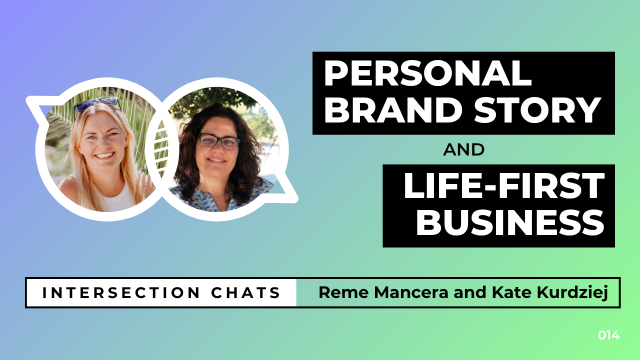
Personal Brand Story and Life-first business - Transcript of the episode
Welcome to Intersection Chat. I am Remi Mancera, a personal brand story strategist. I am here today with Kate. Thank you for accepting this invitation. Hello, Kate.
Hi. Lovely to be here. Thank you for having me. Yeah. Of course.
Please tell us a bit about, what you do and what do you mean with Life First Business? Yes. So my name is Kate Kerje and I’m a life first business strategist and mentor. What that means is putting your own enjoyment of running your business first. So yourself first.
Quite often, I have seen over many years of running my own business and consulting for other women in business that we always come bottom of the list, bottom of the priorities, bottom of who gets to take time off, who gets to stop working. It’s always us or the business owner that ends up working more and more and more. So the idea is that we build a business that supports our life and we don’t try and fit a life around our business. And it’s it’s become quite evident over the years that women specifically are sacrificing themselves for the sake of business success. So my role is to encourage my clients to think about what really matters to them, what their life would look like if they could have everything they ever wanted, and then we create the strategy to get them to where they want to go, not where some random business coach who promotes, you know, ten k months, 6 figure years, whatever that might mean.
That might not mean something to my client. So it’s all about making sure their life is aligned to what actually they define as success. And we have everything from working four day weeks to working part time to employing, actual real life employees, going from associates to an employee model, raising prices, removing clients, bringing in better quality clients for higher prices, all of the things that might mean moving towards their goal, that’s the strategy that we put in place. So it’s across the whole business, encompasses marketing, operations, sales, all of the back end support as well, and the client delivery, to mean that you have a business at the end of the day, which you are proud of, that you are not feeling like runs you, that you run your business. You are the leader of your business, and you’re very happy with the journey that you’re on.
I love that you bring this idea of how success can looks different for for different people, different business owners, and I feel that’s really important. And sometimes there is, like, a mainstream concept of what is success and how is a successful business looks like, and that could be so different from different for different people. And it is. And, you know, when we see these money milestones, they’re very important because, you know, we’re not running not for profits, charities. You know, this is a business at the end of the day, and I want to make that very clear that I’m not like, you don’t need to make money.
Of course, you do. It’s a business. And to create the lifestyle that you want, you need a certain amount of money. I want you to reframe and rethink what that actually looks like to you. So is it that you need 5,000, 10,000, 20,000?
Who knows? But having some depth behind the numbers is very important and not just focusing on the revenue, always focusing on the profits as well and how much you’re paying yourself each month, is very important. So I think, you know, sales and marketing coaches do a brilliant job of pushing the the money milestones, but I think unless you have depth behind it, you can burn out quite quickly just trying to make that your only goal. Whereas actually deep down your goal might be to work less and go to a beach and spend more time with your family. And actually I would argue do you need x amount of money to be able to do that if that is your definition of success?
So there’s no rights or wrongs. I just ask my clients what really, you know, what is success for them? What do they actually want to be doing? And actually, a lot of women don’t know. They get so caught up in you know, they start a business, they land on Instagram or somewhere else, and suddenly, all they see is money milestones, and that’s what they then use.
That’s their measure of success. And next year, I make 50 k. Next year, I make a 100 k. And, actually, they haven’t stopped to ask themselves and reflect on why did I really start the business? What is it that I’m actually trying to create?
And most of the time, we want money. Like, you know, we’re here to make money, of course. Most of the time, we actually want to work less. That’s often more important than making way more money. And so my argument is, why can’t we have both?
Why can’t we put just as much emphasis on the life and the lifestyle and the enjoyment as the money and the the revenue milestones and goals that go with it? Because I think you can have both. I think they can live in harmony. But we’re forced fed this one. And, actually, my sort of work these days is around, well, what about this one?
What does this one look like to you? And that’s the one that isn’t cookie cutter. That’s the one that we really have to go deep on to understand what your life, you know, it’s quite a deep question, isn’t it? Like, what do you actually what do you want from your life? And I think that is quite when you’re caught on this treadmill of business business business make more, you don’t take enough time to stop.
I certainly didn’t in the first few years. Stop and think, what am I actually doing this for? Like, if I’m working twelve hours a day or ten hours a day, that’s the opposite of what I wanted to do, but I’m making loads more money. So which one’s more important? And I think those questions are really crucial to ask certainly after you’re through that startup phase where, of course, you need to get the wheels turning, you need to get clients in.
There’s a certain element of you do need to put extra effort in in the first few years, but after that, that’s not sustainable. So what are we doing this What are we doing this? Yeah. I 100% agree on that idea of asking yourself why. When I work, with the foundations of the personal brand strategy, one of the things that we we we analyze is, like, your why.
And I always like to have, like, two types. One is, like, the global why. Who do you want to have or how you want to help them? Why this this solving this or helping in this situation is important to you. But then also the internal why, why you started your business, why you want to have this certain lifestyle.
And all of that, it I feel is so connected to what you are sharing about priorities, values, and and really being aware of what is important to you, then how you make your business around that and and make everything align. Yeah. I think there’s a lot of parity between the two because you’re exactly right. The why is important for, you know, creating a business that you want. But the marketing of it, you need the brand story.
You need to understand where you’ve come from, right, and where you’ve ended up and why it is that you’re doing it. So it’s all it’s very it’s very linked, I think, these two these two worlds. Yeah. I wanted to ask you specifically in your experience with your clients, how have you seen, like, their personal brand story having clarity in their personal brand story has happened to have more clarity in this idea of the life first business. How has been your experience with working with clients and yourself?
So the word that I always use in a lot of my marketing and how I help people is that clarity. It’s that clarity of understanding where it is that you’re coming from, where it is that you’re going to, and often I help clients in that messy middle stage where they’re not start up anymore. So a lot of the work that I do is it can be quite deep because it’s because it’s transitioning from that, I don’t know what I’m doing. I’m so busy. I’ve got too many clients.
I don’t really know what I’m doing. I’m always working on my laptop late at night to being more of that CEO leadership role, very clear, very calm, very, focused in the business direction. And a lot of women need help to get to that point. But to get to that point, we almost need to go back to the beginning of the story and understand why did you start the business, what is it that you want to achieve, and look at this story because quite often so say I’m helping somebody build their agency and going from a sort of solo, social media or marketing or virtual assistant, something like that, or HR accountant by themselves. And now they’re like, oh, I’m ready to expand, but I’m scared a lot of the time.
I’m scared to make a mistake. I’m scared to manage a team. I don’t know what I’m doing. So my role is to to almost guide and hand hold through that transition because the practical stuff’s easy. I can tell you how to manage a team.
I can tell you how to delegate. I can show you all of this stuff, but most of it is up here of actually feeling like you are able and capable and very clear on the direction of the team and what you want your whole business to do. So I think there’s definitely an intersection here because we always have to go back to be able to go go forward and work out if this is actually what they want. You know? Because the the idea of of following their story throughout and actually thinking, well, do you want to grow?
Or do you want to stay by yourself and take on a different kind of client or bigger projects? Do you want to manage a team? So that’s where we always have to go back to the why. So why did you start? Managing a team isn’t easy a lot of the time.
So do you want to take on that role? You know, are you prepared for what comes next? And quite often then, that’s when we have to go back to, what are you doing this for? Do you wanna acquire that? Or do you want more money?
Or what do you want? And yeah. So there’s there’s a lot of questions that get thrown up, but I think going through that story with people, and I don’t necessarily do it from a marketing point of view, but often there is a switch in in the marketing because they’re suddenly saying I’m now an agency owner and they’re seeing themselves and talking them talking about themselves in a very different way. So it kind of does feedback to the the branding and the marketing as well. Yeah.
I feel like when you have these analysis and kind of, like, reevaluation of your priorities on your business, like, financials, then it’s going to affect your messaging because then you have clarity in in your why, you have clarity on what you want to achieve, your goals, your business goals, that also is going to reflect reflect on on your messaging, your voice. And back to your point, if what you want is, let’s say, from a solopreneur to an agency, one of the things that will help you also to have your team to understand the context of what has been your story, what is the your brand voice, all of that using your own story there could be really, powerful for them to understand why you are doing this, why you are doing in a certain way, because there are other people offering similar services, but then you have a unique approach and that usually is going to be connected to a meaningful moment in your in your life. How when you share that with people that work with you, it’s not just beneficial for your clients to understand, what has been your your path, but also for the people that work with you and is going to embrace that messaging, that’s that brand voice.
So even for that could be helpful to have clarity on on your story and how it’s connected to the values and the goals of your business. Yeah. 100%. And what are the big fears about when, somebody is feeling ready to expand beyond themselves, so, like, hire team members in? There’s a big worry about getting the right team member and making sure that there isn’t a reduction in quality of service delivery.
And I think a lot of that can be mitigated with making sure that you are very clear on the business and the brand and the voice and the story and all of the wonderful stuff that you do to actually make sure that people are coming in because they connect with that, because you want your team to connect with the overall message and value and feel like part of the team. You don’t necessarily want associates or employees who aren’t connected with that journey. So I think that’s really important. Mhmm. And back to your point of clarity, I feel like when you have the strategy, when you have clarity on what are your intention, like, how you want to be intentional in everything that you do in your business Mhmm.
It’s like, okay. What are the assets that I have? And I feel that there, you still become an asset to help you build that life first business because you are providing the context of why you started doing this and you continue and how is your evolution, especially because you are working with people that they are not in the earlier stages. Yeah. They have more knowledge about what they like, what they don’t like, what type of clients or or business models feel right.
So all that is really important information in especially in that evolution because even, you know, when you start and you introduce yourself in a networking event, for example, there you have a a way of introduce yourself, but you keep evolving. Your business keep evolving, and that’s going to change. I’m using your story to to provide more context and to help you build that connection with the people that you are in contact with. Either they are potential clients or collaborators or even team members, but that’s going to help people understand, okay. This is the journey of this person.
This is why this this is important for for them. So I feel that that’s also really interesting how the clarity is so connected to the strategy when you have yeah. You know what are the intention, what what is the destination that you want to go. Yeah. Yeah.
And I think sometimes I was speaking to a client, on one of my retreats actually. So she was saying that she sometimes suffers with perfectionism and procrastination because she’s so worried that she doesn’t know the end goal, like the end of the desk, you know, what is the destination and actually with work that we did and with a guest expert that comes in on my retreat as well with some mindset work. She actually reflected that she doesn’t need to know the final destination. You know, it’s sometimes the joy is actually just knowing what the next step is, you know, an overall goal of, I maybe wanna work less or or I wanna take Fridays off or, you know, whatever that might be or I wanna earn a certain amount, all of those kind of things together. But actually, we don’t need it to be like, this is what my life is 100% gonna look like.
So I think that can be quite scary to people and makes people go, I don’t know. I don’t know. And I think, okay. Well, in twelve months time, what would you like to be doing? Like, let’s break it down into smaller, more manageable goals that feed into the direction that you want, but actually you don’t need to know the end goal.
Some people do. But for this particular client, she found actually that she had a huge weight released because she realized she doesn’t need to know the end end goal. She just needs to know the next goal, and I think that’s also quite powerful. Everybody is so different with their kind of life plan. You either have one or you don’t have one, or maybe you have one for the next three to five years instead of the next ten to twenty years.
You know, everyone’s different. So making sure that your business is supporting you at this current stage and into the next stage, that’s really important. It doesn’t need to be set up for the next thirty years. We just need to go in in chunks of time and with permission to evolve, you know it’s such a great word that you use, evolve our business, evolve our messaging, and I’ve gone through an evolution recently in the last twelve to eighteen months as well of feeling like the business that I started over five years ago during COVID with a tiny baby on my hip, you know, that isn’t the business that I’m really running these days. So what is it that I want to do?
Because I’ve moved country twice in the last five years. You know, everything’s everything’s changed. So but my business, I felt like that was still the same even though I wasn’t the same person. So it’s really crucial that we don’t put too much pressure on ourselves to know the end destination, but just knowing where you’re at and almost reflecting. I don’t know if you do this, but, like, do you reflect every six or 12 months, let’s say?
And real you know, reflect on am I doing the services? Am I providing these services to people that still line me up, that still fit? You know, because there has to be a fit with the market. You know, does it fit with making money and are people buying it? But also we change, I think, as people.
So is it something that I still want to do? Because the whole element of the idea of life first is making sure that you’re happy and you’re building a business that lights you up and that doesn’t drain your energy because you’re like, oh, another button day. Like, this is something I have to do all the time. You know, how can we how can we create a business that’s means that you don’t feel like that all the time because that isn’t a sustainable feeling. Do you wanna feel like that for the next twenty years?
Probably not. So how can we change it? How can we create something that is structured to fit your life right now and for the next phase? Yeah. This is, like, actually so, timing for me because as I mentioned before we start the conversation, I just came, from holidays, from taking a month off, like, no computer and all that.
So I am really in that moment of reflecting, okay, what is the next, thing that I want to try or if I have some. For example, one of the fees that I tried, and I want to keep exploring that is how incorporating the fun element into the storytelling. Because to me, I remember when I started my business feeling really overwhelmed by the idea of you need to use storytelling, you need to be vulnerable, and so all the shoots. And for me, feel like I don’t have an epic story, what I am going to share. And I know that for a lot of people in my audience, they have that feeling of, okay.
Yeah. Everyone is telling me that I should share my story, but I am not sure what to share, what is going how it’s going to be relevant for my business. So all of that. And that’s I feel connected there with your approach of splitting because it feels like too big and too overwhelming. Let’s split, and that’s why I started doing my 10 story connector framework.
Instead of looking for one big story, let’s look for 10 meaningful moments, and each of them is connected to one key factor of what you offer, so you really know why you’re sharing that story. So back to that idea of the overwhelming, I want to go from that idea. I’m bringing the fun, the joyful element to, okay, this is business, this is strategy, I love strategy, but you can also incorporate the joy, there. And that’s why I I started creating a storytelling game session, when we play with the stories and we’re sharing the same stories in different ways, and this is going back to when we were child, and this is like working with our imagination, our creativity, and being there with our humanness and the emotions and the feelings. So I am really looking forward to keep exploring that because I know that that’s something interesting to me.
Every time that I have run it, I am, like, enjoying that process. So I know that I want to explore that. And back to your to your idea of if you are reflecting on what you want, it’s like, okay. I how my business is going to reflect on my the lifestyle that I want. Mhmm.
But also how I run my business is connected to the emotions that I want to have as well. I love having the results for my clients and helping them with the clarity. I also want to incorporate this element of, okay, this can be also be something joyful. Let’s play. Let’s go back to to play with ideas and and and stories and and all that.
So I I invite people to also think about that. Okay. Analyze what is your version of success, and also analyze how values or elements that you want in this stage of your life, how you can incorporate that also in your business as well, not just in your lifestyle because also I feel that that’s going to help with the alignment. I don’t know your thoughts on this. Yeah.
I think I think well, you work with personal brand. I think it’s really hard to separate business and the person. And I think we can do it to a certain extent with great boundaries, processes. You know, we can do that to a certain extent, but actually a lot of the powerful marketing when it is just you comes from your personal brand story and sharing more about yourself. And I remember when I first started my business over five years ago, I felt really uncomfortable doing that.
I was never sure how much to share. I was never sure, yeah, of which story to share or, you know, all of these questions. And it just made me almost put a really professional veneer on, you know, like, I wasn’t I was still very much in employee mode where I had this, you know, I always worked in places where I needed to present myself in a certain way, I was always operational. And actually, slowly taking that down and sharing more has actually brought people closer to me. And I think certainly with my own personal story, that’s why my business retreats work so well is because I live in Spain.
And I can put all of my expertise together into these incredible transformative weeks, but we get to do it in Spain, you know, put your life first and literally live in a villa and have a private chef and go, you know, sit around the swimming pool and all of these beautiful things. It’s kind of a a real example of, you know, yes, you don’t have to move to Spain. You don’t have to move country, But you can slow down. You can take time out. You can create strategy in your business when you’re feeling calm, not trying to finish a client email, run to a coffee shop, work on your business for an hour, and then go pick the kids up from this from school.
Like, that’s not the calm space that you need to go much deeper, which is why I created the retreats. They were born out of kind of a, oh, let’s just do one because people thought I was running one because I I put some Instagram stories up. This was like two years ago. I put some Instagram stories up. I was in a lovely restaurant and I put on Instagram, oh, fancy coming along for a a five course meal with me.
And it was by the Mediterranean Sea. It was beautiful. And I just meant, I’ll take photos of each course and put it on my Instagram stories. And I had, like, five or six DM straight away being like, oh, I thought you were inviting us out to Spain. Oh, how amazing would that be?
And I was like, oh, wow. Like, if you’re up for it, like, let’s do it. It’s one of those things that, yes, if you really asked me, I would have loved to have done it, but it didn’t feel possible for me at that point. And then, I was working with people who were running retreats. I was supporting them, but I wasn’t running my own retreat.
And it just sort of happened from there. And then the first time I did it back in 2024, I was like, wow. This is this is what I’m meant to be doing. I know it can be better. So the one that we’ve just done in 2025, got 10 out of tens, 80% of people are rebooking.
It’s it’s just been an incredible experience, and I’ve felt fully in the in the zone of expertise and genius because it’s it kind of encompasses everything and puts me in an environment where I’m just like, wow. We get to live in a villa for a week and, you know, do all these wonderful workshops together. So that has felt amazing, but it’s taken a long time to get there. You know, let’s not pretend that this is like you just know what you want overnight. It’s trial and error and feeling, you know along your story of actually thinking I don’t like that, I didn’t like that, and working out where your next move is.
And it’s you know it’s over five years into business now and I’m like oh this is what I wanted to be doing all along I think but I wouldn’t have been able to do it five years ago. This is the right time to be doing it. So yeah I think good things happen, but you have to be brave enough and courageous enough to try stuff and fail. I don’t like the word fail because I think in business, even if you did it, it’s a success. Doesn’t matter if no one buys.
Doesn’t matter what happens next. But, you know, you can try and fail and try again. And as long as you’re doing the thing that inside feels like the right thing to do for you, I don’t think you’re gonna go that far wrong because you’re very clear on the direction. But I think back to my point at the very beginning, a lot of women aren’t clear on the direction that they’re going. So I think we work well together actually because I think you need to know where you’re coming from, and I think what you need to know where you’re going to, and then you can build the together.
Yeah. Yeah. 100%. And something that I want to also point is how you you mentioned that this idea of feeling possible, like, something that you maybe even not think that is possible and just, like, getting to the point where, actually, I can try this. And connecting to the idea of failing and trying, I have, changed my way of thinking of this of, like, I am experimenting things.
So in an experiment, all the time, you will get learnings, and you will get lessons, and just trying is already something that is like, okay. I have achieved something. I have tried this, and then I did not work as I expected, but I am getting lessons from there. I am iterating or changing things. So Mhmm.
That has helped me a lot. And it’s a mindset that from my business, I’m trying to incorporate to my life as well. So how everything is, going back to that idea. And something that I I really feel like you are really an example of someone leading by example, and, like, working the talk because of, how you share your story as well as a part of how you have, getting that that point and how you are sharing your lifestyle. And and so it feels to me from when I am interacting with you and your business, it feels so aligned in the terms of, okay, you are helping others to run these life first businesses, and it feels that way with your own businesses when I am getting near your brand.
Yeah. Oh, thank you. That’s really important to me that it’s very genuine and, you know, there’s a lot of, rubbish online, you know, a lot of untruths, a lot of bad advice, a lot of twists to make something seem a certain way that isn’t necessarily true. And I think you know everyone loves the idea of sitting on a beach and getting a Stripe notification. Like, amazing.
We we would all love, I’m sure, to be fully passive income, like, you know, but we also love working with clients. I work with service providers. You know, we do this because we’re good at the thing that we deliver, and that also gives us a sense of achievement. So I’m very careful that it’s a very genuine alignment with with people. I still consider myself a service provider, and I still have, you know, a couple of clients on retainer where I work actively in their business at a senior operational level because I think that’s important not to disconnect from that too much.
If I am helping service providers, I need to know what’s happening on the ground. So it’s genuine in the marketing of it, but it’s genuine in what I’m actually doing as well. It’s very, important to me that that is authentic across the board. So, yes, I think, you know, we all share the highlights. And I always say I really need to share more of the the lowlights.
And, you know, I try and be very realistic. But, actually, I think we could all do a better job with sharing what’s not working or what we tried and that didn’t quite work or those kind of moments as well. And I think that’s very easy to say and not so easy to do. But that is my commitment, you know, going forward to to try and share more of the whole journey and not just like, I live in Spain. Isn’t it great?
You know, because I do share that, and that’s completely genuine. I never fake anything in any way, and I never would. However, there’s moments where it’s not so good. And I try and talk about that as well. Like my son goes to Spanish school now.
And you know, there’s conversations that I have to have with, you know, the the, what is it in English? Like, dinner ladies, like, the ladies that look after them after lunch time in the playground. You know, you have to have conversations with them in Spanish. And, you know, to to be able to do that, you have to do a lot of learning beforehand. And you know what it’s like speaking a second language like that is quite, quite scary sometimes.
So, you know, there are moments of my life across the week where I’m like, yeah. It’s not all roses and, you know, isn’t it wonderful in Spain? There’s there’s times in the business as well that I think, like, I should share more of this. And I think that’s something that we could all do. I’m sure it’s not I’m sure it’s not just me.
But I think that alignment piece is really important because if you’re seeing a a mentor or strategist that’s only ever doing amazing things, I sometimes think, well, doesn’t that create the like, almost widen the gap? I want to close it and bring people closer to me. So just a point of my own reflection there. Like, that’s something that I want to to work on myself. Yeah.
I really like that that idea of being intentional with bringing not just the highs but the lows. And I feel like also some of the ways I have seen how, people that I work with, they are trying to incorporate that even with their own stories. When when you are sharing moments of your stories that maybe felt like something that was in the back direction, but how that bring you a lesson that now is helpful, that’s something is sharing how that’s part of the journey, and it’s going to be highest and lows. Sometimes using telling your stories can be a way to create that safe space that you mentioned before because I feel like when you go deeper and in your work and in mine, we we go deeper because it’s related to what you want in your life, what you want and how your path has bring you to the moment that you are now. I feel like they’re creating a space where people can feel like, okay, this is a space where I can share my my thoughts and my concerns and my fears and my desires.
Doesn’t need to be space where I feel, yeah, I can be vulnerable here and not, in so it’s the safe space. I feel that using your stories there and your own vulnerability in the sense of are you sharing the lows and the highs and then share like genuine, how how I’ve seen things, I feel that can help both of the sides and sometimes because back to this idea of sharing our own stories at the beginning not feeling like okay who will care and how to do it in a way that makes sense, I am not really private person. So for me it’s like this boundary of okay, I am not sharing certain things and that’s okay. My business doesn’t need me to share that. But sometimes in conversation with clients, I will share certain things that I am not sharing in my social media, for example, because I feel that they are in the conversation.
It’s helpful for both of us, for me to sharing with them how I understand their context and for them to understand that, yeah, my human side of things somehow. So it feels like you can be the one deciding the level of detail that you want to share in certain environments that you are not sharing in others. And that makes sense because it’s the same, like, if I go to the supermarket, I am not going to share my story or what happened in my day the same way if I share with my friends. So you you are doing that in your regular life. So it makes sense that you can do the same with your brand messaging.
Mhmm. Yeah. And I think I think the the ability to use, like, Instagram stories, for example, to share the sort of mini moments of your life, I think that brings people a lot closer as well, you know, that there may be some things that you might write in a post or a reel that it’s much easier to be more human and more genuine in Instagram stories, for example. So I think there’s there’s perfect places to share these kind of conversations, in platforms that we’re we’re already using. Yeah.
Yeah. And you are the one deciding how you want to do this in a way that makes sense for you because for some people, maybe they they are not they are better writing. Okay. You can use the writing element to do something similar and maybe as you were explaining how you were just sharing this dinner, with the people, this picture, and maybe you could do the same in an email and could have been having a similar circumstances because I always invite people to look at what is the communication style that they feel comfortable with and go with that. If you are someone that are sending audios with your friend, maybe that’s your natural way of expressing.
Use that also when you are creating content or sharing your messaging because that’s something that feels natural to you and make things as easy as possible. So back to the asset that you have, it’s like, okay, how you can make things easier. And then I know that you are also a fan of simplicity in business, so I feel like there, we are also connected. Yeah. 100%.
Like, quite often I ask my clients, like, how can we make this easier? You know, like, when we’re having a conversation and they’re like, I wanna do this. I’m gonna do this, and I’m not sure about this. I’m like, okay. How can we make this easier?
Sometimes it’s easier to make the decision. So sometimes it’s actually just going through the options and working out actually what are the main two things that we’re trying to do here. And sometimes it’s just what they’re doing with the client, for example, is just so messy because they’re trying to do so many things, and everyone has in their business, like, essential things and nice to have things. And sometimes we get so caught up in the nice to have things that the essential things, like actually sending over a contract or checking in with a client halfway through their program with you. You know, all of these things aren’t really being done very well, and actually, the essential things are the ones that matter, and we put far too much in.
How can we make this easier? How can we make this simpler? How can we refine what we have so the service is actually incredible, but we’re not trying to do a 101 things and dance around the whole thing. Yeah. It just gets overcomplicated sometimes because Yeah.
A, I think we take advice from far too many people. I think we save posts on Instagram and we’re like oh we’ll do that as well. I’ll send that to my client. I’ll do that. And then we work with a business coach for six months and we do stuff and then we change and work with a different business coach for six months and then we do different stuff.
And I think there’s so many things going on there that there is a a certain argument to refine where you’re taking advice from and who you’re taking advice from and just simplify what it is that you’re trying to do because you’ll gain far more momentum doing that because you’re not trying to go off and do loads of different things you’re just trying to do one main thing. And that might be one main service, it won’t might be one main type of client, Doesn’t define what that might be, but it can feel like you’re wading through a trickle when there’s just too many things that need to. And we’ve all all done it where we’ve opened our to do list and been like, start. I don’t know where to start and you end up procrastinating or picking something that is not actually gonna have any impact at all. So I think there is a there is a beauty and simplicity in business.
Yeah. Yeah. I I this, I always say a sentence that a lot of my clients, they were like, I have you in my mind saying simplify and focus. And I know that is easier said than done, but it’s something that I try to apply even to my own business, like, okay, how we can simplify. And I feel like, as you say, it can be the offer, it can be the type of clients.
Something that you focus on is going to help you to find the right people that for that service or for that offer. It’s going to help you to to sell, to communicate, because it’s easier, and you are focusing something specific. So I I feel that there. And that’s something also that I try to do also with the personal brand story first, because, of course, you can share your story in different ways. For me, it’s really important that it’s connected to your audience and what you offer.
And then we go back to your story. We explore the journey. We identify which moments to share. Mhmm. But to me, it’s really important that you have in mind.
Okay. Who is the audience that I want to reach out, and what is my proposition for them? Again, having the clarity on that will help you to identify, okay, which parts of my story makes sense for me and will help me highlight the benefits and the skills that I am providing here. So I feel that that’s also connected to the idea of, life first business when you have the clarity of, okay, what is the the destination that they want? It can be short term or long term, but it’s like, okay, what is the destination?
And then how is the easiest way to get there for my business and my lifestyle? Yeah. Yeah. Exactly. And that’s where the strategy takes over because when you know where you’re going, where you’ve come from, and why you’re going there, then the strategy becomes much simpler and easier.
And as long as you’re taking actions in the right direction at the right time and doing the right things, so many people don’t do the things in their business that actually move the needle. I don’t really like that phrase. It’s very corporate, but, you know, they actually create impact in their business. They’ll get completely distracted with admin or scheduling emails or something like that when actually they should be following up with leads or doing a certain activity in their business because it feeds into the overall goal of where they’re going to. And I think once you’re clear on that, everything else gets gets a little bit easier.
Yeah. And I feel that they are, both of our works are connected because from outside, it can look like investing time in reflecting on your business and and the success the version of success, and this deep work can feel like, okay. I don’t have the time. I’m busy here. My biz running the business.
I don’t have the time to do this, but, actually, it’s the opposite. You invest the time in doing that more deep work, and then it’s going to reflect back in your business and and getting the results that you want. Yeah. It feels similar with the story when you have clarity on how you share your message in a way that will build that connection and that trust in people that maybe they are new to you and then using your story to build that. You are investing time and going deeper there, but it’s going to help you in a more, like, foundational level.
The same with the business call and the type of business that you want to to build. It’s like when you have clarity there, you are going in the direction that you want. It’s not I don’t remember now the same, but something around the lines of it’s not it’s more important go in the right direction than going, like, fast. Because if you are going fast in the direction that you don’t want to, it doesn’t make sense. You are, like, doing the opposite that you want to achieve.
Yeah. Yeah. And often, back to what we started talking about, often it’s the chasing the money. Mhmm. And it it’s because you’re missing the step of defining what your real goals are.
And when I do goal setting with my clients, we have a section for business goals, but we have a section for personal goals as well. Because, like you say, they’re so interlinked that, you know, my personal goals range from making sure that I always pick my son up from school every day because that’s the whole point of not working a nine to five is so I can do more stuff like that. Someone else might not be so bothered about that. But that’s important to me, which means that I have less capacity, because I need to be finished by, let’s say, 03:00. So that impacts the kind of services that I can offer, my availability, which might mean that I need to earn more money in less time.
So that means that I need to offer a certain kind of service to be able to do you know what I mean? It kind of it it all trickles through everything and that’s just one goal. You know, that’s just one measure of success for me that actually has a big impact. So imagine if you knew, you know, for anybody watching, imagine if you knew what, let’s say, five to eight very key goals are for your business and your personal life. Imagine if you knew all of them and we reverse engineered it into okay.
So this is what you actually should be doing. This is your realistic capacity. This is a realistic service model for you, business model. This is realistic pricing for you. These are the figures that you need to hit to be able to achieve this, which means that you can hire somebody, which means you can double your capacity.
Imagine if you knew all of that, you’d be like, that’s so freaking simple. But it’s because I’m now clear on where I’m going and why I’m going now. Yeah. So I feel like we we have the conversation can be going on for a lot more time, but, maybe it’s time to start wrapping up. So before we finish, I always like to to give a space.
If there is something that we haven’t cover and you feel like something important for us to for the people listening to to hear. Yeah. So I want to just send a reminder to anybody watching this, especially women, that you do not have to sacrifice yourself for the success of your business. It shouldn’t be one or the other. There is a way to run your business that feels really good, that doesn’t drain you, that gives you energy, and gives you the time to look after yourself, which is probably what you need to be doing, let’s be realistic because you don’t do that enough now, and actually take the time back for yourself.
That is possible but all of this work needs to be done to make sure that you are really living the life that you want. And business can be really fun, and it can be incredibly fulfilling, but you need to make sure that you’re doing it your way. So defining what your way is is your starting point. Love that. Coming as I said before, coming from this time of my computer, having that time off give me the energy, the creativity, and now I’m back here starting working with clients this week, and my brain is fully recovered fresh and energized.
So it’s so important to have both of the sides as you mentioned. So I love that. I like that reminder that, yes, you can have both of them. That’s a need to be one or the other, and it’s so important that you take care of yourself, as part of, strategy of your business. So, yeah, thank you for that reminder.
So final question is if you have a way to summarize that connection between personal brand story and building a life first business, How would you use that I don’t know, a couple of words to summarize that? Okay. Clarity is one that’s come up a lot. So being really clear on what brought you here and then where you want to go. So clarity is is key for personal brand story and then creating a life first business strategy.
And I think another phrase that comes up is, is the the the depth that you need to go to fully understand that but to create a business that is meaningful to you. I think a lot of women and I would count myself in this group very easily, who come out of a more corporate role, there’s almost this this veneer of not being able to share more private things or certainly more personal things. Like you said, how much you need to share, how much you’re comfortable sharing. So the depth that you need to go to to be very sure of who you are and what you are actually sharing to get to where you want to go is really important. So clarity and depth.
And if you do that work, everything else fits into place. Beautiful. For me, I will choose context and alignment. I feel that both of the the concepts are related to that. Analyzing the context of where you are, where you want to be, and then and providing your story as a way for others to understand the context.
Okay. How has been your journey and how why this is important to you? I feel that one of the, important elements that bring sharing your story is that it’s providing the context of why you are doing that. And then alignment, because with your personal brand story, you are able to highlight your values and why it’s important the work that you do. And I feel like especially in a life first business, alignment is really, really important.
I feel in every business, but especially one that you have the focus there, that approach is, I think, like, just, genuinely bringing that idea of being aligned. Otherwise, it doesn’t make sense because you are high you are bringing that type of more of business because you want to feel aligned and feel fulfilling in several aspects of your life, not just business or life, but every area. Right? Yeah. So I feel that will be my two words.
Yeah. I love that. Yeah. I I would totally agree with that. And I think, like, my little headline that I’ve been working on at the moment is, deep clarity plus simple strategy plus aligned action equals life first business growth.
Oh. So I think those words are all yeah. I would definitely definitely bring those words into into my work too. Nice. So for people that are curious to learn more about what you do and even if they want to try your one of your amazing business retreat, the links are are going to be in the description.
But if you want to send them to a specific, part to connect with you, feel free to share now, where they can find more about what you do. Yeah. So if you are ready to learn specifically about the retreats, then come over to the website /retreats, and you’ll be able to see when the next retreat is and if we have spaces on them and then apply there. I say apply because I always want to make sure it’s the right group of people. Having a group of women together is very important that the dynamics and the alignment is spot on.
So if you are a service provider and you are ready to get into real simplistic business and alignment, then the retreats are for you. If you’re ready to be decisive and step into that leadership role, this is what the retreats are all about. You could be growing a team or you could be staying solo and looking for your next step, this is perfect for you. If you want to just simply come into my world of life first business strategy and see what I do in Spain, then my Instagram, Kate underscore underscore kr j is where to find me. I’m also on TikTok as well where I share a little bit more sort of travel around Spain.
But these are the places that you’ll sort of learn more if you’re curious about that life first business strategy, anything. I haven’t really heard of that before, but you your ears are breaking up thinking, oh, that feels kinda cool. That feels much easier. Then this is where to find me. Nice.
So I am going to make sure to add the links to that, there as well. And as for me, if you if people watching are curious about learning more about story connector framework and getting examples and ideas, my website is the best, place to go. And, also, I am preparing a a resource where you are incorporating more the game and the storytelling, but it’s not ready yet. So I will wait for having that there. But, yeah.
So thank you everyone for watching this, for being here, especially Kate. Thank you for accepting this conversation. Has been a pleasure. For all of the, us, yes, see you the next time, and thank you for watching.

Want more conversations like this?
Explore more episodes of Intersection Chats where I invite guests to talk about how personal brand story intersects with their expertise. Get real-world insights from experts across different fields on how personal brand storytelling builds trust and genuine connections; plus tips to use your personal stories more strategically in areas like PR, email, SEO, content creation, and beyond.
Here are a few examples to get you started:
- Personal Brand Story & Conversion Copywriting, with Reme Mancera and Mimi Zhou
- Personal Brand Story & Market Differentiation, with Reme Mancera and Marj Martirez
- Personal Brand Story & Video Storytelling, with Reme Mancera and Paige Burns
Whether you’re just starting to explore your personal brand story or want to apply it more strategically, these chats offer real-world insights from experts across different fields. Don’t miss the opportunity to get the most out of it!
WORKING REMOTELYInternational

GET IN TOUCHContact
WORKING REMOTELYInternational
CONNECTSocial links
Reme Mancera · Personal Brand Story Strategist
Copyright © 2018-2026 Reme Mancera. All rights reserved.