Personal Brand Story and Public Speaking,
with Reme Mancera and Heather Black
Have you ever said yes to a speaking opportunity and then wondered what you should actually share?
Or delivered a talk that felt good but didn’t really lead to anything after?
Speaking is not just about visibility. It’s about connection.
In this episode of Intersection Chats, I had a conversation with Heather Black about how personal brand story and public speaking can work together to generate trust and connection when you are in front of new audiences.
Personal Brand Story and Public Speaking
Here are 3 angles that we covered:
1. Why public speaking without story can falls flat
Even when your content is valuable, using your stories makes people lean in, connect and remember you.
2. How to choose the “right” stories (even if you don’t have a big one)
You don’t need a dramatic trnasformation. Choose meaningful moments from your journey that are powerful because they are relevant. They provide context about who you are, why this work is important to you, what your values are, and what your unique approach is.
3. How to make your speaking strategy actually support your business goals
Not every speaking opportunities will impact your business in the same way. We discuss how important it’s to understand why you accept a particular opportunity, what outcome you want, and how your story plays a role in achieving that.
If you’ve been thinking about public speaking (on stage, on podcasts, in live videos, at workshops…) and would like to look at it as a long-term growth strategy that feels clear and aligned, I think you’ll enjoy this one.
Who is Heather Black?
Heather Black is a Speaking Strategist and an Event Expert. She helps Kingdompreneurs, Speakers & Visionary CEOs scale with a repeatable system to get on more stages and create their own without wasting energy on ineffective processes.
Who is Reme Mancera?
Reme Mancera is a Personal Brand Story Strategist and the creator of the 10 Story Connectors framework, a strategic storytelling tool to choose which personal stories to share so they build trust, create genuine connections, and lead to clients.
She is the host of the podcast Who Cares About My Story? and the live series Intersection Chats.
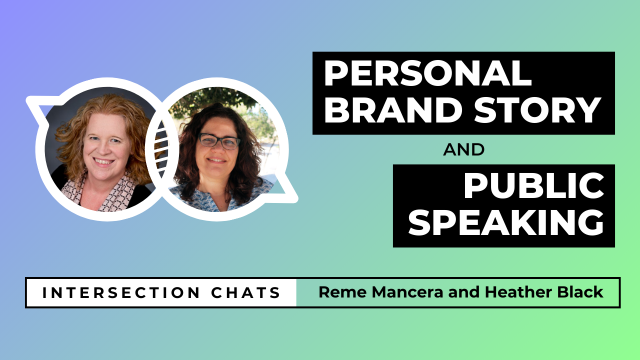
Personal Brand Story and Public Speaking - Transcript of the episode
Hello, welcome to Intersection Chats. I am Reme Mancera. I am a personal brand story strategist, and I am here today with Heather. Welcome, Heather. Hi, how are you? Yeah, good. Please introduce yourself and what you do. Uh, so my name is Heather Black and I am a speaking strategist and a vet expert. Nice. And today we are going to talk about the intersection from our experiences and how the, our work is, uh, somehow overlapping how they interact.
Uh, so please, let’s start, like, in your experience, how has been for you like, uh, the intersection between personal and brand story? Um, public speaking. Yeah, so they are completely, um, intertwined. Your brand story is going to shape the kind of stages that you belong on. It’s gonna help us identify the audience you wanna attract.
It’s gonna help us identify the types of events you want to be at, um, and the types of speaking you want to do, because speaking is, isn’t just necessarily getting on stage. There’s podcasting, there’s doing your videos. Just multiple opportunities for speaking. So your brand story is gonna help us figure out that strategy to do that.
And once you’re on the stage, your story, your brand story is gonna build trust, it’s gonna create credibility. It’s going to attract the right people to you, which is gonna help your business grow. Um, so without the story, um, your speaking can just fall flat, right? Like people are not gonna connect with it, and you’re not going to have that same conversion that you, that you want.
Yeah, and my experience is something like whenever I am working with someone about their personal brand story and they have in mind that they want to go and do public speaking, it’s like, okay, how you are going to articulate your stories in a way that is like highlighting, especially if you are a business owner and you have, you are on stage, but you are really promoting your business and your offering.
That’s a different mindset that. If you are just doing public speaking and that’s like your business, is that right? Yeah. Absolutely. It is different and it’s really important. ’cause what people connect to is stories, right? That’s what they really connect to. You can get up there and talk stats and have pretty slides and all of those things, but what people really wanna hear is the story about you, who you’ve helped, how you’ve helped them, what that transformation was that happened on the other side.
And so when you come. Articulate that in a way that people are leaning in. That’s what I always, I always tell my clients, you wanna be looking for the audience to be leaning in. ’cause when they’re leaning in, they’re connecting with you. They’re connecting with your story and what you’re saying, and that’s what you want.
Because otherwise they’re gonna be over on their phone scrolling, they’re gonna be mm-hmm. Daydreaming about, you know, what I’m having for lunch today, or, you know, what am I cooking for dinner tonight? And all of those things. And that’s not what we want, but a, a good story. It is going to make them lean in and they’re going to connect with you.
It’s just so important. Hmm. Yeah. A hundred percent. And it’s like we have been there as, um, attendees when they are sharing a lot of data and you are just, your brain goes somewhere else. It’s like difficult to, to, uh, like get the attention for, for a long time if you are not engaging with the, um, some.
Like emotions or lessons or a bit more like even if you share that data, but you connect with something that is like more relatable and something that, um, speaks a bit about who you are and what you do, right? Yeah, absolutely. And it’s very important to have, you know, your data and your stats. Yes. But you have to work them into your story in a way that people can connect with that.
And it all comes back to that connection and how they connect with you. And honestly, when you start building your messaging for your business, really think about long-term how this is going to affect an impact. Because what people really want is when you start understanding your audience and their pain points, you can start incorporating that into your story and how your brand.
Can fix those pain points, right? What am I doing to serve my audience? So it’s just really important. And a lot of times it comes back to your why, which is one of the first things I work with with my clients is what is your why? Right? That, why did you start your business? Why do you wanna make do this work?
Who benefits from it? And all of those things compile as you know, and I’m sure you work with your clients ’cause you do the 10 different story connectors, right? Yeah. So I think, and I’m sure that their why and all of those things are, are one of those story connectors that you do. Right. And why? Because that’s what people connect with.
Yeah. And so when you have those stories and you can tell them in a way that is compelling, it just creates more impact. Um, and when you start speaking, suddenly you’re making more impact because your story’s going even farther because those people leave that room and they go tell their friends. Right?
Mm-hmm. Oh my God, I heard this amazing story. Oh my God, you wouldn’t believe what I learned today. Right? And so that impact becomes a ripple effect that really can just reach way farther than you ever thought, just through your marketing, through just through your clients and referrals. Yeah, absolutely. I feel like even when you, because that’s happened.
In business, you are like uncertain about something. It is like, okay, what is your why, why you are doing this. It’s like reminding even for yourself, uh, why, why you want to, to start this business and working with this group of people and all that and this something that, yeah, certainly I work under their, their why and I use like two different reasons that I call it like inner reasons because you.
There is like the, the internal reason why you, you do this work and then the externalism because you want to do some good in the, in the world or you want to help a specific group of people. But then there are internal reasons of why you are doing that. And both of them are important to really understand and have the context of why you are doing that specific, uh, thing that you are doing or offering, uh, that specific thing that you are offering.
Right. Yeah, absolutely. Yeah. So then also the idea of how, especially on the stage, you can use your stories and the strategic storytelling to feel that connection with the audience and they can see like you are someone trustworthy, you are relatable. They can resonate with the things that you are sharing, even if they haven’t been specifically in.
Same situation, they can relate with the emotions or, or because they’re like some general, uh, things that we all connect to. And this is something that I, I love working with people from different, uh, places. So I, this, one of the things I have worked like one-on-one with more than people from more than 20 countries.
And I love that because that gave me the opportunity to learn from different cultures, different backgrounds. And again, there are some like general. Uh, emotions that are there no matter what is your background. And this is a way of connecting. And you can see even when you read a book of someone that has a totally different life from yours and you are connecting with them.
So same with the story, especially in Sta on stage, right? Yeah, absolutely. And. That’s really what you want is you really want to show up authentically being vulnerable and showing your real self, because when you start telling the story from that deep internal desire that you have to create a change.
People will automatically connect to that. They’re going to see that vulnerability, they’re gonna see that authenticity. And we all have those moments, right, where we’re just like, I don’t know what I’m doing. Why am I even doing this? And so when we can show up in that place and connect with the audience on that level, whatever.
Problem it is that you solve and be like, I was once in that place where I didn’t know how to do X, Y, Z. And so I get how you might feel frustrated or you might feel scared that you’re not ever gonna solve this problem. But yes, there is a solution, right? People are gonna be like, oh wow, they get it right.
We don’t wanna have to, we don’t need to stand up there and be like, I have all the answers. I know everything, and I have never experienced difficulties in my life. Right? Nobody connects with that. Your story is your journey. And your journey is what brought you to where you are. So when you start sharing that, people are gonna connect with that and be like, oh my God, they totally get me.
Like they understand where I’m sitting in this mess that I’m in or in this situation that I have, and how do I get out of this situation? They’ve been there, they get it. They know and they can help me. And so that’s the connection you wanna make. But you really have to be willing to be a little vulnerable.
Right. And to say. Yeah. When I first started my business, I didn’t have a clue what the heck I was doing, or when I first started trying to lose weight, I didn’t know exactly how this was gonna work out, whatever problem it is that you solve. When I started in accounting, I had no idea what a p and l was.
Right? Like we gotta be real about the journey that we’ve taken because that is our story and that’s what people connect with. Yeah. Yeah, and, and also because it’s like our journey is an evolution and even. Where we are now is going to be different in two years, and that’s part of the things that you are going to be telling, like different lessons that you get from the way, and it’s about also like, okay, this idea of sharing your vulnerability.
I know from my own experience, that was something overwhelming me at the beginning because I felt I don’t have an epic story to share. I don’t know how I, I will. Listening to everyone telling me that, yeah, you should be vulnerable, you should share your story. And I was just like overwhelmed by this idea.
And I remember those days and then when I started working around personal brand strategy and specifically around storytelling, it was like, yeah, I know how it feels when you are overwhelmed by that. Let’s, instead of looking for this one big story lesson. Split into time, meaningful moments, and that’s how I created this, this framework story connector that what I want to share here is that you find your way to do the things.
And there is not one size fits all. Formula I’m sure for speaking is the same. And then you find a way that makes sense for you. You find your voice something that is like aligned with who you are and what your, your values and that will feel right. And it’s also a practice of course, but it’s from a place that you are not just getting this kaki.
Cookie cutter formula and it’s just like adapting a framework, adapting some something that makes your own and then it’s your voice and you can’t stand when you are really believing what you are telling because I’m sure you have had experience around that. Like how is when you are sharing something that you are not really clear about this the right thing that I am talking about and how when you don’t really believe in what you are telling, you can tell.
Right. 100%. Oh, totally. Your audience will pick up immediately if, if you have any doubts about what you’re sharing. And I think it can be overwhelming, particularly for newer business owners to figure out what their story is. I’ve been in rooms where, you know, like workshops and that kind of thing where you’re writing out your brand story and these people have these amazing transformations, you know, that they went through whatever, and I’m like, I.
I just had God tell me I needed to start a business, right? Like, I don’t know that I’ve been through any sort of traumatic experience that led me to this place. And so how do I have that, you know, they call it the hero journey. Well, I don’t see myself as a hero. I’m just out here doing what I do. But that is heroic, right?
Whatever your story is, it doesn’t have to compare to somebody else’s. Please don’t compare it to somebody else’s ’cause. It’s your story and it is going to grow and change as you, as you go through your journey. And that’s what I coach my clients around. Same thing. I don’t do cookie cutter because every single client that comes to me is unique.
Their goals are unique, their business is unique, where they want to go is unique. And so we build a strategy unique. To them and where they want to get where they are today. Yeah. Right. And so one of the things I coach them on is once we write out your why and your who. We look at that at least, at least twice a year, preferably, I ask ’em to look at it once a quarter because your journey is going to shift and change, and you need to be going back and not just looking at it to see what’s changed, but reminding yourself why you’re doing this.
Why are you getting on these stages? Particularly when things aren’t going the way you want them to go, right? When the, when you’re not getting the results that you were expecting and you’re like, oh, why am I even doing this? Like, why am I just give up? This is when you go back to that why this is when you look at your, your story and you remind yourself why it’s so important.
And every time you do that, that story becomes more powerful. Hmm. Yeah. And this is something that I also like to, to highlight to people is how. Even if it’s not something like dramatic or heroic in a sense, it’s something meaningful. Yeah. It’s, it’s a piece of your journey that explain who you are, why this is important to you, and it, it’s meaningful for you, but also for your audience to understand.
Who you are to take an informed decision of, okay, yeah, I trust this person. I want to know more about the solutions that they are offering for me. And that is a like a way to build this bridge between you and them. But this based on something that is meaningful to you. And that can look like something small from outside if you don’t have the context.
But when you have the context, it is like, okay, this makes. A lot of sense. And even if I am not in that like situation, I can understand why this person has moved in that direction. And going back to the idea of the evolution, how when you, you are evolving and things are changing, but there is this common threat.
I have a lot of, uh. Times where I have working with people that they are somehow pivoting in their business. So they, they are looking for visibility in the new offering and so on. And it’s like no matter how is the, how big is the pivoting? There are common threats. There are, there are things that are important to you no matter if you were doing something totally different.
How, what is the new thing that you want to try? There is these common threats and you can use that to bring like context and nuance of. Who you are. You can create unique examples also for the, for the talk isu, when, when you are like using specific stories that are like password experience of things that are unique to your life, gives you the opportunity to create a, an unique angle in your talk.
Yeah, absolutely. And it’s one of those things like you need to be. Identifying what is the connection you want with your audience? What is that common thread between you and them, and what are the stories around that? And as you, as your talks grow, as your speaking grows, as your your brand grows, what happens is you get more and more of those stories, right?
And so you can change them and you evolve. It evolves and all. But those common threads stay the same. That usually does not ever. Change, right? Because whatever our core being is that we are looking for that. Very rarely ever changes. And so you can always be looking for those as you go about your day, as you’re interacting with your clients, as you’re working your business, as you’re doing your speaking, and continue to grow and evolve and add more and more stories to your brand, to your speaking, and just continue to grow and evolve, and that’s the beautiful thing.
But when you start identifying what those common threads are, that’s when you can really start making those, those connections. Yeah, and something that I always invite people is to look at the like skills that people see as something valuable for them. And it is like, okay, how that is a skill that you have is valuable for your clients, but for you, it’s something natural that even you overlook.
And sometimes that’s the case, right? It’s like we, we are not so aware of things that are supernatural to us, so we don’t value in the, in the, in the way that others do. And so that’s why I, I ask them, go to your testimonials or the messages that you get from clients and then see, okay. What is something that they are highlighting from you, and then you can go back and see, okay, in other moments of my life where I have been like having this skill naturally, and that has helped others because based on what you just said at the beginning, how we have been in their shoes, in the shoes of our audience, or also we have been helping others in with something that is natural to us.
And because you do. Helping others like raise their voice and finding their voice. I’m sure that’s something that has been there in different, uh, experiences of your life or even when you were like younger. I am sure there are other moments where you help others to, to, I dunno, it’s that the case. I am just throwing here something and, and maybe I’m wrong.
Yeah, no, you’re not wrong. And it’s kind of funny you said that because, um, when I first started my business, I hadn’t really identified, um, I just had one expectation of how I was gonna help people, right? I was just gonna help them manage the details of their speaking, help them plan events. And when I started working with people, what I really realized was that what they needed was.
Strong foundation of strategy organization and understanding the profitability of what they were doing, and I didn’t realize that. Um. That had been what I like. I didn’t look at what I had done for 20 years sitting in a meeting planner seat as being strategic, planning and organizing events and planning budgets and looking at profits and losses and all of those things.
But that was exactly what I was doing for those 20 plus years of sitting in that seat. And so when I created my signature process this year, those are the three pillars that I focused on, because that’s where my skillset is, right. But it’s absolutely work that I was doing that I never consciously acknowledged as strategic planning organ.
I mean, I knew I was organizing ’cause I was planning events, but at, but that profitability piece, I never looked at the strategy. I didn’t recognize that that’s what I was doing. But it’s absolutely true. We have these skills because it’s natural to us. It’s just what we’re, we’ve been doing for so long.
We’re not calling it what it really is, but our clients are. So looking at their testimonials, getting their feedback, asking them those questions will help you hone exactly what skillset it is that you’re really providing. Because it’s really hard for us to look, we’re in the jar, right? We can’t see what’s on the label, right?
Yeah. Yeah. I love that, that expression. I, it is not so long ago that I learned that, like from inside, uh, of the jar. And I, I really, uh, appreciate that you are one of your pillars. Is profitability because I feel that sometimes, especially maybe that’s a belief that I have, but uh, around public speaking, how there is like, um, uh, something that is like, yeah, you are talking and you are highlighting something, but.
How that is connected to your business or, or to the way that you are connecting to new audience that then becomes your clients in a way. So that’s that aspect. I feel that’s really important. And sometimes it’s, uh. It’s like in social media with these vanity me metrics of, uh, followers and then, okay, you have a lot of followers, but that’s help in your business or not.
I feel that’s really important, especially as a solopreneur or small business business owner. What’s your opinion on that? Yeah, it’s 100% important. And I think it’s the thing that a lot of times, particularly when we come to talking about speaking, that we don’t look at, um, because we are like, yeah, I think it’s growing my business, but I don’t really know.
Because a lot of times, particularly as business owners, we’re doing free speaking, right? We’re going in and educating, we’re providing workshops, we’re doing webinars, we’re doing these things that are free. Quote unquote to the people who are attending, but it’s not free to your business. And that’s the thing people forget to look at, right?
Yeah. And so it’s really important to not just understand what you’re speaking is bringing in money-wise, but how is it growing your business? Is it growing your email list? How long until those people become clients? Are you making sales from stage? Is that legitimately happening? And what is it costing your business and time and money?
Because it’s not free to you. And so when you start looking at those things, suddenly you might realize, well, I’m not really making any money doing this, which probably means you’re not in the right rooms, you’re not talking to the right people. And so we go back to that strategy and figure out where you really need to be, which goes back to that why and back to your brand story, right?
And so really and truly the brand story, having that clear is honestly, that’s that cornerstone piece of everything that you do in your business. You’re speaking your events. How you, how you do sales, all of it. Your brand story is that cornerstone that you have to have in place. It’s so important. I feel also, uh, that, uh, like when, you know, what is the goal, the intention of something, that’s really important because then you can decide.
As you said, like this, not free for your business. You are investing time, you are investing energy, uh, to go there, to be there, ready for doing this talk and so on. So what is the reason why you are doing that, that. Public speaking, uh, opportunity. And then maybe it’s about positioning. Okay, then I am investing this because I want to get position around certain, um, for example, when I started talking about my own framework, I was doing a lot of speaking around that because I want to get my, my framework position because no one knew about that.
So that was something that I was. Investing my energy and my time to do that and time that I was not investing in doing other stuff with, with clients or, or getting like direct money. Right? Yeah. But then it’s like, okay, this is my decisions. I want to invest time in doing this because I know that long term is going to help and benefit my business.
But then you are the one deciding and, and taking these. Decision based on your goals. Based on your intention. Sometimes can be, okay, I want to be in this stage because that’s going to position myself or, uh, like generate this authority. So it can be different levels and sometimes it’s about, okay, this audience is like overlapping my audience.
I will get direct opportunities for working directly here. But sometimes it’s about building the relationship with the host. So there are so many different, uh, like. Reasons why you, you are doing this. I feel that connecting to what you said, like I feel it’s so important to know why you are doing that.
And then, okay, I think it makes sense of not, and then you put in the balance and you decide, right? Yeah, absolutely. And setting those goals and understanding your why. And one of the things I work with my client, it’s not just about why. A general why you need that, but we also wanna look at every single event that they’re looking at.
What’s the why? What are, what are we looking to, what’s the goal for this specific event? Because that’s how we’re going to craft our call to actions. Mm-hmm. That’s how we’re going to craft tweak the story, if you will, to make sure that we’re connecting with that audience. It’s just so important to understand what the goals are.
For this audience, for this speaking event, for your business, for your speaking in general, what are the short-term and the long-term goals? Because speaking is a long-term strategy for your business. It’s not something you’re gonna be, do one, and you’re gonna, you know, make six figures and you’re gonna be done Speaking is something you’re going to consistently be doing for whatever works.
For you. And that’s what, you don’t have to be on a stage every week if that’s not what feels good to you. If you don’t wanna be on a stage of 500 people, you don’t have to be, we’re going to make your set your goals based on who you are and what you want to be. If you’re comfortable only on podcasts, then that’s where we’re gonna focus our efforts, right?
Yeah. If you just wanna go live on LinkedIn once a week, that’s what we’re going to focus on. But you have to understand the why. You have to have the story, and you have to know what the outcome is that you’re looking for, because otherwise we can’t measure it. Yeah, a hundred percent. And this is something I feel, feel like is really, really important.
Like when you know what is the outcome that you want to get, then you can see if it’s working or not, if you might give another opportunity or not. Again, you have the data to take the decision. It’s not just based on. I have the feeling you have actually. Okay. I know that this is what I wanted, how I, I am getting closer or not.
So I feel that’s like really interesting. Also, a way to, to even like. Yeah. Have a, a data to, to, to decide, okay, this is the next step that I am going to do. I am going to double down here, or no, I will change my, my my thing. And I feel that, as you say, podcast, it’s the thing that I enjoy more. Maybe I am not going to do more public speaking in person because that’s like more challenging to me or whatever it is.
Whatever it is. Absolutely. But it’s really important to understand what you want the outcome to be so you can measure it. Because if you can’t measure it, just like you said, we don’t know if we’re being successful or not, so we can’t pivot, we can’t move and adjust. We’ll just keep doing the same thing and.
Expecting different results. And that is the definition of insanity. So one of the things I really work with my clients on is making sure that we’re clear on what the outcomes are and that we’re tracking our metrics to make sure that we’re receiving those outcomes. Um, so that if not we can be making adjustments to the strategy.
Hmm. Yeah, I love that because it’s like you are, it’s like when you are with this mindset of iteration and then like taking note, tracking things, and then you can change things because it’s like you have the information to decide like, okay. I can try something as I can. I keep tracking, tracking the, the metrics, and then I can decide, okay, this movement has made something, let’s go in this direction or not.
So I feel that’s really important as well. When you are like, and it’s not about. Like, um, having a success or having a failure. I like this approach of this an experiment. We are trying things and then we are like getting the data to see if it’s working or not. And also because we. This. Like, again, going back to this idea of evolution, we are going to evolve.
So maybe the outcome that I want now is different from what I want later, but the data that I am getting now can be helpful for the decision that I make later as well. Right? That’s absolutely correct. And I tell people, you know, my clients be like, well, I think I had a bad experience. Well, with a bad, because you like.
Didn’t perf, you know, you didn’t deliver your message well, or was it bad? Well, I just didn’t make the connections I wanted, so no speaking engagement is a bad experience, right? It’s all, like you said, it’s an experiment. It is experience and is a learning opportunity. And if you got there and you didn’t make a single connection, let’s look at why we decided you should be in that room.
And why it was not the right room, so that the next time we can make a better, more informed decision. But you have the experience and you never know who might’ve heard you that later on, we’ll remember that, right? So it’s all opportunity, it’s all experimentation. There’s, you know, going to be some trial and error.
The key is when you get really. Clear on your story and your why, and we get really, really strategic. We can collapse that timeline and we can reduce lots of trial and error. ’cause you don’t wanna spend a year figuring out what stages you need to be on. Right. Yeah. Let’s do it in 90 days. Yes, absolutely.
Absolutely. Yes. So before we start wrapping up, um, there is some message or some insight that you would like to share that maybe we haven’t covered. Yeah, I think that the biggest impact of your brand story is that it’s going to make your message memorable and your audience when they remember your story, because it’s more than a sales pitch.
They’re gonna connect with you and it might take some time to cultivate them, right? Because we, people don’t just necessarily buy right on the spot. So understanding what your. Your audience’s buying habits are is important, but speaking and knowing your brand story is gonna differentiate you and differentiate you in a crowded market.
Hmm, a hundred percent. And I would like to, to also mention my own experience around public speaking. Um, because I, I use, and this back to the what, what are your goals, uh, of this public speaking? And for me, there was a time with, was, uh, related to growth, like personal growth because I have this memory of, uh, the, at the university, like having this presentation with an other, um.
Students. And then I was like, oh, I had my, my voice was checking. I was, I don’t remember the words. I was having the worst time ever. And then after years having my own business now and so on, it’s like, oh, I don’t feel like I have feel, I feel that I have grown. But then. I have just this memory around per around public speaking.
I want to create a new memory around that. And that was a goal that I had. And then I, I went, I tried doing online spaces and that gave me the opportunity to actually go in and in person, in real, uh, life, uh, scenario. And then I was talking to this. 150 women entrepreneurs. And for me that was huge. And I was like, okay, if I start talking and I am able to deliver the message, and it’s not just me like.
Chatting now, or I don’t know. It was going to be a celebration already, so I remember just starting talking. It was two questions at the beginning. I was like, I need to breathe in the middle of those. I need to breathe. And then I breathe and it’s like, okay, my voice is kind of okay. I am able to, the people are looking.
I just focusing on them and it felt really good creating this new memory now that I have around public speaking. And then that that has opened different opportunities and different things that I was not even like thinking about. I was focusing on this. Okay, I want to. Talk about this framework that I have, I, I want to share about this.
I have like, I don’t need to learn goal by word because that’s something that I am, I know my heart and this help me to realize, okay, yes, you can create new memories around something that is like challenging you and at the same time you are opening doors and opportunities that maybe at the beginning you are not knowing.
Connecting to what you say is something, it’s like you are planting seeds and then you don’t know. Sometimes it’s like something that is super long term and then maybe after two years something come back from that and it’s like, okay, maybe that was not in my bingo car, but it’s coming from that opportunity that I suggest to.
So I invite people to think about this as well in the in the way. Yes. Be strategic, get help. Figuring out how to like reduce the trial and error. So you are investing like wisely your time and the, and your business time. But also be open to say yes even to something that at the beginning can be a bit challenging because that growth can, can give you like different opportunities that at the beginning maybe you are not thinking about.
Yeah, I 100% agree with everything you said, and it can be very nerve wracking for people to step in onto those stages. Virtually are in real life and so people that are really scared about, I like, well, get in front of our friendly audience, invite your friends over for dinner and give your speech to them until you feel comfortable, right?
Get their feedback. But at the end of the day, the thing you need to remember is the audience is root for you. They want you to be successful. They want to hear your story. They want to connect with you. They’re not waiting. They’re not really noticing if your voice sounds a little shaky, right? And if, if they notice that, they’re probably like, oh, come on, you can do this.
Don’t be afraid. We’re not gonna bite. Right? They really are rooting for you. So remember, they’re on your side and they want to hear from you. Your message matters and they want to hear it. So they’re just waiting for you to come and give it to them. Mm, a hundred percent. And just one final thing, you can start, as you say, in an environment where you feel safe, it’s a, it’s a space where you know that the feedback that you will get is like, is a constructive feedback for people, that they just want to help you.
And then it’s going to be a, a fair experience that can help you to move forward to different stages. That can be maybe more, more like, uh, challenging to think about that. Yeah, absolutely. Start where you feel comfortable, but be prepared to grow because yeah, saying yes to those opportunities that make you uncomfortable, that’s where growth really happens.
So yeah, I encourage you and 150 people, that’s a big room for most people. So congratulations. That’s a big deal. Thank you. Yeah, thank it was for me, for sure. Um, so thank you so much. Just a final, um, question. How you’ll summarize the, the connection between personal, brand story and public speaking in one or two or three words.
I would say story fueled strategy. That would be my, my phrase for you. You have your story and have that story fuel your strategy. Hmm. Love that. For me, I would say leveraging visibility because I feel that public speaking is a great way to, to get visibility strategically. And then when you, uh, join that with, uh, like, uh, personal brand stories, that going in a different level of strategy and, and helping your business and your, um, own personal brand to, to grow.
Yeah, absolutely. I agree with that. Okay. So thank you so much. This has been really interesting to go through the connections and the points of, uh, contact between our topics. Thank you so much for joining and, and for sharing all your expertise and insights. Oh, thank you for having me. I love conversations like this ’cause they show the power when we combine strategy and story.
Hmm. Nice. Um, for people that are watching us, thank you so much. Uh, or if you are watching the replay, and then if you want to comment on something that we share or you want to learn more about what we do and how we can help you just go around. There is the links on the, in the description and also because, uh, maybe you are interested to go a bit deeper into the, uh, public speaking and how to do it in a strategic way.
Go and check out what Heather has because. She has also some workshops coming. So go and check out, uh, her profile or her website. Um, yeah, and in the meantime, just uh, see you soon. If you have any question, just comment in here or contact with us. Thank you. See you soon.

Want more conversations like this?
Explore more episodes of Intersection Chats where I invite guests to talk about how personal brand story intersects with their expertise. Get real-world insights from experts across different fields on how personal brand storytelling builds trust and genuine connections; plus tips to use your personal stories more strategically in areas like PR, email, SEO, content creation, and beyond.
Here are a few examples to get you started:
- Personal Brand Story & Conversion Copywriting, with Reme Mancera and Mimi Zhou
- Personal Brand Story & Market Differentiation, with Reme Mancera and Marj Martirez
- Personal Brand Story & Video Storytelling, with Reme Mancera and Paige Burns
Whether you’re just starting to explore your personal brand story or want to apply it more strategically, these chats offer real-world insights from experts across different fields. Don’t miss the opportunity to get the most out of it!
WORKING REMOTELYInternational

GET IN TOUCHContact
WORKING REMOTELYInternational
CONNECTSocial links
Reme Mancera · Personal Brand Story Strategist
Copyright © 2018-2026 Reme Mancera. All rights reserved.