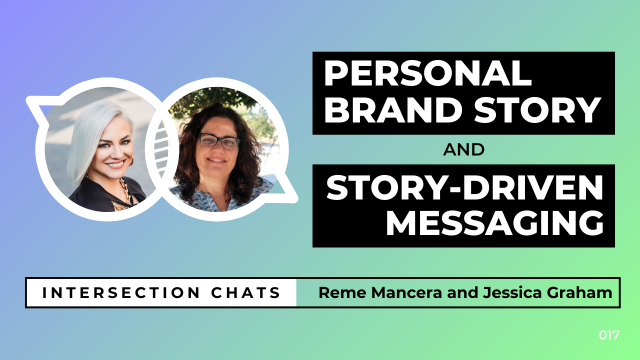
Personal Brand Story and Story-driven Messaging,
with Reme Mancera and Jessica Graham
What if the reason your messaging feels unclear… isn’t your strategy, but the way you see your own story?
You might have years of experience, powerful insights, and real results from your work.
But when it comes to putting it into words (especially in a way that feels natural, clear, and aligned), it can still feel hard to connect the dots.
In this episode of Intersection Chats, we explore how your personal brand story connects with story-driven messaging. We talk about how you can use your personal stories in a way that feels strategic, authentic, and grounded (without oversharing or pretending).
Personal Brand Story and Story-driven Messaging
These are 3 questions we cover in our live chat:
1. What if your personal story is more relevant to your messaging than you think?
If you’ve ever thought “my story isn’t that important” or “this has nothing to do with my business,” this episode will introduce you a new perspective. We talk about how your experiences, transformations, and the way you navigate challenges can become a powerful foundation for your messaging.
2. How can you share your story without oversharing or losing your boundaries?
Storytelling doesn’t mean revealing everything. We explain how to choose what to share, how much detail to include, and how to adapt your story depending on the space. The goal is that you build trust while still feeling comfortable and in control.
3. How can story-driven messaging help you communicate your value more clearly?
We talk about how to connect specific moments from your journey with the benefits of your offer, so your audience can better understand your approach and why your work matters.
I explain the origin of my 10 Story Connectors framework and how this series of intentionally chosen personal stories can really highlight the value you bring to your clients.
If you’re in a moment of refining your messaging, repositioning your work, or simply looking for a more aligned way to express what you do, this conversation might give you a new perspective. Tune in!
Who is Jessica Graham?
Jessica Graham is a Story Strategist and Ghostwriter. She is the creator of Beyond The Story Method and helps leaders transform their lived experience into powerful storytelling.
Jessica is also a 15+ year expat navigating identity, belonging, and meaning across cultures.
Who is Reme Mancera?
Reme Mancera is a Personal Brand Story Strategist and the creator of the 10 Story Connectors framework, a strategic storytelling tool to choose which personal stories to share so they build trust, create genuine connections, and lead to clients.
She is the host of the podcast Who Cares About My Story? and the live series Intersection Chats.
Personal Brand Story and Story-driven Messaging - Transcript of the episode
Welcome to Intersection Chats. I am Remi Monterra, a personal brand story strategist, and I am delighted to have here today, Jessica. Welcome, Jessica. Thank you for accepting this invitation. Yes.
Thanks for having me. I’m excited. So please before we start into the proper conversation, tell us, what you do, who you are. Yeah. Sure.
So my name is Jessica Graham. I call myself a story coach. I was telling Rema before that the whole thing of that led me here really is I was a teacher before. I’ve been teaching overseas for over a decade, and learning about other cultures and other people through a story is what I was like, this is it cuts out all of the BS. And I decided to leave teaching and start a copywriting business.
I love writing. When I was working with a lot of brands on developing their positioning and their strategy, I quickly realized that when we start with the story, when I knew the whole background as to why they started what they’re doing, what their mission is, how it all ties together, it made more sense to move forward with the messaging. And so that became kind of an obsession because I love hearing people’s stories. I wanna know what drives you to make the decisions that you make, what has happened in your past that kind of, like, plays into what you do now. And so I was helping a lot of solopreneurs with their stories, but once they got, like, a clear idea of the transformations that they’ve experienced and how those mirror what they are helping their clients achieve and their clients do, there was a lot of disconnect between not feeling empowered enough to really share that side of their story.
They felt like it didn’t position them to be an expert. They felt like it kind of was embarrassing to share. There’s a lot of shame around it. And my own journey started, like, fifteen years ago where I got into some therapy. I did a lot of self help stuff that helped me unpack any of the shameful stories that I was carrying around, because I always knew, like, when you carry that stuff around and you’re not able to even be honest with yourself about it, much less somebody else, it’s like these little skeletons are in the closet, and they’re just running the show.
And so I was like, maybe I could help people kinda do what I’ve been helping myself do. And I started to help women really rewrite their stories. So taking those experiences that might have felt not, not empowering enough and really shifting the perspective by unpacking all of it and being really, I always say, radically honest with yourself about it and being like, taking ownership over your role, blah blah blah. And I think that that’s really where I land today is, like, helping women, really rewrite the stories that are running the show and helping them, make decisions that feel like it’s more their decision rather than doing it because it’s gonna make other people happy. Yeah.
And this is something that, I feel so important how when we are working around the the stories that we share for our business and how they are like, that that connection with the stories that we talk to we tell to ourselves that, that all these, conversation, how important it is on this idea of being honest with ourselves. So I feel that’s really a crucial, element to it as well. So let’s go into, the topic. I’m then we can talk about so many anchors here because of, how both of us, we talk about, stories, but, it will be about how personal brand story intersects with story driven, messaging. How when we are focusing on this way of having a messaging with, based on stories, how the connection between them and our personal brand story.
How has been your experience with clients? What is your point of view? Yeah. I really find that, like, when we lean into what our own experiences are and what they’ve been and we start to see, like, what’s the transformation that I’ve gone through? What are the challenges that I’ve overcome?
That is really your unique superpower because a lot of us think that like, there’s two sides to this. A lot of us think that no one else would understand what we’ve been through, and so we don’t wanna share it. And I always say that that’s kind of the unicornism that we carry around. But on the flip side, it really is a unicornism in a lot of ways because how you have dealt with something or how you have, managed through and navigated through a different challenge or hurdles or whatever it was, that is, like, your unique superpower. So whatever angle you wanna see it as, it’s very relatable.
So when you share this stuff, even if someone hasn’t been through, like, the details of what you lived through, they can see themselves in your story because they’re like, oh, yeah. I’ve faced a challenge that was kinda similar, or I’ve, you know, gone through something that I really didn’t know how to navigate it. And the way that she’s articulating how she navigated, that really speaks to my heart. And so I think now we know especially that people really connect with people. And so if you are sharing your experiences from that, like, human perspective, then you’re going to draw people in to really know who you are and kinda get a backs, like, a inside peek.
This is how they think. This is how they process. This is and maybe it’s very similar to you, and maybe it’s completely different, but it makes you it challenges the way that you see your own life or how you navigate things. So that’s where I think, like, the intersection is. I always say that, like, your story really is your purpose.
I think we have a responsibility to look at what we have lived and kinda unpack what is there. Because I think a lot of us navigate life through the lens that we think that, like, we have all of these beliefs. Like, I was born this way. This is just kinda how I do things. But then when you start to really examine things and strip things back a little bit, you realize some of that stuff was actually other people’s beliefs that I just, like, okay, agreed to.
And, I think when you start to really unravel that and look at it, you’re able to really know who you are on such a deeper level. And the more you know who you are on a deeper level, it’s so much easier to show up in your business or in relationships and really be like, this is what I value. This is what I stand for. This is what I believe is important. And it doesn’t matter so much anymore of, like, what are other people gonna think?
What are other people gonna say about this? It’s like you get such an inner confidence from knowing your own story. I feel really aligned with what you just shared because I feel like even doing the the process of, identifying which stories to share and all that, it’s a deep process of, even self awareness of your own journey. I work a lot with people that they have made some kind of pivot in their business, so they are, in this transitional moment. And going through that process of understanding which stories to share is also understanding, okay, how all these milestones in my in my path has helped me to to move to where I am now and how each of those is, like, showing up, how there are certain things that are important to me no matter the if I am working something totally different.
There is this common thread coming up because those are your values, things that are important to you. Why for you is important to to work with a certain group of people, and how you work on a certain topic or or problem is related to who you are and using your your stories to to highlight, to provide this context. I feel the same, like, it’s like helping others to show that you are someone relatable and how even if you haven’t experienced the same experiences, you connect with the emotions, you can, get, takeaways from their lessons that they have lived through that. So I feel that as well how first of all, it’s an interesting process to ourselves when we are learning about our own stories and how they are connected. And then in a strategic way is like how that will help your audience and people that get around you to know like, okay.
This person has certain values. Then it’s showing your unique combination of your story, your background, your expertise, and who you are, your personality. So that I feel is so important on how you can use that, of course, in your messaging and in your communication in the different levels. So yeah. How has been your process?
I don’t know if you have, found a lot of people because this is something that happened to me that they feel that their story is not relevant for others, so for their audience. I even I have a podcast on this call, who cares about my story? Because that’s a question that a lot of people, resonate with. So how has been your experience? Have you, worked with people that they have this, feeling at the beginning before working with you?
Yeah. Yeah. Definitely. I think that’s very common. A lot of people think, like, my story doesn’t matter.
Why would anybody care? Or they think that, like, it’s not big enough because I think that a lot of us see these, like, really big before and after moments, and they think, like, well, I don’t mine’s not that big or mine’s not that crazy. But I always think that, like, you know, we all have those before and after moments even if they’re not as big. But to what you were saying before, it’s like everybody still finds a point of relevance or, like, they resonate with something that you are sharing because they themselves can, like, see themselves in your story. They are drawn to it in some kind of emotional way.
And I think that it really has a lot to do with, like, how you share that story and what the perspective is that you have on it. That’s why I think, like, when you start to unpack because if you think your story really doesn’t matter, it’s probably because you really haven’t you yourself dissected. Like, what are the lessons that I really learned from this? What gifts has this experience given me? What have I taken from these experiences that now I give back to other people?
And, like, how am I using this to my best? Like, how am I really, taking these hardships and, like, shifting it into something that’s a positive? And so I think that that’s where, like, maybe a little more digging into needs to happen. Because if you do think that, like, you don’t have a story that matters or it’s not relevant, I I would suggest to look at it a little more closely and, like, come at it from perhaps a different angle. Because sometimes too, like, I think we all experience this.
When we’re, like, so close to our own stuff, it’s so hard to, like, pull back and see it from a different angle, from a different perspective. And so that’s why I think when we talk to other people about things and we start to, like, openly share and kinda get their insight, it’s magical. Like, I talk with clients so often, and they’re just, like, sharing their stories. Nothing they they didn’t come into it thinking like, oh, I’m gonna tell Jessica this one story. They’re just telling me about whatever their life experience is, and I am like, oh my gosh.
That’s fascinating. And they’re shocked that someone is saying that because they weren’t thinking that it sounded that, you know, moving. But I always like to share with them why. Like, when you said this, I felt this. And I think when you start to, like, see, oh, that really, like, resonates with people.
I didn’t realize that. Then you start to feel more confident to share more of your experiences. 100%. This idea of how we overlook certain stories that for us are natural and then for others can just be so oh, this so, a story that if you use it will be memorable, has this visual element. I remember especially when I was working with, someone.
She’s a copyright team for fashion brands, and we were working on her story. And I in the questionnaire, I have this questionnaire before our sessions. And so she didn’t mention and also during the process, she didn’t mention any connection with the fashion as a child. And so I during the session, I asked her, and I was thinking that maybe she was going to tell me about making these little, dresses for her dolls or something like that. Because I asked, hey.
What is your first memory around fashion? And then she she start talking to me and telling me how she remember being under the swing table of her mom because her mom was a tailor, her grandpa was a tailor. She grew up in this family making high quality clothes with, a lot of detail to attention, taking care of their customers. And to me, it was like I got a good when when she told me. It’s like, wow.
This I I have the picture of you as a little, child work, playing there. And it’s like, this was, a moment she haven’t shared because she was also all the time looking for stories related to writing and related to the copyright inside, but she didn’t think about, sharing this. And and to me, it was clear that this is something that you can, share in a because of it’s memorable, but also because there is a lot of values there that you were doing that process and can connect with, as you said, something relatable to other. Sometimes for ourselves, we we overlook those and and we I always say that you don’t need an epic story because it’s like you need I I like to help people identify these meaningful moments and I call it that way because, yeah, when you share what is around that that moment, there is a it says is there is context of why that there is this connection. Because I I look for the strategy side and how they are connected to something that is valuable for your audience and the people that might, use your services or your offers.
But it’s like, it’s important. There is this, feeling of it’s important for you, so you are sharing with confidence. Because when you are not sure about why you are sharing certain story, it does it’s not going to land the same way. I don’t know how has been your experience, but it’s like, no matter if for you is an amazing story to share, if the person doesn’t see or doesn’t understand how how they they it’s going to be relevant. They are not going to share with the confidence and the trust.
You need to to be sure that, yeah, this is the story that I want to share. So I feel that there is that this power, is so different when it’s, like, from them. Right. Yeah. And I always call that owning your story.
That’s, like, the difference between, like, knowing it and being really owning it. And I think the ownership of it really comes from feeling empowered by it. Because like you’re saying, if you are coming from a place of, like, I’m not really sure this anyone’s gonna care about this, or, like, I don’t know if I wanna reveal too much. Like, energetically already, you’re coming from a place of, like, hesitation. And so it’s not going to be received in the way that it could be received if you’re coming from that place of, like, owning it and feeling very empowered by your own story.
So yeah. I Yeah. And, yeah, I I wanted to go into this topic because you mentioned how, like, when you are not sure about how many details you want to share, and this is a topic that is really important to me because I am really private person. And I I when I work with people, I I always like to highlight that you are the one in control of what which is the level of detail that you are sharing. I would love to know your thoughts about that when people are concerned about how much to share or being concerned about not oversharing.
What has your been your your experience around this topic? Yeah. My experiences when I first was getting this, like, help. So fifteen years ago, I kinda reached a place in my life where I was like, I just can’t live the way that I’m doing things anymore, and I didn’t know I didn’t have any answers. And so I started going to therapy.
And the therapist also suggested some 12 step Al Anon stuff. And I don’t know if you’re familiar with that, but it’s just, like, going to meetings and really talking about, like, what are your behaviors and how are your behaviors impacting other people and impacting you. And so in those rooms, that’s when I really saw people sharing their stories in a very honest and open way. And it was something that I wasn’t used to. I had never witnessed that before.
I had never seen people really be vulnerable in a way like that, especially with, like, a group of strangers. And so I took a lot of lessons from that because I felt like I knew that when you could start to be more open and vulnerable with your own story, and I’ll get into, like, how this can tie to your business. But, like, on a personal level, when you can be more vulnerable and open like that, you’re bringing stuff that, like, feels shameful and feels kind of icky or whatever into a place where, like, light can finally be shed on this stuff. So, like, keeping it hidden in a closet and never sharing it with anybody, never being honest with yourself about it either, it’s going to fester and it’s just not it’s gonna keep you stuck in a certain place. So I find that when I learned how to be vulnerable, which I believe vulnerability is a skill.
When I learned that skill, I also learned, like, you can have discernment too because I don’t need me being vulnerable doesn’t mean that I go out and I share every little itty bitty gross detail of my life with everybody, and that’s being vulnerable. It’s more about knowing what needs to come out of me, like, knowing what needs to be confessed and what I need to take ownership over, And then knowing then, like, how to work through it. Like, it’s very much about it taking an inventory of your own decision making, your own behavior, your own choices. And when you can start to do that or, like, dissect everything, then you can look at it and be like, okay. I really like this about myself, and I really wanna work on these things.
And then once you can do that and you get to a place where, like, you might find those meaningful moments, like, what you shared of, like, how do you how do you share those meaningful moments? I like to look at it in, like, those transformation moments. Like, what are those kind of little befores and afters in your life that maybe those can really impact somebody else. And so sometimes though, you get to that point where you start to look at those meaningful moments, transformation moments, and it still feels too personal. I always say there’s, like, a few different ways that you can look at it.
Either, like, if it still feels too personal, I always say don’t share it yet because going back to what we said way earlier, which is, like, the energy in which you’re sharing it from. So if you’re not comfortable sharing it, just don’t yet. But I always say the yet because it might be something that, like, today, I’m not ready to share this story, but maybe tomorrow, maybe next month, maybe next year. And so kinda put a pin in it. And then as you put the pin in it, is it a message?
Like, what is the purpose behind the story? Are you trying to share a message that you really believe people need to hear? They really need to hear, the message behind the story. And if it’s a yes, then can you flip it where it’s really not maybe your personal story and your experience, or can you make a generalized story out of it? Like, it doesn’t have to take that, like, this personal thing happened to me, and now I’m sharing it.
It could be somebody else experienced this, or we’re gonna leave out all the details and just kinda share the message itself. So there’s ways that you can, like, still get that message across to people without, like, slandering other people, which I always am like, don’t do that, or, you know, exposing too much of your own stuff that you’re not ready to. So that’s how I approach all of that. But I’d like to hear, like, what do you think? What is your approach to that?
Yeah. I I really like that approach because it’s like, yeah, giving them the control of how to do it if they want to go to another. In my case, I usually, because the the how I approach the work of a personal brand story, I identify 10 minute 10, story connectors. I call them story connectors. They are the combination in one size is one meaningful moment in your journey, and the other size is a key factor of what you offer.
That way, you have this set of 10 stories, and each of them has a connection with what you want to highlight from your offer. So for choosing those 10, I always invite we go and explore the whole journey and then starting identifying how they can connect. And what is really important to me is if it’s a moment that they don’t want to go really into details or they are not comfortable with, they have the the this boundary to decide not to do so because you can choose others. It’s not that you know that this is important. I I feel like during the process, it’s important that they recognize and they acknowledge that, yeah, this moment is meaningful to me.
I don’t want to share it for whatever reason, but I know that this is important to who I am and what does has been my journey. Yeah. And then when they they decide to to choose one of those, is like what is the level of detail that you want to share? Because you can share in a superficial level about the moments, story, but then you are highlighting the lessons. You are highlighting the emotions that you live there in that moment.
And then the focus is more into those that can be something that people will relate to than specific details about that moment. And is on then if they really want to share or not. And also some other, option that I always like to to invite them is to think about the different places where you are using those stories and how maybe in your social media something super superficial, but then in your email newsletter, you feel there is more, intimacy there, so you share a bit more. And then maybe in your onboarding process, you are using your story as a way to create the safe space and sharing your vulnerability will help your clients as well. So even that could be it’s not that, okay, this how I share my story.
No. It will also be different in different scenarios. And as you say, it’s going to evolve. And maybe what you share now is going to be different of what you share later, especially because you you are going to evolve. Your business is going to evolve, so your stories will evolve as well.
Right? Yeah. Oh my gosh. I love that. And I love to like, I usually take this suggestion on myself, but I also share it with other people that once you have these stories, it’s so good to just practice them at networking events.
Yeah. That’s a good good place to just, like, you know what? I’m gonna test this one out today. Yeah. I love that you said that because I always when, because one of the places that I invite people to use their stories is in the intro when they go to networking places and introduce themselves.
And I have done a lot of online networking events. So there, they have these breakout rooms and you need to introduce yourself. I think that’s how we met, actually. Hey, Laila. So when you are introducing yourself, you especially if you are in a Zoom call, you are seeing the faces of others, and you see if they make some oh, they are not understanding what I mean, or they got curious and they ask you more.
So it’s a super good place to practice. So I love that you you said that. Yeah. I love it. I love it.
Because I think too, like, social media is a great place to also practice, but you’re not getting the, like, live exchange that you get at a networking. So yeah. That’s Yeah. And something that I I would like also to know that about your your process. Because, during the work that I do, I have them to articulate how they are sharing the story, especially when they are, like, talking about that, more like writing.
Because I am not a copywriter, so I work with them more in how if they are going to a podcast and they are going to be a guest or if they are introducing themselves. So more in the, like, the oral way. Yeah. And I like to work with them in how they can share the same story from different angles and maybe starting in the middle of the actions, so you get, like, oh, I want to know more. Or maybe they start in the benefit that they want to highlight and then talking about the story, or the opposite way around and they use the story as a bridge to talk about the the benefit or the value that they want to highlight.
So I would love to know how is your process? How do you help them also to think about this telling the same story in different ways? Yeah. I think when it comes to the brand story, I take a lot of what you just shared too with, like, the different ways to outline it. So, like, yeah, starting with the the hook and the excitement and practicing this and this story could actually work really well from this angle, and I would say it like this.
So we can have those, like, strategy sessions where you’re going over this. When it comes to, like, the personal story, which is, like, a lot of where my work is now, the last piece of what we’re doing is, like, what I call the embodying part. So it’s like, how are you embodying this more authentically you version of the story? Because now we did all the stripping away of everything. We did the reframing and the rewriting.
So now how are you, like, embodying this next part? And there’s a few things, and I think that it really comes down to, like, you figuring out what feels good. I always say, like, there’s rituals. Like, I love, like, if you have a morning ritual or however it is, your daily ritual, your nightly ritual, but having something that is a constant reminder of who this version of you is. Because I think when we do that kind of work, and I I say this from personal experience, experience.
I can have those moments, especially as women, because I feel like we’re a little you know, there’s a lot of different waves happening in our bodies every month. So, like, sometimes I feel very connected to this, like, version of myself that is a lot more courageous, a lot more aligned with, like, who my true authentic self is. And so it’s easier for me to kinda make decisions from that mindset and to really step into showing up on networking events or showing up on calls from that mindset. But then you have those other times when maybe you’re tired or maybe you’re a little moody or whatever it is, and, like, you easily slip back into those old patterns and those old ways of maneuvering. And so I always try to talk about, like, how can we have a ritual where we’re reminding ourselves of this new stuff.
And one of them is scripting. So I’m a big journaler. I love a journal. And so I I really, love the practice of scripting, which is like writing from a place as though it has already happened or writing from that kinda higher version of self place, and maybe putting out different scenarios of, like, even this. If we’re showing up on a livestream podcast today, talk and script out, like, how you felt when all of that happened and how, empowered you felt when you shared that one story that you were kind of scared to share or whatever it is.
And I also think that, like, you know, having that grounded kind of meditative process is also really helpful. But I think there’s so many things that you can do to really start embodying that version of your story. And, like, we’re talking about practicing, and I think that that’s, like, a huge part of it. Sometimes it really does feel like you’re pretending to be someone else. Like, act as though it is that other version of you making the decisions today, having those conversation conversations today.
And then, like, it suddenly is like, oh, but I’m actually doing it. Like, I’m actually living this. So, that’s one of the things that I like to work on. And I know it’s a little more woo woo and not as, like, strategic, but I think there is kind of that practice in, like, journaling, writing, being very, aware of your own behaviors. Love that idea of practicing.
I feel that, as you were saying, vulnerability skill. I feel storytelling is also a skill that you with the practice, you feel more comfortable with. I always invite people to check what is the style of communication that they feel more comfortable. Is there if they prefer to write, if they are sending audios to their friends, if they are comfortable doing video because then use that as the first step to practice how you share your stories because that’s the natural way for you to tell story, to tell something to a friend, to to yourself. So use that channel as the first step, and then let’s say you want to move to a different scenario.
Okay. Then you practice that as well, but start with what feels natural and makes it easier for you. I love that. And that’s such a good point because, like, I’m a write like, I love writing. So for the majority of my business, I’ve always been more of a writer, and I craft these, like, carousel posts and a post, and it’s all written.
But then I realized there’s such a disconnect between me writing out what happened and being able to, like, edit what is being shared there and how I’m sharing it versus speaking about it. So then I realized, like, I really need to practice a lot more of the speaking part. And it’s not necessarily speaking in order to be on a stage and having it, like, perfectly crafted and you know your TED talk and you know how you’re gonna stand, but it’s just like having conversations like this. You know? And it really is like, one of the things I forgot to mention in my practice is the mirror work.
Like, I feel like, that’s something that I recently adopted more of. And it’s funny because when I heard about it, I was like, oh, I did this when I was a little kid, but I never put two and two together that, like, you can still do it. But it’s just kind of pretending, like, you’re acting out something that it hasn’t happened yet, but you are like and you can literally do it in the mirror so that you kinda get an idea of, like, what you look like when you’re saying this stuff. You know? And I think that that’s a really good way to practice too before you’re getting on these calls if you’re still a little hesitant.
Little mirror work is a good practice. Oh, I love that. Yeah. Something that I I because you were mentioning, and I feel this is important. It’s not just about when you are sharing to be in a stage or a TED talk or anything.
Even just to have a conversation like this or even if you are doing sales calls and how you are telling your stories, using your stories to highlight those benefits and and for the other person to learn about who you are and and to have an informed decision to make. Right? So I feel like that’s, like, key as well. And I love this exercise of the mirroring, something that I told, how we do kind of role plays because, with some people that they are going to be in podcast and maybe they are still Esita. We play that role where I am doing interviews and then they are sharing with me, and then it’s like that process.
You are experienced how it feels. It’s not the same, of course, but it’s a practice. So it’s the first step to practice and to get more comfortable to see how it lands better because you know how it is. I have sometimes the same story you are telling several times and then someday you share in a bit different way or something. It’s like, oh, actually I like this angle.
I am going to share this. And then you you keep refining and polishing and making it more owning your story as you said before. Like, this process of getting more comfortable sharing those. A 100%. And it’s, like, exactly what you said because the more that you talk about it, the more that it just becomes a second nature.
Because if you’re not practicing and you’re just showing up on a call and you say it one time, I know this from my experience, I would be, like, a little shaky and, like, so nervous. And then you kinda have this, like, out of body experience, and then afterwards, you’re like, what did I even say? So I think it’s really good practice so that you kinda know, like, this is what it feels like. This is how you’re gonna feel, and you get into that mindset where it’s like you’re calm. You’re not, like, hovering in this, like, shaky space of trying to story.
Yeah. And from my experience, I also know that I was not comfortable learning one way of sharing my story, and then it’s word by word. And I went to a different podcast interview, and it’s like, okay. Here I go again saying the same words next to each other. It’s like, I don’t feel comfortable.
I feel that if you listen to this one, it’s the game. So for me, it was really important to how I can share the same story in a different way or different. And that’s also was part of me, helping having these different meaningful moments that I can start with because then I can combine the order in a different way. And it’s not that the people will remember word by word, but I am feeling like a robot telling the the same word. So it’s Yeah.
Helping my confidence. And this is the case. Sometimes it’s not about the others, how they will might be not remembering word by word, but you are feeling like, okay. Here I go again, and then you don’t feel, like, confident and owning it. So for me, that was an important process as well to learn to share the same similar stories.
My story so it’s the there is element that are common, but in different ways. So I don’t feel like if I miss a word, I am just losing my my thoughts. My my my goal my mind go to, okay, what which word this word? Doesn’t matter. It’s a story.
I can use different words. Right. And it’s fun because, like, I love I’m sure this is your approach too of just kinda helping them have a few I call them signature stories, but a few stories that you can just, like, pull out of your pocket that really showcase who you are and what you do. But also maybe it’s like maybe one version of the story is specific to a client journey that you took them through. Maybe another version of your story really highlights the value that you have in this one area.
And so you kinda have those, like, back pocket stories that when you’re in those moments and you’re you’ve practiced them a lot, just whip one out. You kinda know, okay. I’m gonna share this one, and it goes this way. And then you also know why you’re sharing it. I think that’s, like, the biggest thing is, like, if you’re just sharing something, but you don’t know why you’re sharing it, it’s gonna come across really empty.
100%. I feel that’s, like, the key, and that’s why I put together this framework of the 10 story connector because each of them has a category so you know why they are they are connected to something specific. So one of them is related to your values, one of them is your connection with your audience, one of them is related to the approach that is unique from your even if there are someone else offering something similar. So each of them, you can combine several of them, but you know exactly if you bring that specific story. That’s why I use the sample of the sales call because my clients, they use is like, okay.
I want to highlight this because that person are not sure about this point. So they use specific story because they remember how they are connected, and they don’t need to be big epic stories. They they are meaningful moments as a bridge to talk about that topic. So 100% what what you just were saying. I love it.
I love that. K. So we are going to, start wrapping up. So something that we haven’t mentioned or a message that you would like to highlight and we haven’t covered, maybe this, the opportunity for you to share whatever we haven’t covered. Yeah.
Sure. I think the only thing that we haven’t really covered is I touched on it with my love for journaling. And one of the things that I started to do is host a monthly I call it a journaling circle, but the point and purpose of it is to get on, and it’s women who come together. We have a reflective prompt, and the prompts are always, like, there’s a theme. So, for example, this month is reflective, and so we’re really, like, going back through and kind of reflecting on what this year has been like and what is uncovered and what patterns are there.
So we’ll have a couple of prompts that we take some time collectively to journal on. And then once that is finished, then we have an open share portion. And that’s where I think that it’s funny because I started this because I felt like I was going to all these networking calls. And especially in the beginning of my business, I felt like I was always rattled. Like, I was in this very messy middle.
I felt really alone. I felt like not a lot of people understood, and you’re getting this, like, presentation as though entrepreneurship is great. You just started, and then maybe you have a couple hiccups, but all of a sudden you’re successful and it’s great and it’s perfect. And I was just like, am I the only one who has not experienced this? And so I wanted a place where people could come together and just kinda share what was really going on.
And it didn’t have have to do with business, but just in life because that’s the other thing that I think a lot of us experience and learn very quickly is, like, you no longer I think when we work in jobs, it’s easier to have, like, your personal hat and your professional hat. But when you have your own business, the two go hand in hand. So if you are struggling on a personal level, that’s going to be showing up in your business. And so how do you cope with that? How do you unpack that?
And so I like to really use the tools and share the tools that I have learned that, you know, taking that inventory and kind of being able to have that vulnerability, portion just to, like, get it out of you. So, anyway, I share all of that because, one, everybody is invited. And two, just to really even if you don’t come, I really think the power of having a journaling practice is, very impactful both personally and professionally. So just wanted to share that too. Nice.
Yeah. Thank you. We I am going to make sure to have all the links, for them to be easy, for them to to find out about this, circles. Yes. So the final question usually that I like to ask is, like, how this intersection between personal brand story and messaging, especially story driven messaging, How will you summarize this with, one to three words?
My motto is your stories matter. So that’s how I would summarize it. I think that all of us have stories that very much matter. They really are our purpose. I think we really experience things that it is our job to then take the lessons we’ve learned and share them to really just be helpful and impactful for other people.
So that’s wonderful. I I need to share this. Now it’s backwards. So it’s like this also my motto is real is connected. I feel it’s like your story is relevant and it’s worth telling.
I have this postcard that I share with people just as a reminder. Great. So, yeah, we are totally aligned with that. And as a way to summarize, I will say that these, key ingredient, one to the other, they are key because the how you share your personal brand story will shape your messaging and how using your personal brand story in your messaging is key. So thank you so much for this conversation, Jessica.
As I said, the links are are going to be in the description updated with this, invitation that you have for everyone listening. Thank you for sharing your insight, and, it has been really interesting to talk to someone working on stories as well. Yeah. So good to see you, and thanks for having me on today. I really appreciate it.
Thanks. For everyone listening or watching the replay, yeah, thanks, and see you soon. Bye.

Want more conversations like this?
Explore more episodes of Intersection Chats where I invite guests to talk about how personal brand story intersects with their expertise. Get real-world insights from experts across different fields on how personal brand storytelling builds trust and genuine connections; plus tips to use your personal stories more strategically in areas like PR, email, SEO, content creation, and beyond.
Here are a few examples to get you started:
- Personal Brand Story & Conversion Copywriting, with Reme Mancera and Mimi Zhou
- Personal Brand Story & Market Differentiation, with Reme Mancera and Marj Martirez
- Personal Brand Story & Video Storytelling, with Reme Mancera and Paige Burns
Whether you’re just starting to explore your personal brand story or want to apply it more strategically, these chats offer real-world insights from experts across different fields. Don’t miss the opportunity to get the most out of it!
WORKING REMOTELYInternational

GET IN TOUCHContact
WORKING REMOTELYInternational
CONNECTSocial links
Reme Mancera · Personal Brand Story Strategist
Copyright © 2018-2026 Reme Mancera. All rights reserved.