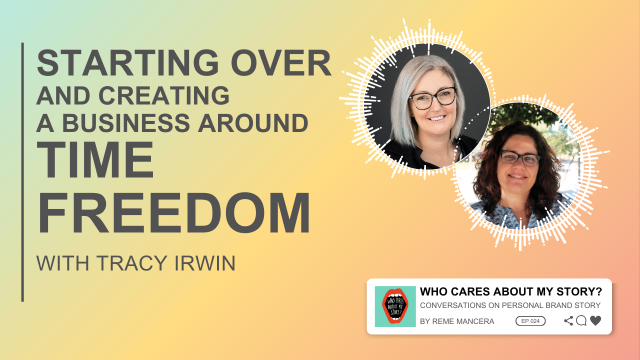
Starting over and creating a business around time freedom, with Tracy Irwin
Starting over and creating a business around time freedom
Have you ever looked “successful” on the outside, but felt stuck inside? What if the story you’re afraid to tell is the one that could set you (and your business) free?
Today’s guest is Tracy Irwin, a bestselling author, business mentor, and the founder of an award-winning accounting practice in the UK, which she now leads from the Spanish mountainside.
With a lot of openness and honesty, Tracy talks about what it really means to design your business around the life you want, not the other way around.
In this conversation, Tracy shares how a personal turning point led her to walk away from what looked like a “perfect” life, with two suitcases and a strong desire for something more. She tells us about her experience of writing her book, struggling with imposter syndrome, and how finally publishing it in 2023 transformed her business, her confidence, and her visibility.
Of course, we also go into storytelling, and how it has become a powerful tool for Tracy, whether she’s coaching clients, sending emails, or speaking on stages. Tracy reminds us that sharing our mistakes, not just our wins, is what truly connects us.
If you’ve ever wondered whether your story is worth telling, this episode is for you. Tracy shows us that it’s not about being loud or having a dramatic backstory. It’s about being real. Don’t miss this encouraging conversation.
Links and resources
🔗 Tracy Irwin’s links:
– Website: www.tracyirwin.co.uk
– Resources: https://tracyirwin.co.uk/links/
– Linkedin: https://www.linkedin.com/in/tracyalaineirwin/
– Facebook: https://www.facebook.com/tracyirwintfa/
– Instagram: https://www.instagram.com/tracyalaineirwin
🔗 Reme Mancera’s links:
– Website: https://www.rememancera.com/
– Instagram: https://www.instagram.com/rememancera/
-Linkedin: https://www.linkedin.com/in/reme-mancera-postigo/
-Youtube: https://www.youtube.com/@rememancera
🔗 Ready to gain clarity and confidence in storytelling? Let’s explore your 10 Story Connectors: https://www.rememancera.com/story-connectors/
Who is Tracy Irwin?
If you’re a busy service-based business owner feeling trapped and time strapped, if you want to take control of your calendar and your business rather than them claiming you, Tracy Irwin can help guide you to grow your company while enjoying more time freedom.
Tracy Irwin is a bestselling author, entrepreneur, business mentor, world traveller, lover of all things crafts and anything salted caramel. She also founded an award-winning bookkeeping and accounting practice in the UK, which she now oversees from a strategic level since moving to her Spanish home in the beautiful Sierra de Bernia in 2016.
Who is Reme Mancera?
Reme Mancera is a Personal Brand Story Strategist and the creator of the 10 Story Connectors framework, a strategic storytelling tool to choose which personal stories to share so they build trust, create genuine connections, and lead to clients.
She is the host of the podcast Who Cares About My Story? and the live series Intersection Chats
Who Cares About My Story? Podcast - Conversations on Personal Brand Story
Interviews with amazing guests about how sharing their stories has impacted their businesses. We cover the benefits and the behind-the-scenes challenges you face in deciding what to share, without oversharing or pretending to be someone else.
Subscribe now and don’t miss an episode!
Who Cares About My Story? Podcast 024 - Transcript of the episode
Reme: Hello. Welcome to Who Cares About My Story, Tracy. I am delighted to have you here.
Tracy:
I’m delighted to be here. Thank you for inviting me.
Reme:
So please tell us who you are and what you do.
Tracy:
Okay. So my name is Tracy Irwin, and I’m a business mentor. I also live in Spain as well and have done for the last eight years now. And, I started my entrepreneur journey 23 years ago nearly now as, as a bookkeeper in my home. And I’ve been through quite a journey in the last 23 years to be here, and now I help other people find their happy. I find a lot of business owners look successful from the outside, and they look like they should be really happy because they have everything, but they’re not. They’re all consumed by everything else in their business. They’re not doing what they wanted to do when they started their journey, which is where I was back in 2017.
Tracy:
And, I know not everyone’s idea of success and happiness is taking two suitcases and moving to Spain, but there is something for everyone in there. So I now help other people find their happy.
Reme:
And I love that you already bring the idea of our own definition of success because that’s something that usually is always, coming up in this podcast. Because one of the reason that, why I started this podcast is about that, about each of us, we see success differently. We check what is important for us, for our the lifestyle that we want, and the goals that we have. So I loved how you were, you have the clarity of, okay, this is what I want, how my business can support what I want. Right?
Tracy:
Yes. Exactly that. Yeah. Definitely.
Reme:
Nice. So I know that now you are, like, you have a book and you help a lot of people with the idea of time freedom. I would love to know a bit more about how did you became that, how that become your expertise?
Tracy:
So when I moved to Spain, people started asking me different questions than what they were asking me when I lived in The UK. And they started asking me about my story. It was like, how have you done that? And, so it kinda just started coming into my blogs and things. And I started to change from being everything financial to actually, you know, this is how you do this in your business, and this is how, and I was like, suddenly I realized, like, actually, I have this area of expertise here that I didn’t actually realize that I had. I think as business owners, quite often, we learn by doing. And, I mean, the book one of the feedback I have from the book is, you know, I wish that people wish they’d had it when they started their business. I yeah, I wish I had it.
Tracy:
I wish I had all that knowledge when I started my business, but we don’t. So we either we know we read what other people’s journeys are, or we learn by doing. And, so I started to write the book. So I wrote the book in 2018, but then, unfortunately, I got imposter syndrome. And every time I tried to edit it, I kept thinking, who’s gonna wanna read this? Like, it was really strange because I, people were asking me the questions, but it was very different to think, well, actually, you know, say, I’ve written a book about it. You know? It it’s a great thing, but at the time, it didn’t. It felt like I’ve just imposter syndrome was not nice at all. And, it took me till 2023 to actually, publish the book.
And it’s been amazing since then, because it is my story. It is my story. It’s very practical book. It tells you how to do things, but it is entwined through my story. Getting an editor was the best thing I ever did. She created all my mumblings into something that’s still my story, but it’s now very legible and, very practical. So, yeah, it was it was a great experience, but there was a time where I really struggled because I think, I think as women as well, especially, we struggle to, like, to emphasize our voice a lot, to say this is who I am. People, we think that people don’t want to know, but they do.
They really do.
Reme:
Yeah. And congrats on finally, doing it because it’s like okay. It was worth it even, it was some years later, but still was a good experience, and I’m sure it has helped so many people and so many people to come.
Tracy:
So Yes. Yeah. Yeah. I got some really good feedback. One person said it was, like, part two to the E-Myth. That’s probably been the biggest compliment I’ve ever had because that book has been, like, part of my life. So it is a very practical book for anyone who’s either just starting out in business or wants to take a step back in the way that I did by either, like, false exiting or exiting for real, out of their business.
Reme:
Nice. So could you tell us a bit about how sharing your story has impacted your business?
Tracy:
Yeah. A lot. It’s been massive. My journey since 2023, has been huge. So even though I still do financial director clients, I now have become the Time Freedom Alchemist, and it’s because of sharing my story in the book. And it created a lot more feedback of people really wanted to know how to do this. And, you know, there is people who can take things from a book and do it, where there’s other people who want somebody there making them accountable and giving them, like, a holding their hand through it. So, 2013, I didn’t only just publish the book.
Tracy:
I then went and did a coaching degree because I felt, again, I didn’t, I felt like I had the expertise, but I didn’t have the qualification that went with it. And so I thought I’m just gonna do my coaching degree so that I can actually be a mentor, a proper mentor, and do it correctly. And, so, yeah, I got my coaching degree at the end of 2023. My life now is really different from what it was, even just two years ago. I’ve taken an even further back seat from the accountancy practice. Some the, like, the some of the employees are shareholders of the practice now. They look after everything. And, I can help clients and, who want to, like, exit their business and get more either more time or more profit from their business.
Reme:
Amazing. And can you think of a specific example of a business opportunity that arrived because of you sharing your story?
Tracy:
Yeah. I think when I started to share my story, I realized that with living in Spain and having an English audience, social media was the only way that I could kind of grow my audience or I had to start speaking at conferences. And, I met a lady on LinkedIn. And I’ve been friends with her on LinkedIn for a long time. We’re still not 100% sure where we or how we connected. But I’d seen one of her posts, and it was about helping people to speak on stage. And then I couldn’t find her again. I knew she was called Liz, and that’s all I could remember.
Tracy:
And I was like, who was this woman? I had to wait and wait and wait until she came back onto my feed. And I was like, there she is. And I messaged her and said, I’d like to start speaking on stage, but it’s the one thing that scared me. So I’m fine on a one to one Zoom with clients, but you stick me in a networking environment and get me to talk about myself, that this time last year was really difficult. It’s not now, I’m talking to you. I’m absolutely fine. But this even this a year ago would have been really nerve wracking for me.
And just that her one post and sharing the book. So once I’d shared the book and I knew I had to do this, it gave me the opportunity to be able to speak on stage. I, like, have spoken on two events already this year. I’ve got two really big events at the end of the year. One in October, one in November, in London, where I’m speaking on stage to over 300 people.
Reme:
Wow.
Tracy:
And that opportunity to be able to share my story is, it’s humbling and it’s a privilege because I know that there’s like, I’m really honest, by the way, when I tell my story. I know we’ve talked about, you know, how much should you share and things, but I share my mistakes more than I share my successes because that’s what people need to hear.
They need to hear that all the people who are now, you know, successful, still make mistakes. I made huge ones in the accountancy business, by the way. You know? And in the book a lot, I’ve shared a lot of them because I just feel it’s more relevant to the my audience to know that I’ve made mistakes in the past. And you still just you just get up and get and carry on. So, yeah, it’s nice, and I do that quite often when I’m on stage as well. I just tell I just tell stories when I’m on stage, by the way, because that’s what people prefer.
Reme:
Yeah. I love that. And it’s, so good you sharing that idea of how even a year ago, all the progress that you have had in in how confident you are now in sharing your story. Because sometimes for people, when we see someone sharing their story confidently, we might think that they have been like that, from forever or this is just the natural way for them.
Tracy:
I know. I think that’s what it is, and it is about getting out of your comfort zone. I’ll tell you a story. It’s in the book, but I’ll tell you a story. When I first started my business, I got invited to a BNI meeting, and I never knew what it was. I just knew I was having breakfast way too early in the morning for anybody, and I had to talk about my business for 60 seconds. And I was like, that was awful. And, I practiced at home.
I wrote it all down. It’s on a piece of paper. I printed it out, and I practiced it in front of the mirror. And I got to this networking event, and it was my turn. I stood up. The paper was shaking in my hand, and I’d sat down within 30 seconds. I did not draw breath at all. Just like I was so scared.
And I continued to go to BNI for a year, and it wasn’t for the networking as in, like, getting business. It was for my confidence and really needed to grow my confidence. Now that was 2002. If you told Tracy in 2002 that in 2015, she would fly to America, to New York, stand on stage, for Mike Michalowicz of a Profit First convention and speak to a hundred of her peers because it was all other accountants in that room, she would have said, not a chance. I can’t do it. But the practice of, like, sharing, and standing up and speaking is the only way you get more confident. Like, I know I’m going to be nervous getting up and speaking to 300 gym owners. I know that.
But, actually, by doing it is the only way it’s gonna get less and less. And it is about sharing your story. Again, you’ve got to remember, you just, people love stories. And as long as you’re in, you’re educating them at the same time, they’re gonna get benefit from it, however nervous you are. So
Reme:
Yeah. Absolutely. And it’s, it’s about practicing, and it’s about having clarity on why you are doing so. Because when you have a reason why, then everything makes sense, and you know that your story is relevant because you know exactly why you’re telling that part of your story. And that could be to highlight a certain benefit of working with you. It could be to explain better your framework or could be for several reasons. But the main idea that I would like to share now is, like, when you know the reason, it’s easier for you to remember and to, like, okay. Maybe I’m nervous. Maybe I am a bit afraid of how it’s going to be, for me. But still, I know the reason, and I know this, that it’s valuable for the audience that I want to reach out.
Tracy:
Definitely. And I think it’s easier when you’re telling a story. If you’ve got, like, a list of facts to tell somebody, you’ve got to remember them. When you’re telling a story, it’s already in your head. It’s your memory. Like, you can tell it differently to different people. Like, I have a habit of, in my personal life, if I have something to tell my family, the person I tell the first, tell it first to gets the whole story. By the time I’ve told six to seven people, that last person is just getting the bullet points.
But it and it’s the same, isn’t it? Like, it’s not the story isn’t any different. It’s just that, you know, it’s when you’re repetitive sometimes, it can get the just the important bits. And that’s what happens when you tell your story in a business environment. You just end up telling the important bits, and that just keeps everyone riveted anyway because you’re not waffling.
Reme:
Yeah. And, the framework that I have developed around personal brand story is called Story Connectors because it connects a part of your story with a part something, a key factor of what you offer. And I always tell my clients how they can use their Story Connectors as a bridge to talk about something that they want to emphasize. It could be something about their offer or some skill or a different approach. But having that story is going to make things easier that maybe in a sales call, you want to address a certain objection, and you can bring a story as a tool to make it easier for you. So they are powerful to use in our businesses.
Tracy:
Very. I do that with my videos. So, I do a video of my clients, on my list every single week. And what I do is I connect it with something that’s happening quite often to my grandchildren as well. So they, it makes it nice for people, and then you just connect it to a business idea or something to help teach people in your industry. And because you’ve got them hooked at the beginning from the story. That’s what they want to hear. But by the time you get into your point, they’re already hooked.
They’re gonna listen for the rest of the, you know, the other minute that you’re gonna talk about. So it is, story is the most powerful tool, I think, there is. Like, we spoke before we came on about the StoryBrand book, and I was just blown away by that book just through understanding that I’m not the hero, my client is. And it’s just like little things like that again with your story of where you fit and where your clients fit. Like, that’s what you teach people and that is it’s so important to not, you know, where your story fits in with helping a client.
Reme:
Yeah. And I, I read one of your posts about your grandchildren, and one of them was you explaining a certain moment with them and how that was helpful for you to talk about overpromising in an offer.
Tracy:
It was overpromising and underdelivering. I was told I was allowed to play with princesses, But, apparently, grandma had to sit and watch Corey play with princesses. She definitely yeah. She definitely overpromised and underdelivered that day. But that’s what it is, isn’t it? You remembered that. You’ve remembered that story. If I just talked about overpromising and underdelivering, that wouldn’t have meant anything to you. It’s this connection of the story behind it, isn’t it, that makes the actual subject memorable.
So, yeah, she’s fun.
Reme:
So I would like to ask you now, have you experienced any unexpected challenges when sharing your story?
Tracy:
I think the only challenge was that time I got imposter syndrome. So when I was writing, I took the entire month of the August off, and I dictated most of it. I’m better at speaking than I am at writing. And, you know, I was so elated and pleased and proud of myself at the point where I’d finished all the content. It’s it did surprise me when I just I couldn’t edit it. And, I’m part of a business group that every couple of months, they were like, is your business book ready yet? And I’m like, I haven’t done it. And I just couldn’t edit it, and that was really hard to overcome. Like I said, it took 6 years.
That’s not a short period of time. I do feel like everything happens for a reason, by the way. So, you know, there is because there is a section in the book that wouldn’t have been in there if I’d have if I’d have finished it in the 2028, which is really important to people because it’s about communication, with your team. But, yeah, it was the biggest hurdle I had to get over, and I just had to outsource it and give it to somebody else so that other people could actually enjoy my story.
Reme:
And you are pretty open about these challenges, and you have said before how you are sharing on stage mistakes and lessons that you learned from those, situations. So how do you think being open about your challenges has helped you stand out and attract the right audience?
Tracy:
I think honesty is part of being authentic, and it makes you more human. It makes you more approachable. I think, yeah, I could hide my failures and stuff and, like but then the people who have those issues wouldn’t come to me, because they wouldn’t feel like I would have any empathy for them at all. So it it’s kind of knowing that people aren’t gonna look down at you because you made a mistake. They’re more likely to look up to you because, actually, you’ve got over that, and you just make you. It does, it makes you more approachable. And I found that people, you know, who are having the same issues that I did are the people that come to me for help. So I think it’s a good thing.
I’m not quite sure where oversharing starts. I still have, I still have a concern. That’s I think that’s the best word I’m gonna say it. Of because of my lifestyle in Spain, as an English person, I always I’m always concerned of where showing my success stops and bragging starts. And I don’t often push the lifestyle that I live. A lot of people tell me I downgrade it a little bit, and it is for that reason. So that’s the only time I actually worry about oversharing.
So mistakes, everything like that is fine. It’s I downplay the success slightly because that’s the bit that can’t, that worries me. I don’t want to become, I don’t want to be deemed to be one of these people who stand in front of a yacht going, I’ve made £10,000,000 this year, and I can teach you how to do it too.
Reme:
In five seconds.
Tracy:
Yeah. I really don’t want to be one of those people. And I wish, I wish I could be a bit more honest about you know, I feel I always feel nervous when I put on four beautiful photographs of our coastline, by the way. And it’s just like, people come here on holiday all the time. They share them. I get this all year. Why can’t I share it? So, yeah, that’s the only so it’s not it, it’s more the other way around of sharing my successes I find a bit more difficult, than I do about sharing my mistakes.
Reme:
Yeah. I hear you there. And, you know, when it’s the opposite case, I usually what I tell if it’s a tough story and you are worried about oversharing, I always tell people that they can focus more on the lessons and the emotions and not sharing a lot of details, going, like, in the superficial level. So you can go into that as well. You can share still about your lifestyle, but in a way where you don’t feel oversharing your privacy, but still talking about, yeah, how your business is helping, doing that. And you can do it in a way that is not bragging because it’s not coming from so it’s, your nature is not like that because otherwise, you will be doing it and not share worrying about that concern. Right?
Tracy:
Yeah. Very much so. When I start with a new client, I always do a values questionnaire with them so that I understand what is important to them. And I have a client, bless her, that she needs to be the front of her brand. She is a story brand, but the biggest like, her value, the biggest one was privacy. And I’m like, you have got so much trouble, girl. Because like being the brand yourself, you have to put yourself out there. You know? You have to let people know who you are, what you’re doing.
And she really struggles with that because to her I mean, it’s not mine, by the way. You probably recognize that I’m speaking to me, but for her, that’s much more difficult for her to do than it is for me because she’s not she’s not comfortable in sharing her private life. But that’s what people buy. People buy people. So it’s yeah. It it’s harder for some than it is for others. I’m yeah. I’m honest to fault.
If I’m if I’m nothing, I’m honest, by the way. So
Reme:
Yeah. But still, because I am also quite a private person, and that’s, some. I always like to highlight how privacy, so private and personal is not the same.
Tracy:
Yeah.
Reme:
And you can share your personality, your values, what is important to you, what do you stand for, why you work with this, group of people, why you focus on that specific problem or situation that you want to solve, and still keep your privacy. But you need to show who you are in the sense of as a person.
Tracy:
As a person. Yeah.
Reme:
You can keep your detail, your privacy. So if, let’s say, you want to keep how your family looks like or which kind of, family structure do you have, it’s okay. You don’t need to share that. But this Yeah. What are your values? What is important to you? That’s what is going to be the connection. And you always can, specifically, choose the stories or the moments of your story that you want to share in a way that makes sense for you. You feel comfortable, but still, you know the reason why you are sharing because it’s connected to that idea of your audience or your approach to work and all that.
Tracy:
Yeah. I think it does boil back down to that, doesn’t it, what you said before? Everything boils down to the reason why you’re doing it.
Reme:
Yeah.
Tracy:
And if you can come to terms with that and you understand that, then you’re never going to overshare. Never. Because you’ll only tell the bits that are relevant. So, yeah, I think that that’s really good wording, that what you’ve used, actually? Yeah. Definitely.
Reme:
Yeah. Thank you. So what could you say to someone that is wondering who will care about their story?
Tracy:
Oh god. That is so such a difficult question knowing what I’ve been through myself. I would say people do care about stories. Like and just to go for it. Share a small part. Share an important part first just to test the waters if that, don’t, you don’t, everyone doesn’t have to, like, suddenly publish a book and go, there you go. There’s my story. You can put blogs on your website.
You can talk about different things on your social media. I find my personal posts do so much better than any of the value posts that I put up. I can spend hours on a value post to give really good content to help people, and it just doesn’t go anywhere as near as if I stick an ice lolly on because I’m really hot or a picture that I’ve drawn or a crochet thing. It’s like, the personal ones do so much better. And I think that’s what to trying it with social media in in a little way just to show that people do, people buy people. Like I said, it’s kind of, if you hide behind a brand, you aren’t in this day and age, you’re not going to stand out because all the companies do the same thing. It’s the person that people connect with, and it is so important. And it is just taking baby steps and practicing, talking to a, you know, finding a group to network with of like minded people.
I went to my first networking group in Spain this year. I’ve been here for, like, nearly eight years and I went and honestly I could have flown out that room. My feet weren’t touching the floor because I’d been in a room with like minded women for an hour. It’s just like and so that’s one and I felt like that was what was missing. I don’t have the same because there are Spanish groups, but my Spanish isn’t good enough to sit. I can sit and have a one to one conversation with somebody. But if you put me in a room full of Spanish people, bless you. You talk too fast.
Reme:
Yes, we do.
Tracy:
I can’t do it. So I’ve been missing that, and it was so nice. So, yeah, just finding places where like minded people are, where you feel comfortable to talk about yourself, to talk about your values and things. Because, I mean, that’s a private thing in itself, isn’t it? But it is what people connect to knowing that we are like minded. So, yeah, that’s my, that would be my advice. It’s small steps, baby steps in comfortable places.
Reme:
Yeah. I love that, because it’s so important to find safe spaces where you can be open practicing and maybe getting feedback from people that you trust and that you feel comfortable with, that that’s going to be helpful as well. And, yeah, I always when people say about the comfort zone, going out of your comfort zone, you can start by expanding your comfort zone. You don’t need to jump out. You can just
Tracy:
No.
Reme:
Start with baby steps.
Tracy:
Push it slightly.
Reme:
As you said. Yeah. And, I agree is so, sharing your story is a great way to build trust in the people that your audience, people that already know you, you will create deeper connections with them. And people that they are new to your work, it will help you so much to build that connection, to start building that that trust. So, yeah, it’s a it’s a great way. So it’s worth it. So, yeah, inviting everyone to try it and to get baby steps, about sharing their story. Okay. Now a question that I love to ask to all my guests. So what part of your personal brand story surprises people the most?
Tracy:
I think the most shocking bit of my story is, so in January 2016, my granddad was really poorly, and he passed. It wasn’t a tragedy. He was 94. But before then, I’d been going to work. I was always the first person into work. And then I was staying in the office later and then waiting for visiting time in the hospice, going to visit my granddad for a couple of hours, going home, having my tea, going to bed. And that had become my routine for about four months. And then when he passed in the January, I remember it like, it was yesterday.
I remember it, I sat at my desk, and what went through my head was, shit. I have to go home. And I realized I didn’t want to go home. I created my safe space at work, and suddenly, I realized that I wasn’t doing all this work because I wanted to. I was doing it because it was the only place I felt safe. And, some people say it is an epiphany. Others would say it’s a midlife crisis, but I took twelve months to process that business, get a divorce, get two suitcases, and move to Spain. And when I tell people the shortness of time I did that, they go, how long? It’s like six months.
Most of it was done all in a six month period. And I get told I was brave, but I don’t see it as brave. I don’t see that any of what I did was brave. It was more of a, I’m in a life I don’t want. Let’s create a life I do want. And, yeah, some things went by the wayside. But they needed to happen. And I’m happy with that, and I’m really happy now. So I think that’s a bit that shocked people the most.
Reme:
Wow, that’s an amazing story to share for sure. And this is the power of stories. Like, that sharing that is making, unforgettable your brand because then and it’s like, I connect with that. I remember that part of this and could be for several reasons. Could be because I have a think about going to a different country. It could be because you were stuck in an office and when you want to go out of this. Could be so many different reasons.
Tracy:
It is.
Reme:
And that’s why sharing story is showing how you are trustworthy, but also relatable even if the person that is listening does, has not gone through that exactly same situation. Right?
Tracy:
It’s not the exact same thing to go through, is it? But like I said at the beginning, so many business owners, like, I from the outside at that point, I looked like I had everything. I had a really successful business. I employed lots of people. I had a marriage, a nice car, a big house. I had everything, but I didn’t have happiness. Like, it was everything had kind of, like, happened to me, and I’d let it consume me. And I think so many business owners let that happen because we go, tend to go into business because we want to help people with something, and we never put ourselves first. And other people will have realizations like that over time.
I want to be there to help them when they have that realization. And like I said, it doesn’t mean, you know, coming to Spain, but it means something to everybody. And, I want other people to have that happiness, whatever that means to them.
Reme:
Mhmm. Yeah. Thank you for sharing this beautiful message. I don’t know if before we’re wrapping up, you want to share something else or share an idea that is important for you and we haven’t covered yet in this episode.
Tracy:
No. I feel like we’ve covered everything about my story. I mean, the book is on Amazon. If anybody wants to, to either listen to it, you can listen to my voice for five hours if you want. I would recommend it on 1.5 speed and or to read. It’s on Kindle and paperback. I am. I do do one to one coaching. In 2025, I am looking to do a bit of group coaching.
I haven’t quite decided how that looks yet. A lot to go through this year still. But I want to help as many people as possible in a cost effective way. And I’m really looking forward to doing that. But, yeah, just working with people one to one right now. But that’s everything’s on my website. So
Reme:
Nice. Yeah. That was my next question. Like, if you can share how people can find you. Of course, in the show notes, we will have all the links. But if you want to, point out something specific or a channel that is, the easiest to get in contact with you.
Tracy:
Easiest way to get a hold of me is on LinkedIn, if I’m totally honest, under Tracy Irwin. But, yeah, there’s a website tracyirwin.co.uk, and, it’s our Time Freedom Alchemist on YouTube too. Lots of videos.
Reme:
Amazing. So thank you very much. This has been a delightful conversation. I hope our listeners enjoy as much as I did. Thank you very much.
Tracy:
Thank you. I really enjoyed it.

Want more conversations like this?
Explore more episodes of Who Cares About My Story? where my guests share how telling their personal brand story has impacted their business, and how they’ve faced the challenges of deciding what to share and what not to, especially pivots in their lives or businesses. Here are a few examples to get you started:
- Sharing your story as part of your healing journey, with Nancy Diaz | 002
- Overcoming fear of rejection when telling your story, with Kim Gross | 012
- Sharing your real story despite the fear of losing clients, with Laura Vegh | 027
If you’re ready for more, explore the full podcast library for honest conversations, real stories, and practical insights to inspire you to share your voice and amplify your impact.
WORKING REMOTELYInternational

GET IN TOUCHContact
WORKING REMOTELYInternational
CONNECTSocial links
Reme Mancera · Personal Brand Story Strategist
Copyright © 2018-2026 Reme Mancera. All rights reserved.